
SK Hynix invests $38 billion to expand memory manufacturing for AI demand
What happened
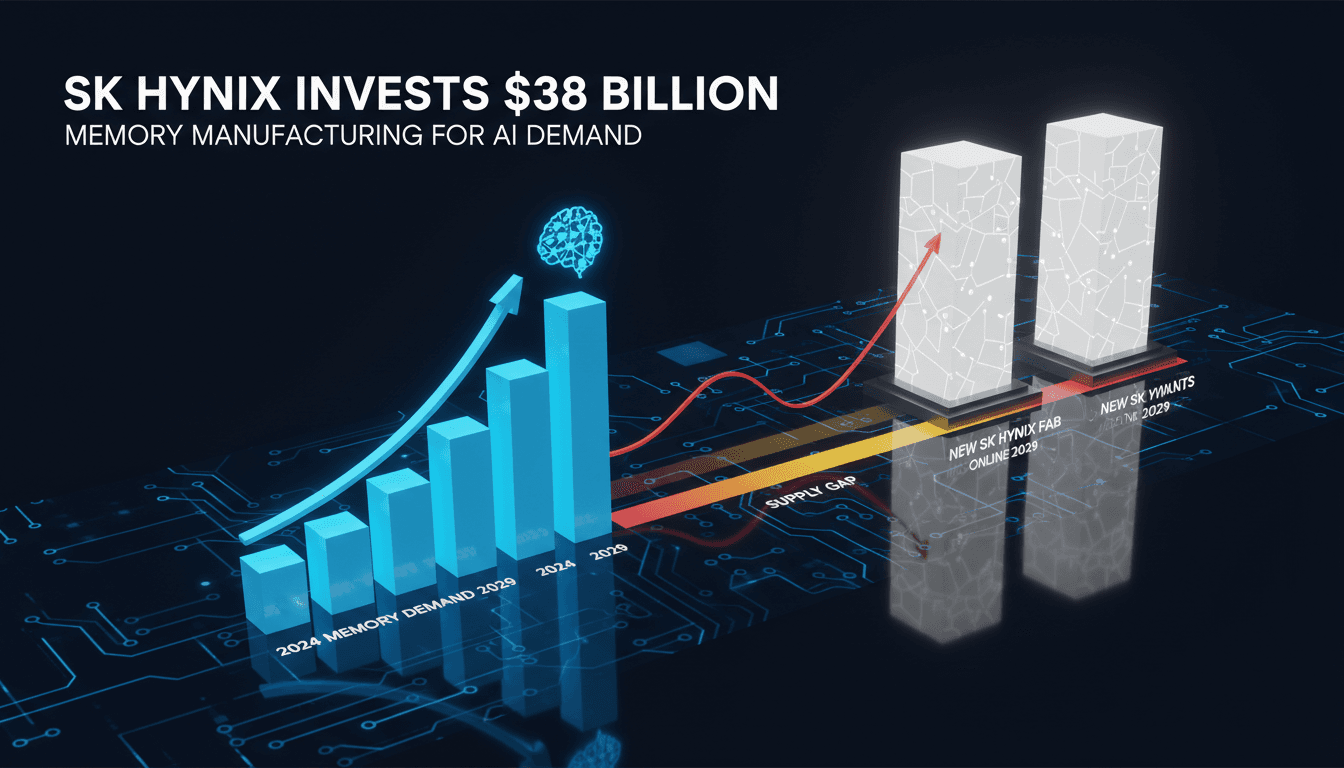
SK Hynix has approved a significant investment of $38 billion to construct two new chip fabrication plants. This initiative aims to enhance production capacity for DRAM and NAND flash memory, addressing the rising demand driven by advancements in artificial intelligence technologies. The new facilities, named 'Y2', will focus on high-bandwidth memory and NAND production.
Despite this ambitious expansion, the new capacity is not expected to alleviate supply pressures until 2029. This timeline highlights the ongoing challenges faced by the semiconductor supply chain, which has been strained by the rapid growth of AI applications.
The Context
SK Hynix is one of the largest memory manufacturers in the world, alongside competitors like Samsung and Micron. The decision to invest heavily in new fabrication plants reflects the urgent need to meet the surging demand for memory products, particularly as AI technologies evolve. The investment totals approximately 54 trillion won, emphasizing the scale of this commitment.
The construction of these new fabs is expected to take several years, with supply relief anticipated only by 2029. This long timeline suggests that while SK Hynix is taking proactive steps to address market demands, immediate supply issues will continue to challenge the industry.
Takeaway
As AI technologies advance, the demand for memory products is likely to drive further investments in manufacturing capacity across the industry. Stakeholders should monitor developments in AI technology and its impact on memory demand, as well as updates on the construction timeline and operational status of the new fabs.
The memory market is poised for significant changes, and while immediate supply issues may persist, the long-term outlook suggests a transformation in memory production capabilities. Companies like SK Hynix are positioning themselves to meet future demands, which could reshape the competitive landscape.
News and guidance for IT pros on AI adoption.
"Enterprise-focused tips, explainers, and news for professionals."
— A47 Editor
SK hynix Approves $38 Billion Memory Expansion as AI Demand Strains Supply
SK hynix has approved an investment of approximately $38.1 billion for the expansion of two memory fabrication plants, aiming to address the increasing demand for memory chips driven by artificial intelligence (AI). However, the new high-bandwidth me...
Stock market news, investing ideas, and trading analysis.
"TheStreet provides market news and retail-investor-focused analysis."
— A47 Editor
SK Hynix’s $38 billion buildout has a name attached: Nvidia
SK Hynix has announced a significant $38 billion buildout, primarily driven by its partnership with Nvidia, which is crucial for the production of high-end AI chips. The collaboration emphasizes the importance of SK Hynix's memory solutions in enhanc...
Tech news, hardware, and AI tools coverage.
"PC/tech site increasingly covering AI hardware and apps."
— A47 Editor
SK Hynix is spending $38 billion to build two new chip fabs
SK Hynix has announced a significant investment of 54 trillion won (approximately $38 billion) to construct two new chip manufacturing facilities in South Korea, focusing on DRAM and NAND technologies. This expansion includes a new DRAM facility in Y...