
Thomson Reuters Unveils Proprietary Legal AI Model Thomson for Enhanced Document Review
Here's what it means for you.
If you're in the legal profession, this proprietary AI model could streamline your workflow and reduce costs.
Why it matters
The launch signals a shift towards domain-specific AI solutions that prioritize data control and cost efficiency in professional services.
What happened (in 30 seconds)
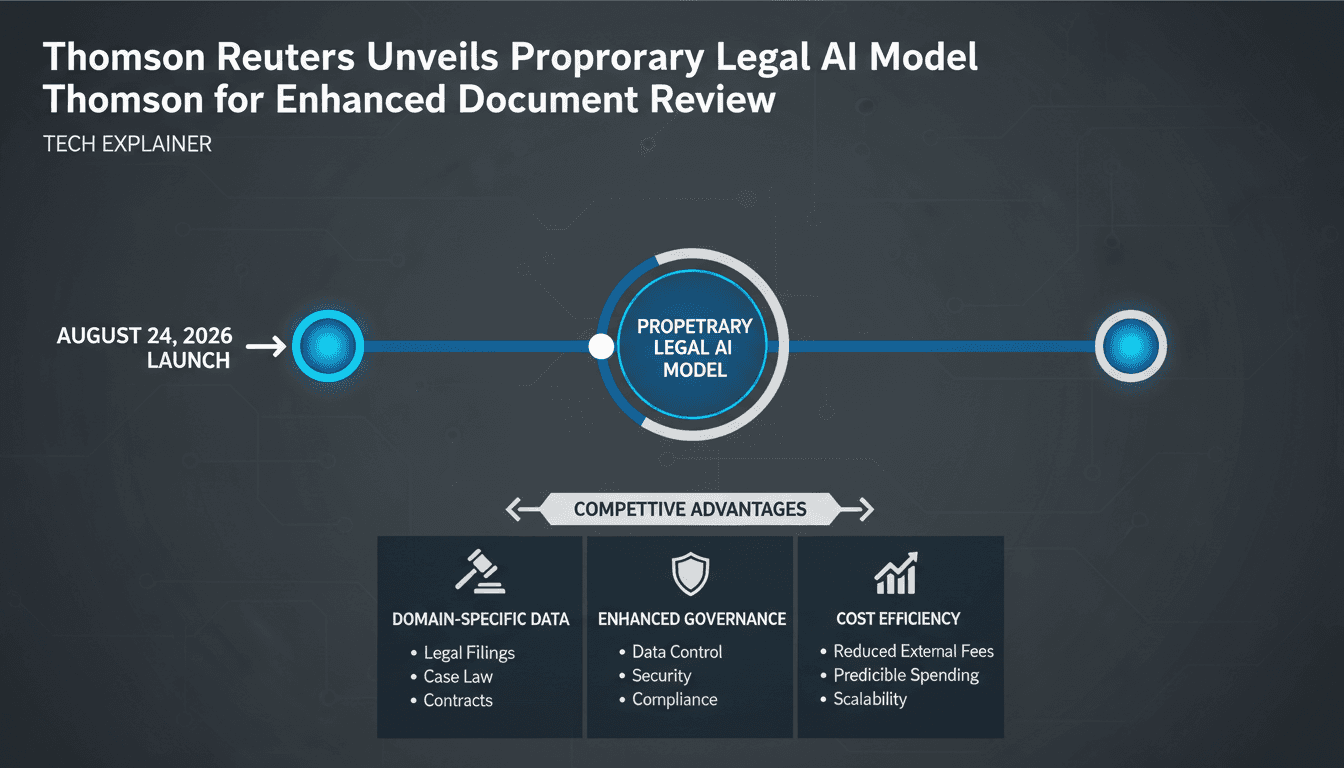
- On August 24, 2026, Thomson Reuters launched Thomson, its proprietary AI model designed specifically for legal work.
- The model is built on an open-weight foundation and trained with proprietary legal datasets, enhancing its relevance and accuracy.
- Initial deployment is within the CoCounsel Legal AI assistant, focusing on high-volume structured document review.
The context you actually need
- Thomson Reuters has invested $40 million over two years to develop this AI model, emphasizing the importance of in-house expertise.
- The model's development was influenced by rising costs and governance concerns associated with external AI models, leading to a focus on data privacy and legal standards.
- Internal benchmarks show that Thomson outperforms or matches leading models like Claude Opus 4.8 and GPT-5.5, particularly when using Thomson Reuters data.
What's really happening
Thomson Reuters' launch of its proprietary AI model, Thomson, represents a strategic pivot in the legal technology landscape. The company has invested significantly—$40 million—over two years to develop this model, which is tailored specifically for legal applications. This investment reflects a broader trend in the industry towards domain-specific AI solutions that prioritize data control, cost efficiency, and alignment with professional standards.
The decision to build Thomson in-house follows Thomson Reuters' acquisition of Safe Sign Technologies in 2024, which aimed to integrate authoritative content with advanced AI capabilities. This move was driven by rising costs associated with using external frontier models, which often come with governance and data privacy concerns. By developing its own model, Thomson Reuters can ensure that the AI aligns with legal professional standards and maintains control over sensitive data.
Thomson is built on an open-weight foundation, allowing for flexibility and adaptability. The model underwent extensive pretraining on proprietary content from Westlaw, followed by targeted post-training and reinforcement learning. This rigorous development process involved input from hundreds of subject-matter experts, ensuring that the model is not only technically proficient but also contextually relevant to legal professionals.
The initial deployment of Thomson within the CoCounsel Legal AI assistant focuses on Tabular Analysis, enabling high-volume structured document reviews. This feature is particularly valuable for legal professionals who deal with large amounts of data and require efficient processing capabilities. The multi-model architecture of Thomson allows it to incorporate third-party models for other tasks, enhancing its versatility.
As the legal industry increasingly embraces AI, Thomson Reuters is positioning itself as a leader in this domain-specific approach. The company plans to expand Thomson's integration across various legal and tax products, providing API access for select customers and releasing a smaller version on Hugging Face for non-commercial use. This strategy not only enhances the company's product offerings but also reinforces its commitment to providing sovereign AI solutions that prioritize data security and cost efficiency.
Who feels it first (and how)
- Legal professionals: Lawyers and paralegals will benefit from streamlined document review processes, saving time and reducing costs.
- Law firms: Larger firms may see a competitive advantage by adopting Thomson for high-volume tasks, improving efficiency.
- Legal tech developers: Companies in the legal tech space may need to adapt their offerings to compete with Thomson's capabilities.
What to watch next
- Adoption rates: Monitor how quickly law firms integrate Thomson into their workflows, as this will indicate its market acceptance.
- Performance benchmarks: Keep an eye on ongoing assessments of Thomson's performance compared to other AI models in legal applications.
- Regulatory responses: Watch for any emerging regulations or guidelines regarding the use of AI in legal contexts, which could impact deployment strategies.
Thomson Reuters has launched its proprietary AI model, Thomson, for legal work.
The model will gain traction among legal professionals seeking efficient document review solutions.
The long-term impact on the legal job market and how firms will adapt to AI integration remains uncertain.
Frequently Asked Questions
- Why it matters?
- The launch signals a shift towards domain-specific AI solutions that prioritize data control and cost efficiency in professional services.
- What happened (in 30 seconds)?
- On August 24, 2026, Thomson Reuters launched Thomson, its proprietary AI model designed specifically for legal work. The model is built on an open-weight foundation and trained with proprietary legal datasets, enhancing its relevance and accuracy. Initial deployment is within the CoCounsel Legal AI assistant, focusing on high-volume structured document review.
- What's really happening?
- Thomson Reuters' launch of its proprietary AI model, Thomson, represents a strategic pivot in the legal technology landscape. The company has invested significantly—$40 million—over two years to develop this model, which is tailored specifically for legal applications. This investment reflects a broader trend in the industry towards domain-specific AI solutions that prioritize data control, cost efficiency, and alignment with professional standards. The decision to build Thomson in-house follow
- Who feels it first (and how)?
- Legal professionals: Lawyers and paralegals will benefit from streamlined document review processes, saving time and reducing costs. Law firms: Larger firms may see a competitive advantage by adopting Thomson for high-volume tasks, improving efficiency. Legal tech developers: Companies in the legal tech space may need to adapt their offerings to compete with Thomson's capabilities.
- What to watch next?
- Adoption rates: Monitor how quickly law firms integrate Thomson into their workflows, as this will indicate its market acceptance. Performance benchmarks: Keep an eye on ongoing assessments of Thomson's performance compared to other AI models in legal applications. Regulatory responses: Watch for any emerging regulations or guidelines regarding the use of AI in legal contexts, which could impact deployment strategies.
AI news with an enterprise and cloud focus.
"Covers AI in the context of data infrastructure, cloud, and enterprise stacks."
— A47 Editor
Thomson Reuters launches proprietary AI model for legal work
Thomson Reuters Corp. has launched its first proprietary large language model, named Thomson, which integrates the company's extensive legal knowledge with external LLMs to provide legal advice. The initial deployment will focus on Tabular Analysis, ...
Business and tech news excluding paywalled content.
"High-volume business/tech outlet with frequent AI coverage."
— A47 Editor
Thomson Reuters built its own AI model off Chinese tech to rely less on Claude
Thomson Reuters has launched its first AI model, named Thomson-1, as part of a strategic initiative to reduce its reliance on Anthropic's Claude for AI solutions. This move marks a significant step for the company in developing proprietary technology...
Daily AI news: models, tools, and policy.
"Independent outlet tracking the fast pace of AI."
— A47 Editor
Thomson Reuters bets $40M on owning its AI instead of renting from OpenAI or Anthropic
Thomson Reuters is investing approximately $40 million over two years to develop its own language model named 'Thomson,' built on Alibaba's Qwen. This strategic move aims to leverage the company's proprietary content, such as Westlaw, to enhance the ...