
TypeSafe AI Secures $870 Million Funding at $7.5 Billion Valuation for Non-Text AI Model Jev
Why it matters
The rapid valuation increase of TypeSafe AI signals a shift towards specialized AI models that prioritize efficiency and decision-making over traditional text generation.
What happened (in 30 seconds)
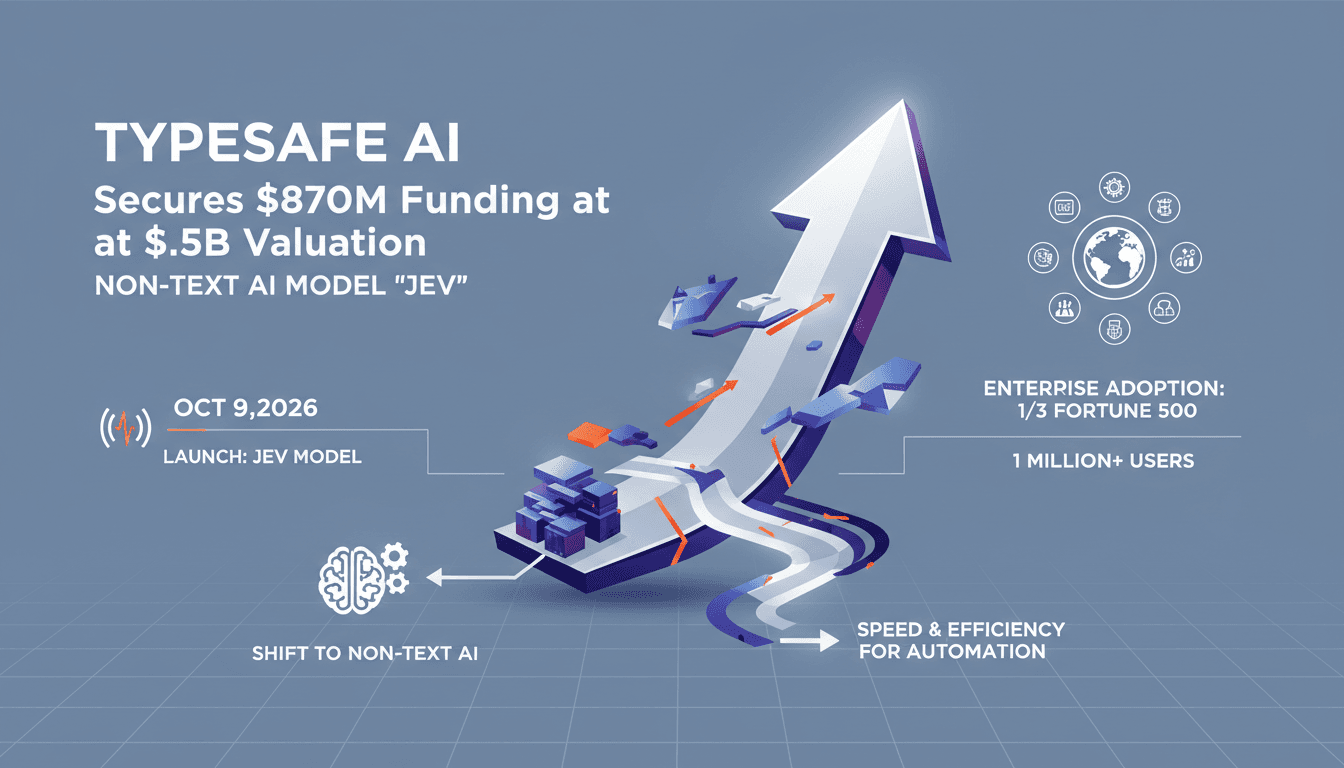
- TypeSafe AI raised $870 million at a $7.5 billion valuation on October 9, 2026, just weeks after launching its non-text AI model, Jev.
- Jev gained viral adoption, with over one million users and claims of usage by one-third of Fortune 500 companies within days of its September 15 launch.
- The funding round was led by Andreessen Horowitz, with participation from Sequoia Capital and DCVC, highlighting strong investor confidence in non-text AI solutions.
The context you actually need
- TypeSafe AI was founded in 2024 by experts from OpenAI and Meta, aiming to address limitations in existing generative AI models.
- Jev's architecture allows for faster inference and lower token usage, making it suitable for structured decision outputs in enterprise applications.
- The model's rapid adoption reflects a growing demand for AI systems that are efficient and resistant to common issues like hallucinations found in traditional language models.
What's really happening
The emergence of TypeSafe AI and its Jev model represents a significant pivot in the AI landscape, moving away from the dominance of large language models (LLMs) that have characterized the past few years. Founded by a team of researchers with deep roots in AI development, TypeSafe AI has positioned itself as a frontrunner in the non-text AI space. The company’s focus on a transformer-based model that outputs calibrated probabilities rather than text is a strategic response to the limitations of LLMs, particularly in terms of speed, cost, and suitability for direct automation tasks.
Jev's architecture is designed to deliver faster inference times—reportedly under 700 milliseconds—while also reducing token usage. This efficiency is crucial for enterprises looking to integrate AI into their operations without incurring excessive costs or delays. The model's ability to provide structured decision outputs makes it particularly appealing for businesses that require reliable and quick automation solutions.
The funding round led by Andreessen Horowitz, with significant participation from other venture capital heavyweights, underscores the growing investor interest in specialized AI models. The rapid adoption of Jev by a substantial portion of Fortune 500 companies within days of its launch is a clear indicator of market demand for alternatives to traditional LLMs. This trend is likely to catalyze further investment in non-text AI technologies, as companies seek to enhance their operational efficiencies and reduce reliance on text-based models that may not meet their specific needs.
As TypeSafe AI embarks on its post-funding expansion phase, the implications for the broader AI market are profound. Investors are already noting a surge in interest for similar non-text models, suggesting a potential shift in the industry towards more specialized applications of AI. This could lead to a landscape where businesses prioritize efficiency and decision-making capabilities over the generative text capabilities that have dominated the AI conversation in recent years.
Who feels it first (and how)
- Tech companies: They will need to adapt to the new competitive landscape shaped by non-text AI models.
- Enterprise automation sectors: Businesses relying on automation will benefit from faster and more efficient AI solutions.
- Investors: Venture capitalists focusing on AI will see new opportunities and potential returns in specialized AI technologies.
What to watch next
- Adoption rates among Fortune 500 companies: Monitoring how quickly other enterprises integrate Jev could indicate broader market trends.
- Emergence of competing models: Watch for new entrants in the non-text AI space as investor interest grows.
- Regulatory responses: Keep an eye on how governments and regulatory bodies react to the rapid advancement of AI technologies.
TypeSafe AI's Jev model has achieved a $7.5 billion valuation and rapid enterprise adoption.
Increased investment in non-text AI models and a shift in market focus towards efficiency-driven AI solutions.
The long-term impact of these developments on existing AI technologies and their applications.
Frequently Asked Questions
- Why it matters?
- The rapid valuation increase of TypeSafe AI signals a shift towards specialized AI models that prioritize efficiency and decision-making over traditional text generation.
- What happened (in 30 seconds)?
- TypeSafe AI raised $870 million at a $7.5 billion valuation on October 9, 2026, just weeks after launching its non-text AI model, Jev. Jev gained viral adoption, with over one million users and claims of usage by one-third of Fortune 500 companies within days of its September 15 launch. The funding round was led by Andreessen Horowitz, with participation from Sequoia Capital and DCVC, highlighting strong investor confidence in non-text AI solutions.
- What's really happening?
- The emergence of TypeSafe AI and its Jev model represents a significant pivot in the AI landscape, moving away from the dominance of large language models (LLMs) that have characterized the past few years. Founded by a team of researchers with deep roots in AI development, TypeSafe AI has positioned itself as a frontrunner in the non-text AI space. The company’s focus on a transformer-based model that outputs calibrated probabilities rather than text is a strategic response to the limitations of
- Who feels it first (and how)?
- Tech companies: They will need to adapt to the new competitive landscape shaped by non-text AI models. Enterprise automation sectors: Businesses relying on automation will benefit from faster and more efficient AI solutions. Investors: Venture capitalists focusing on AI will see new opportunities and potential returns in specialized AI technologies.
- What to watch next?
- Adoption rates among Fortune 500 companies: Monitoring how quickly other enterprises integrate Jev could indicate broader market trends. Emergence of competing models: Watch for new entrants in the non-text AI space as investor interest grows. Regulatory responses: Keep an eye on how governments and regulatory bodies react to the rapid advancement of AI technologies.
Startup news with frequent AI coverage.
"Covers launches, funding, and product updates in AI."
— A47 Editor
The maker of non-text AI model Jev valued at $7.5B just weeks after launch
TypeSafe AI has successfully launched its new AI model, Jev, which has been valued at $7.5 billion shortly after its introduction. Jev is designed to generate classifications rather than traditional text responses, allowing for faster processing and ...
AI news with an enterprise and cloud focus.
"Covers AI in the context of data infrastructure, cloud, and enterprise stacks."
— A47 Editor
Jev creator TypeSafe closes $870M round at $7.5B valuation
TypeSafe Inc., the developer of the Jev artificial intelligence model, has successfully raised $870 million in funding, achieving a valuation of $7.5 billion. This funding round was led by Andreessen Horowitz, with additional contributions from Sequo...
Technology business and AI-related headlines.
"Data-driven tech newsroom with global scope."
— A47 Editor
Andreessen Horowitz Backs Jev Maker at $7.5 Billion Value
TypeSafe AI, the startup behind the Jev artificial intelligence model, has successfully raised approximately $870 million at a valuation of $7.5 billion, with the financing round led by venture capital firm Andreessen Horowitz. This funding follows t...
Technology business news, market impacts, and innovation trends.
"Bloomberg is a premier financial and tech news provider, respected for its in-depth reporting and analytical rigor."
— A47 Editor
Andreessen Horowitz Backs Jev Maker at $7.5 Billion Value
TypeSafe AI, the startup behind the Jev artificial intelligence model, has successfully raised approximately $870 million at a valuation of $7.5 billion, with the financing round led by venture capital firm Andreessen Horowitz. This funding follows t...