
Google Quantum AI Achieves Major Breakthrough in Quantum Error Reduction
Why it matters
This advancement significantly reduces the resource burden of fault-tolerant quantum computing, potentially accelerating its practical applications.
What happened (in 30 seconds)
- Google Quantum AI successfully demonstrated magic state cultivation on its Willow superconducting quantum processor.
- Error reduction achieved was 40-fold compared to uncultivated states, with a logical fidelity of 99.99%.
- Research published in Science highlights a critical step toward efficient fault-tolerant quantum computation.
The context you actually need
- Fault-tolerant quantum computing relies on high-fidelity magic states, which have traditionally been resource-intensive to produce.
- Previous research in 2024 laid the groundwork for more efficient cultivation methods, addressing qubit overhead issues.
- Willow processor advancements established a baseline for exponential error suppression, making this latest achievement possible.
What's really happening
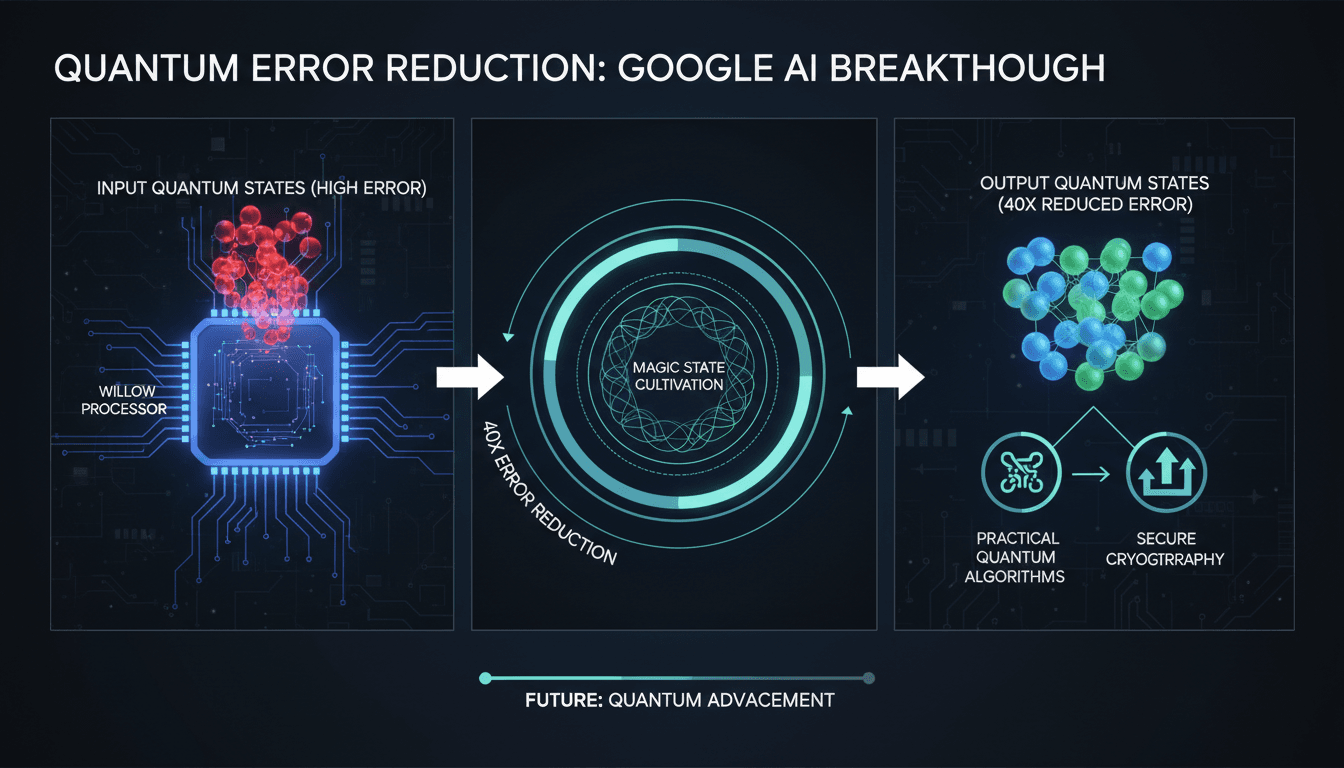
On October 15, 2026, Google Quantum AI announced a significant milestone in quantum computing: the successful demonstration of magic state cultivation on its 105-qubit Willow processor. This technique is crucial for fault-tolerant quantum computation, which requires non-Clifford gates enabled by high-fidelity magic states. Traditionally, the preparation of these states has been a bottleneck, consuming up to 95% of physical qubits due to resource-intensive distillation protocols.
The breakthrough involves filtering noisy input states through coordinated measurements on a distance-3 color code before grafting them onto a distance-5 surface code. This process yields T-states with an impressive 99.99% logical fidelity. The research team, led by Emma Rosenfeld and Craig Gidney, utilized up to 54 physical qubits to inject noisy states into a small patch, apply error-filtering measurements, and successfully expand the viable states. The result was a remarkable 40-fold reduction in error compared to uncultivated states.
This achievement is not just a technical feat; it represents a shift in the landscape of quantum computing. By reducing the qubit overhead required for magic state preparation, Google Quantum AI has opened the door to more efficient quantum algorithms. The implications extend beyond theoretical advancements; they could influence practical applications in cryptography, optimization, and complex problem-solving.
However, while the results are promising, further scaling and distillation are necessary before these advancements can be applied to cryptographic applications. Current fidelity levels remain orders of magnitude away from breaking RSA-2048 encryption, a standard in cybersecurity. As such, while the immediate impact may not be felt, the groundwork laid by this research could have far-reaching consequences in the future.
Who feels it first (and how)
- Tech companies: Those developing quantum algorithms will benefit from reduced resource requirements.
- Cryptography experts: Professionals in cybersecurity will need to reassess encryption standards as quantum computing evolves.
- Investors in quantum tech: Stakeholders in quantum computing startups may see shifts in market dynamics and investment opportunities.
What to watch next
- Further research publications: Keep an eye on upcoming studies that may refine or expand upon these findings, as they could lead to new applications.
- Industry partnerships: Watch for collaborations between tech companies and academic institutions aimed at scaling quantum technologies.
- Cryptography developments: Monitor changes in encryption standards and practices as quantum computing capabilities advance.
Google Quantum AI has successfully demonstrated magic state cultivation with significant error reduction.
This advancement will lead to more efficient quantum algorithms and applications in various sectors.
The timeline for practical applications in cryptography and other fields remains uncertain.
Frequently Asked Questions
- Why it matters?
- This advancement significantly reduces the resource burden of fault-tolerant quantum computing, potentially accelerating its practical applications.
- What happened (in 30 seconds)?
- Google Quantum AI successfully demonstrated magic state cultivation on its Willow superconducting quantum processor. Error reduction achieved was 40-fold compared to uncultivated states, with a logical fidelity of 99.99%. Research published in Science highlights a critical step toward efficient fault-tolerant quantum computation.
- What's really happening?
- On October 15, 2026, Google Quantum AI announced a significant milestone in quantum computing: the successful demonstration of magic state cultivation on its 105-qubit Willow processor. This technique is crucial for fault-tolerant quantum computation, which requires non-Clifford gates enabled by high-fidelity magic states. Traditionally, the preparation of these states has been a bottleneck, consuming up to 95% of physical qubits due to resource-intensive distillation protocols. The breakthroug
- Who feels it first (and how)?
- Tech companies: Those developing quantum algorithms will benefit from reduced resource requirements. Cryptography experts: Professionals in cybersecurity will need to reassess encryption standards as quantum computing evolves. Investors in quantum tech: Stakeholders in quantum computing startups may see shifts in market dynamics and investment opportunities.
- What to watch next?
- Further research publications: Keep an eye on upcoming studies that may refine or expand upon these findings, as they could lead to new applications. Industry partnerships: Watch for collaborations between tech companies and academic institutions aimed at scaling quantum technologies. Cryptography developments: Monitor changes in encryption standards and practices as quantum computing capabilities advance.
Curated tech headlines including AI stories.
"Influential aggregator surfacing the day’s top tech/AI links."
— A47 Editor
Google says "magic state cultivation" works in practice on its Willow quantum processor, calling it a breakthrough that reduces errors by about 40x (Google)
Google has announced a significant advancement in quantum computing with its Willow quantum processor, demonstrating that 'magic state cultivation' is effective in practice, which reportedly reduces computational errors by approximately 40 times.
Covers blockchain, cryptocurrency news, project analysis, and market insights.
"CoinDesk is a well-established cryptocurrency and blockchain news provider, offering comprehensive insights, market data, and industry research."
— A47 Editor
Satoshi-era bitcoin faces a bigger quantum threat after Google’s new Willow breakthrough
Google has announced a significant advancement with its Willow chip, which can prepare quantum states for calculations with 40 times fewer errors, potentially reducing the risks associated with cracking bitcoin wallets. This breakthrough raises conce...
Real-time updates, analysis, and reports on the blockchain and cryptocurrency sectors.
"Crypto News delivers real-time updates, analysis, and reports on the blockchain and cryptocurrency sectors."
— A47 Editor
Google cuts quantum errors 40-fold: Is Bitcoin at risk?
Google has achieved a significant breakthrough in quantum computing by reducing errors on its Willow chip by 40-fold, raising concerns about the implications for Bitcoin security, particularly with 6.04 million BTC potentially exposed to quantum thre...
English-language digital publication covering business, politics, technology, and current affairs.
"The Arabian Post mixes original and syndicated-style coverage with a broad regional and global business-news orientation."
— A47 Editor
Google cuts quantum computing errors fortyfold with Willow
Google has announced a significant advancement in quantum computing, achieving a reduction of errors by approximately 40-fold through a technique known as magic state cultivation, tested on its Willow quantum processor. This breakthrough was revealed...
Covers Bitcoin plus altcoin news, market updates, and educational resources.
"Bitcoin.com provides news, market data, and guides focused on Bitcoin and the wider crypto industry."
— A47 Editor
Google Touts ‘Magic’ Quantum Breakthrough as Bitcoin Q-Day Threat Looms
Google has announced a significant breakthrough in quantum computing, which it describes as 'magic,' amidst growing concerns regarding the potential impact of quantum technology on cryptocurrencies like Bitcoin. This development comes as Bitcoin's pr...
Science and technology stories including AI.
"Longstanding science magazine with thoughtful AI coverage."
— A47 Editor
Google’s quantum Willow chip may be able to grow ‘magic states’
Google has made significant strides in quantum computing with its Willow chip, which may have the capability to generate 'magic states' that enhance the accuracy of complex calculations. This development represents a potential leap forward in the fie...
Scientific research, technology, environment, and society.
"Scientific American is one of the oldest and most authoritative science magazines, known for deep dives into science, technology, and society."
— A47 Editor
Google’s quantum Willow chip may be able to grow ‘magic states’
Google has made significant strides in quantum computing with its Willow chip, which may have the capability to generate 'magic states' that enhance the accuracy of complex calculations. This development represents a potential leap forward in the fie...