
Google Reports Major Breakthrough in Quantum Error Reduction for Computing
Why it matters
This milestone in quantum computing could reshape cryptographic security, impacting industries reliant on encryption.
What happened (in 30 seconds)
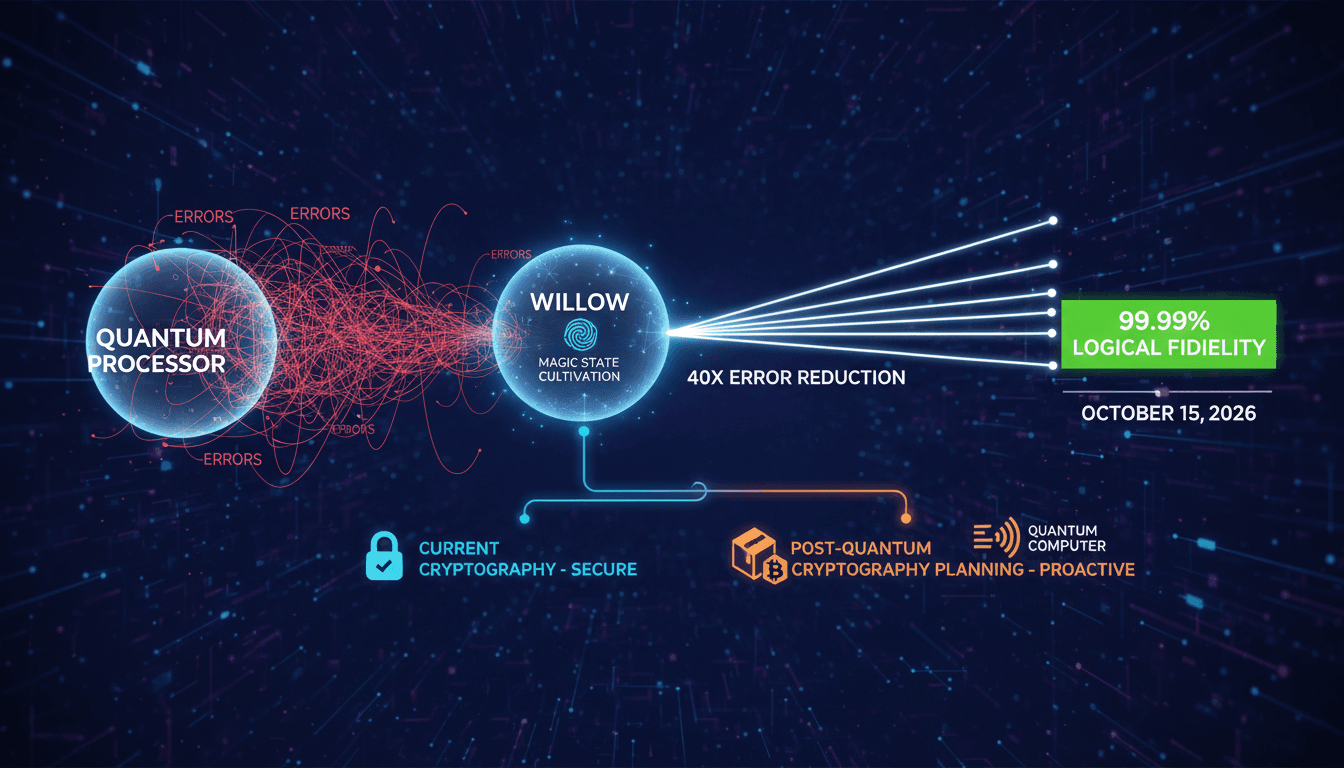
- Google achieved a 40-fold reduction in quantum computing errors on October 15, 2026, using the Willow processor.
- The technique, called magic state cultivation, reached 99.99% logical fidelity in prepared T-states, addressing a significant bottleneck in fault-tolerant quantum computing.
- No immediate threat to Bitcoin's security was demonstrated, despite discussions on post-quantum migration among stakeholders.
The context you actually need
- Quantum computing has long struggled with error correction, which is essential for reliable large-scale operations.
- Prior estimates for breaking Bitcoin's encryption required over 500,000 physical qubits, but Google's recent analysis revised this downward, raising industry concerns.
- Magic states have historically consumed up to 95% of computational resources, making this breakthrough a significant step toward practical applications.
What's really happening
On October 15, 2026, Google Quantum AI researchers published groundbreaking results in the journal Science, showcasing their work on the Willow processor. This 105-qubit processor utilized a technique known as magic state cultivation, which is pivotal for achieving fault-tolerant quantum computing. The process begins with noisy quantum states, which undergo repeated verification checks. Failed attempts are discarded, allowing the researchers to retain only the successful T-states, resulting in a remarkable 40-fold reduction in error rates and achieving 99.99% fidelity.
This achievement is not just a technical milestone; it addresses a critical resource bottleneck that has hindered the scalability of quantum computing. Historically, magic states have been resource-intensive, consuming up to 95% of computational power in theoretical models. By successfully transferring states between color and surface error-correcting codes, Google has made strides in overcoming practical hardware issues such as drift and temperature variations.
Despite the excitement surrounding this breakthrough, it is essential to note that the current scale of the Willow processor remains far below the thresholds required for practical cryptographic applications. No cryptographic attacks were performed during this demonstration, and the implications for Bitcoin's elliptic curve cryptography remain theoretical at this stage. Google's March 2026 analysis indicated that fewer than 500,000 physical qubits could theoretically suffice for such attacks, but this is contingent on several optimized hardware assumptions.
The industry response has been cautious, emphasizing the experimental nature of the results. Stakeholders in the Bitcoin ecosystem are urged to proactively consider post-quantum cryptography planning, including wallet migration recommendations from exchanges like Coinbase. As quantum computing continues to evolve, the need for robust security measures will only grow, making this a pivotal moment for both technology and finance sectors.
Who feels it first (and how)
- Tech companies: Those developing quantum technologies will need to adapt their strategies and products.
- Financial institutions: Banks and exchanges relying on cryptography must prepare for potential vulnerabilities.
- Investors: Stakeholders in tech and finance sectors should monitor developments closely to safeguard their investments.
- Regulatory bodies: Governments may need to establish new frameworks for quantum security standards.
What to watch next
- Further advancements in quantum error correction: Continued improvements could lead to practical applications sooner than expected.
- Industry responses to quantum threats: Watch for how financial institutions adapt their security measures in light of these developments.
- Regulatory changes regarding quantum computing: New policies may emerge as governments recognize the implications of quantum advancements.
Google has achieved a significant reduction in quantum computing errors.
Financial institutions will begin proactive measures to enhance cryptographic security.
The timeline for practical applications of this technology remains uncertain.
Frequently Asked Questions
- Why it matters?
- This milestone in quantum computing could reshape cryptographic security, impacting industries reliant on encryption.
- What happened (in 30 seconds)?
- Google achieved a 40-fold reduction in quantum computing errors on October 15, 2026, using the Willow processor. The technique, called magic state cultivation, reached 99.99% logical fidelity in prepared T-states, addressing a significant bottleneck in fault-tolerant quantum computing. No immediate threat to Bitcoin's security was demonstrated, despite discussions on post-quantum migration among stakeholders.
- What's really happening?
- On October 15, 2026, Google Quantum AI researchers published groundbreaking results in the journal Science, showcasing their work on the Willow processor. This 105-qubit processor utilized a technique known as magic state cultivation, which is pivotal for achieving fault-tolerant quantum computing. The process begins with noisy quantum states, which undergo repeated verification checks. Failed attempts are discarded, allowing the researchers to retain only the successful T-states, resulting in a
- Who feels it first (and how)?
- Tech companies: Those developing quantum technologies will need to adapt their strategies and products. Financial institutions: Banks and exchanges relying on cryptography must prepare for potential vulnerabilities. Investors: Stakeholders in tech and finance sectors should monitor developments closely to safeguard their investments. Regulatory bodies: Governments may need to establish new frameworks for quantum security standards.
- What to watch next?
- Further advancements in quantum error correction: Continued improvements could lead to practical applications sooner than expected. Industry responses to quantum threats: Watch for how financial institutions adapt their security measures in light of these developments. Regulatory changes regarding quantum computing: New policies may emerge as governments recognize the implications of quantum advancements.
Real-time updates, analysis, and reports on the blockchain and cryptocurrency sectors.
"Crypto News delivers real-time updates, analysis, and reports on the blockchain and cryptocurrency sectors."
— A47 Editor
Google cuts quantum errors 40-fold: Is Bitcoin at risk?
Google has achieved a significant breakthrough in quantum computing by reducing errors on its Willow chip by 40-fold, raising concerns about the implications for Bitcoin security, particularly with 6.04 million BTC potentially exposed to quantum thre...
English-language digital publication covering business, politics, technology, and current affairs.
"The Arabian Post mixes original and syndicated-style coverage with a broad regional and global business-news orientation."
— A47 Editor
Google cuts quantum computing errors fortyfold with Willow
Google has announced a significant advancement in quantum computing, achieving a reduction of errors by approximately 40-fold through a technique known as magic state cultivation, tested on its Willow quantum processor. This breakthrough was revealed...
Covers Bitcoin plus altcoin news, market updates, and educational resources.
"Bitcoin.com provides news, market data, and guides focused on Bitcoin and the wider crypto industry."
— A47 Editor
Google Touts ‘Magic’ Quantum Breakthrough as Bitcoin Q-Day Threat Looms
Google has announced a significant breakthrough in quantum computing, which it describes as 'magic,' amidst growing concerns regarding the potential impact of quantum technology on cryptocurrencies like Bitcoin. This development comes as Bitcoin's pr...
Science and technology stories including AI.
"Longstanding science magazine with thoughtful AI coverage."
— A47 Editor
Google’s quantum Willow chip may be able to grow ‘magic states’
Google has made significant strides in quantum computing with its Willow chip, which may have the capability to generate 'magic states' that enhance the accuracy of complex calculations. This development represents a potential leap forward in the fie...
Scientific research, technology, environment, and society.
"Scientific American is one of the oldest and most authoritative science magazines, known for deep dives into science, technology, and society."
— A47 Editor
Google’s quantum Willow chip may be able to grow ‘magic states’
Google has made significant strides in quantum computing with its Willow chip, which may have the capability to generate 'magic states' that enhance the accuracy of complex calculations. This development represents a potential leap forward in the fie...