
Microsoft AI Diagnostic Orchestrator Surpasses Generalist Physicians in Medical Accuracy
Why it matters
The integration of AI in diagnostics could significantly enhance healthcare efficiency and accuracy, impacting patient care globally.
What happened (in 30 seconds)
- Microsoft announced the MAI-DxO, an AI tool that outperformed generalist physicians in diagnosing complex medical cases.
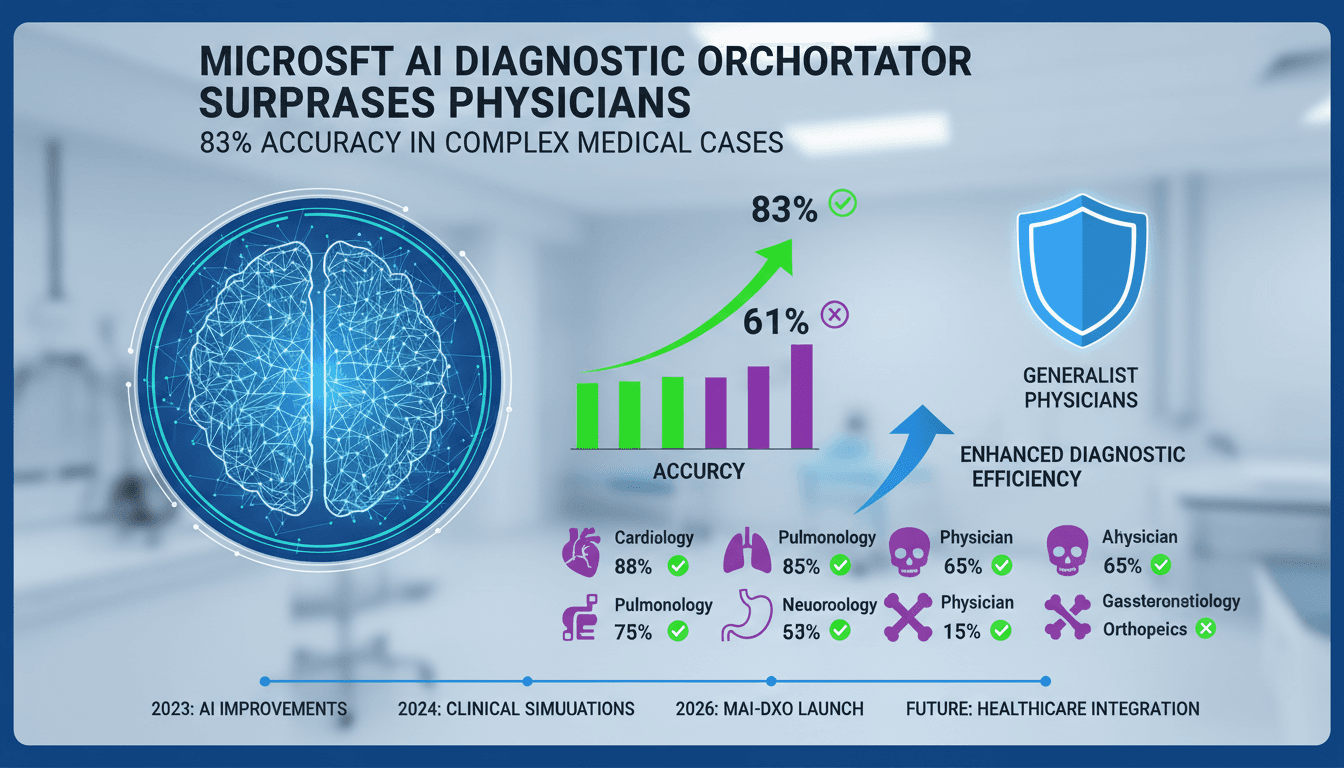
- The tool achieved 83% accuracy on complex cases, compared to 36% for physicians, and 80% on emergency cases versus 47%.
- Cost-effectiveness was also evaluated, with the AI optimizing test pathways to lower diagnostic costs.
The context you actually need
- Traditional evaluations of medical AI have often relied on static multiple-choice questions, limiting their realism and applicability in real-world scenarios.
- Recent advancements in AI, particularly in large language models and multi-agent orchestration, have enabled more dynamic approaches that mimic actual clinical workflows.
- Microsoft's initiative reflects a broader industry trend towards integrating AI into diagnostics, aiming for improved efficiency and accuracy in healthcare.
What's really happening
Microsoft's MAI-DxO represents a significant leap in the application of AI within the medical field. The system operates by coordinating multiple AI agents through a sequential diagnostic process, which includes collecting patient history, ordering tests, evaluating results, and iteratively refining diagnoses. This mimics the collaborative nature of clinical expert panels, allowing for a more nuanced approach to complex medical cases.
The study, published in the journal Science, tested the AI on 304 complex cases sourced from the New England Journal of Medicine and emergency department data. The results were striking: the MAI-DxO achieved approximately 83% diagnostic accuracy, significantly surpassing the 36% accuracy of participating generalist physicians, who had access to medical references and the internet. In emergency department scenarios, the AI's accuracy was 80%, compared to just 47% for physicians.
This performance gap highlights the potential of AI to not only assist but also enhance diagnostic capabilities in real-world settings. Dr. Dominic King, Vice President of Microsoft AI Health, emphasized the importance of bridging the gap between controlled testing environments and the chaotic nature of real-world patient presentations, which often lack structured summaries.
Moreover, the MAI-DxO's ability to optimize test pathways suggests a dual benefit: improving diagnostic accuracy while potentially lowering costs. By selecting more efficient testing routes, the AI could reduce unnecessary procedures and streamline patient care, which is particularly crucial in high-volume healthcare settings.
As the healthcare industry grapples with rising costs and the need for improved patient outcomes, tools like the MAI-DxO could play a pivotal role in reshaping how diagnostics are approached. However, it is essential to note that the AI is positioned as a supportive tool rather than a replacement for physicians, emphasizing the collaborative potential of human and machine intelligence in healthcare.
Who feels it first (and how)
- Healthcare providers: Hospitals and clinics may adopt AI tools to enhance diagnostic accuracy and efficiency.
- Patients: Individuals with complex medical conditions could benefit from more accurate and timely diagnoses.
- Tech companies: Firms in the AI and healthcare sectors will likely see increased investment and interest in AI-driven solutions.
What to watch next
- Regulatory responses: Monitor how healthcare regulators respond to the introduction of AI diagnostic tools and their integration into clinical practice.
- Adoption rates: Watch for the speed at which healthcare facilities begin to implement AI systems like MAI-DxO in their diagnostic processes.
- Cost implications: Keep an eye on how the use of AI affects overall healthcare costs, particularly in terms of diagnostic testing and patient outcomes.
The MAI-DxO achieved 83% diagnostic accuracy on complex cases.
AI tools will increasingly be integrated into healthcare diagnostics, enhancing efficiency and accuracy.
The long-term impact on physician roles and patient care dynamics remains to be fully understood.
Frequently Asked Questions
- Why it matters?
- The integration of AI in diagnostics could significantly enhance healthcare efficiency and accuracy, impacting patient care globally.
- What happened (in 30 seconds)?
- Microsoft announced the MAI-DxO, an AI tool that outperformed generalist physicians in diagnosing complex medical cases. The tool achieved 83% accuracy on complex cases, compared to 36% for physicians, and 80% on emergency cases versus 47%. Cost-effectiveness was also evaluated, with the AI optimizing test pathways to lower diagnostic costs.
- What's really happening?
- Microsoft's MAI-DxO represents a significant leap in the application of AI within the medical field. The system operates by coordinating multiple AI agents through a sequential diagnostic process, which includes collecting patient history, ordering tests, evaluating results, and iteratively refining diagnoses. This mimics the collaborative nature of clinical expert panels, allowing for a more nuanced approach to complex medical cases. The study, published in the journal Science, tested the AI o
- Who feels it first (and how)?
- Healthcare providers: Hospitals and clinics may adopt AI tools to enhance diagnostic accuracy and efficiency. Patients: Individuals with complex medical conditions could benefit from more accurate and timely diagnoses. Tech companies: Firms in the AI and healthcare sectors will likely see increased investment and interest in AI-driven solutions.
- What to watch next?
- Regulatory responses: Monitor how healthcare regulators respond to the introduction of AI diagnostic tools and their integration into clinical practice. Adoption rates: Watch for the speed at which healthcare facilities begin to implement AI systems like MAI-DxO in their diagnostic processes. Cost implications: Keep an eye on how the use of AI affects overall healthcare costs, particularly in terms of diagnostic testing and patient outcomes.
Arabic-language sports reporting covering UAE competitions and major international events.
"Emarat Al Youm sports coverage is mainstream and accessible, with strong emphasis on UAE and regional sport."
— A47 Editor
أداة ذكاء اصطناعي تتفوّق على الأطباء في تشخيص الحالات المعقدة أداة ذكاء اصطناعي تتفوّق على الأطباء في تشخيص الحالات المعقدة
Researchers at Microsoft have developed an AI-powered tool for progressive medical diagnosis, which has demonstrated superior accuracy in tests involving complex cases. This advancement highlights the potential of artificial intelligence in enhancing...
Health, medicine, wellness, and public health coverage with a UAE angle.
"Emirates 24|7 health coverage leans toward accessible reporting on healthcare updates, medical milestones, and wellness topics."
— A47 Editor
Microsoft develops AI tool that can diagnose 'sequentially' like doctor
Microsoft researchers have developed an AI tool capable of diagnosing patients step by step, achieving over twice the accuracy of general physicians in complex medical cases, as reported in a study published in Science. This model utilizes an orchest...
Arabic-language sports reporting covering UAE competitions and major international events.
"Emarat Al Youm sports coverage is mainstream and accessible, with strong emphasis on UAE and regional sport."
— A47 Editor
تتفوق على الأطباء.. مايكروسوفت تطور أداة ذكاء اصطناعي لتشخيص الحالات المعقدة تتفوق على الأطباء.. مايكروسوفت تطور أداة ذكاء اصطناعي لتشخيص الحالات المعقدة
Researchers at Microsoft have developed an AI-powered tool for progressive medical diagnosis, which has demonstrated superior accuracy in tests involving complex cases. This advancement highlights the potential of artificial intelligence in enhancing...
Global business headlines with AI angles.
"General business outlet that frequently covers AI."
— A47 Editor
A New Microsoft AI Diagnosed 83% Of Complex Medical Cases. Doctors Using References Got 36% Right.
Microsoft has developed an AI diagnostic system that successfully diagnosed 83% of complex medical cases, significantly outperforming doctors who achieved a 36% accuracy rate using traditional references. This technology is set to be evaluated in a h...
Pan-Arab political news and analysis.
"Al-Quds Al-Arabi is a London-based Arabic newspaper known for political coverage."
— A47 Editor
مايكروسوفت تطور أداة ذكاء اصطناعي للتشخيص خطوة بخطوة كالطبيب
Microsoft researchers have developed an artificial intelligence tool that diagnoses patients step-by-step, similar to how doctors operate. The tool has demonstrated accuracy exceeding that of doctors by more than double when handling complex medical ...
Market-moving headlines impacting equities, bonds, and related risk assets.
"Real-time catalysts and volatility drivers across indices and sectors."
— A47 Editor
Microsoft develops AI tool that can diagnose ’sequentially’ like a doctor
Microsoft has developed an artificial intelligence tool capable of diagnosing conditions in a sequential manner, similar to the approach taken by medical professionals. This innovation reflects the company's ongoing commitment to integrating AI into ...
Arabic tech news covering startups, apps, AI, and gadgets.
"AITnews is a well-known Arabic technology outlet covering regional tech developments."
— A47 Editor
بدقة تتجاوز 80%.. مايكروسوفت تطور ذكاءً اصطناعيًا يتفوق على الأطباء في تشخيص الحالات المعقدة
Microsoft has revealed research results indicating that its new artificial intelligence system can diagnose medical conditions with an accuracy exceeding that of doctors, particularly in complex clinical situations and emergencies. This development s...
Startup news with frequent AI coverage.
"Covers launches, funding, and product updates in AI."
— A47 Editor
Microsoft’s Mustafa Suleyman says its AI outperforms doctors on hard cases as he chases ‘medical superintelligence’
Microsoft’s AI diagnostic system has demonstrated superior performance compared to generalist doctors in challenging medical cases, as reported in a study published in Science. This advancement highlights the potential of AI in enhancing diagnostic a...
Curated tech headlines including AI stories.
"Influential aggregator surfacing the day’s top tech/AI links."
— A47 Editor
Microsoft says its GPT-5-powered Diagnostic Orchestrator uses agents that mimic panels of experts to diagnose conditions up to 4x more accurately than doctors (Robert Hart/The Verge)
Microsoft has announced the launch of its GPT-5-powered Diagnostic Orchestrator, which utilizes AI agents designed to replicate the decision-making processes of expert panels. This system reportedly diagnoses medical conditions with up to four times ...