
Artemis II Launch Produced Three Ionospheric Disturbances Exceeding 5000 km Over North America
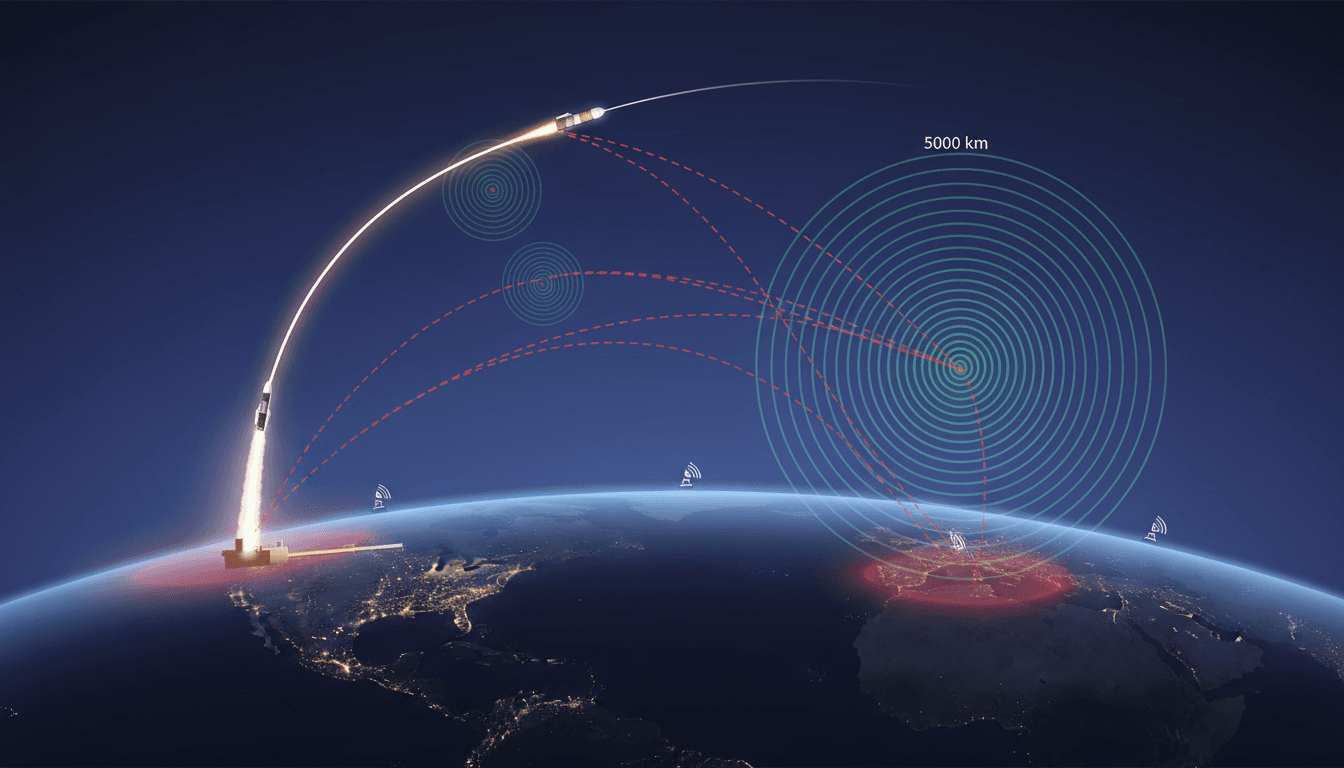
Why it matters
The physical exhaust and shockwaves generated by super-heavy orbital rockets can deplete upper-atmospheric electron densities across thousands of kilometers, introducing measurable radio propagation delays for global navigation systems.
What happened (in 30 seconds)
- Three distinct disturbances occurred: During the April 1, 2026 launch of Artemis II, the Space Launch System (SLS) rocket and Orion upper stages triggered three separate ionospheric perturbations spanning over 5,000 kilometers across North America.
- Researchers verified electron depletions: Scientists at Taiwan's National Cheng Kung University processed terrestrial Global Navigation Satellite System (GNSS) receiver data, recording significant electron density drops across roughly 50 degrees of longitude.
- No infrastructure was knocked offline: While the upper-atmosphere perturbations theoretically introduced localized GPS positioning errors of several meters, monitoring networks reported zero operational outages or practical disruptions to commercial transit.
The context you actually need
- First crewed lunar flight in five decades: Artemis II sent four astronauts—Reid Wiseman, Victor Glover, Christina Koch, and Jeremy Hansen—on a crewed lunar flyby, marking humanity's first flight beyond low Earth orbit since Apollo 17 in 1972.
- Heavy lift creates unique atmospheric footprints: Standard orbital launches routinely cause small, short-lived ionospheric ripples, but the combined thrust of the SLS core and subsequent high-altitude burns concentrated repeated disturbances over the same continental landmass.
- The study relied on tectonic sensors: Rather than relying solely on aerospace telemetry, the research team, led by corresponding author Charles C. H. Lin, analyzed civilian GNSS networks originally deployed across North America for geological and plate-tectonic tracking.
What's really happening
The physical mechanism behind these large-scale atmospheric anomalies combines fluid dynamics and chemical recombination at extreme altitudes. When a heavy-lift rocket like the Space Launch System ascends through the ionosphere—the ionized layer of Earth's upper atmosphere spanning roughly 60 to 1,000 kilometers above the surface—it alters the medium through two parallel processes. First, supersonic vehicle travel generates acoustic-gravity waves, which propagate radially outward as mechanical shock fronts through the thin neutral gas. Second, the rocket’s chemical propulsion systems inject significant quantities of exhaust products, notably water vapor and molecular hydrogen, directly into the ionospheric F-region.
At these operational altitudes, ambient electrons remain suspended because free positive ions (primarily atomic oxygen) recombine with them at relatively slow rates. However, introducing neutral exhaust molecules radically accelerates charge exchange. The exhaust molecules react with atomic oxygen ions to form molecular ions, which then recombine with free electrons at rates orders of magnitude faster than baseline ambient chemistry. The result is a rapid, localized drop in total electron content (TEC)—effectively creating a depletion zone, or an ionospheric "hole."
During the Artemis II flight, this mechanism occurred in three successive operational phases. The primary core stage ascent at 22:35 UTC generated the initial shock-driven disturbance over the southeastern United States. Approximately 108 minutes later, the Interim Cryogenic Propulsion Stage executed an apogee raise burn at an altitude of roughly 185 kilometers, creating the strongest measured depletion across the continent. Finally, more than 24 hours post-launch, the European Service Module carried out its trans-lunar injection burn, generating a third distinct perturbation.
The commercial and operational significance rests entirely on radio wave propagation. GNSS receivers calculate coordinates by measuring the travel time of radio signals transmitted from orbit. Because these signals must traverse the ionosphere, any abrupt variance in electron density alters signal velocity and path refraction. The Taiwanese study documented that the resulting TEC reductions had the physical capacity to alter pseudorange calculations by several meters.
Because modern aviation, maritime traffic, and consumer devices integrate multi-constellation augmentation systems, filtering mechanisms prevented real-world failures during Artemis II. However, the study points to a structural shift in airspace and orbital management: as public agencies and private spaceflight operators scale up the cadence of super-heavy launches, recurring ionospheric depletions will cease to be isolated scientific curiosities and become regular variables in high-precision navigation modeling.
Who feels it first (and how)
- High-precision surveying and civil engineering teams: Technicians utilizing real-time kinematic (RTK) positioning for land surveying, port automation, and structural monitoring experience brief periods of signal jitter during major continental launch trajectories.
- Autonomous fleet software developers: Engineers building positioning algorithms for autonomous vehicles must continuously calibrate sensor fusion logic to ensure localized multi-meter GPS drift does not trigger unexpected lane corrections.
- Commercial spaceport launch planners: Operators scheduling trajectories through busy geographic corridors face increasing technical scrutiny from telecommunications bodies over cumulative atmospheric modifications.
- Regional navigation operators in non-launch corridors: Geographies outside the direct ascent path—including transit hubs in Europe, the Middle East, and Asia—experience zero structural impact, as these ionospheric depletions remain tightly bound to specific orbital tracks.
What to watch next
- Launch cadence threshold studies: Research evaluating how rapidly sequential heavy-lift departures affect the atmosphere's natural recombination baseline will determine whether cumulative depletions are possible.
- Civil aviation ionospheric mitigation updates: Technical bulletins from international civil aviation organizations assessing whether existing ground-based augmentation systems (GBAS) require modified algorithms for high-thrust vehicle corridors.
- Expanded multi-constellation GNSS integration: Commercial hardware adoption shifting from dual-frequency to triple-frequency satellite receivers to automatically cross-correct sudden propagation delays without loss of precision.
The Artemis II SLS launch produced three distinct ionospheric disturbances exceeding 5,000 kilometers across North America, resulting in measurable electron density depletions verified by terrestrial GNSS networks.
Increasing frequencies of super-heavy rocket launches will produce repeatable, predictable propagation delays along established ascent corridors, prompting software-level compensations from precision positioning providers.
Whether multi-launch operational tempos will eventually cause localized depletions to overlap before the upper atmosphere's natural electron density fully restores itself.
Frequently Asked Questions
- Why it matters?
- The physical exhaust and shockwaves generated by super-heavy orbital rockets can deplete upper-atmospheric electron densities across thousands of kilometers, introducing measurable radio propagation delays for global navigation systems.
- What happened (in 30 seconds)?
- Three distinct disturbances occurred: During the April 1, 2026 launch of Artemis II, the Space Launch System (SLS) rocket and Orion upper stages triggered three separate ionospheric perturbations spanning over 5,000 kilometers across North America. Researchers verified electron depletions: Scientists at Taiwan's National Cheng Kung University processed terrestrial Global Navigation Satellite System (GNSS) receiver data, recording significant electron density drops across roughly 50 degrees of lo
- What's really happening?
- The physical mechanism behind these large-scale atmospheric anomalies combines fluid dynamics and chemical recombination at extreme altitudes. When a heavy-lift rocket like the Space Launch System ascends through the ionosphere—the ionized layer of Earth's upper atmosphere spanning roughly 60 to 1,000 kilometers above the surface—it alters the medium through two parallel processes. First, supersonic vehicle travel generates acoustic-gravity waves, which propagate radially outward as mechanical s
- Who feels it first (and how)?
- High-precision surveying and civil engineering teams: Technicians utilizing real-time kinematic (RTK) positioning for land surveying, port automation, and structural monitoring experience brief periods of signal jitter during major continental launch trajectories. Autonomous fleet software developers: Engineers building positioning algorithms for autonomous vehicles must continuously calibrate sensor fusion logic to ensure localized multi-meter GPS drift does not trigger unexpected lane correcti
- What to watch next?
- Launch cadence threshold studies: Research evaluating how rapidly sequential heavy-lift departures affect the atmosphere's natural recombination baseline will determine whether cumulative depletions are possible. Civil aviation ionospheric mitigation updates: Technical bulletins from international civil aviation organizations assessing whether existing ground-based augmentation systems (GBAS) require modified algorithms for high-thrust vehicle corridors. Expanded multi-constellation GNSS integra
Consumer tech news, reviews, and buying guides for gadgets and electronics.
"TechRadar is known for comprehensive buying advice, hardware reviews, and consumer tech news targeted at mainstream audiences."
— A47 Editor
NASA's Artemis II rocket tore giant holes in the atmosphere — and they could have broken GPS
NASA's Artemis II rocket reportedly tore large holes in the atmosphere, a phenomenon researchers say has never been observed before in the ionosphere, and scientists are still assessing whether the disruption could have affected GPS signals.
Conservative-leaning political and national coverage.
"The Washington Times is a conservative-leaning newspaper known for its political coverage and advocacy of right-of-center viewpoints."
— A47 Editor
Artemis II mission may have caused atmospheric disturbances, disrupted GPS signals
A preprint study reports that engine burns by NASA's Artemis II rocket and spacecraft this spring disturbed Earth's upper atmosphere and disrupted signals from satellites, including GPS, according to The Washington Times.
Space science news, astronomy updates, and spaceflight developments.
"Space.com delivers space science news, astronomy updates, and spaceflight developments with engaging coverage."
— A47 Editor
NASA's Artemis II moon launch tore a hole in Earth's upper atmosphere so huge it disrupted GPS signals
NASA's Artemis II moon launch reportedly tore a hole in Earth's upper atmosphere large enough to disrupt GPS signals, according to a Space.com report by science journalist Tereza. The disruption is described as a possible concern for systems that rel...