
Nvidia Leadership Scandal Over Alleged Chinese Espionage Complicates Trump’s APEC China Trip and Chip Export Policy
Why it matters
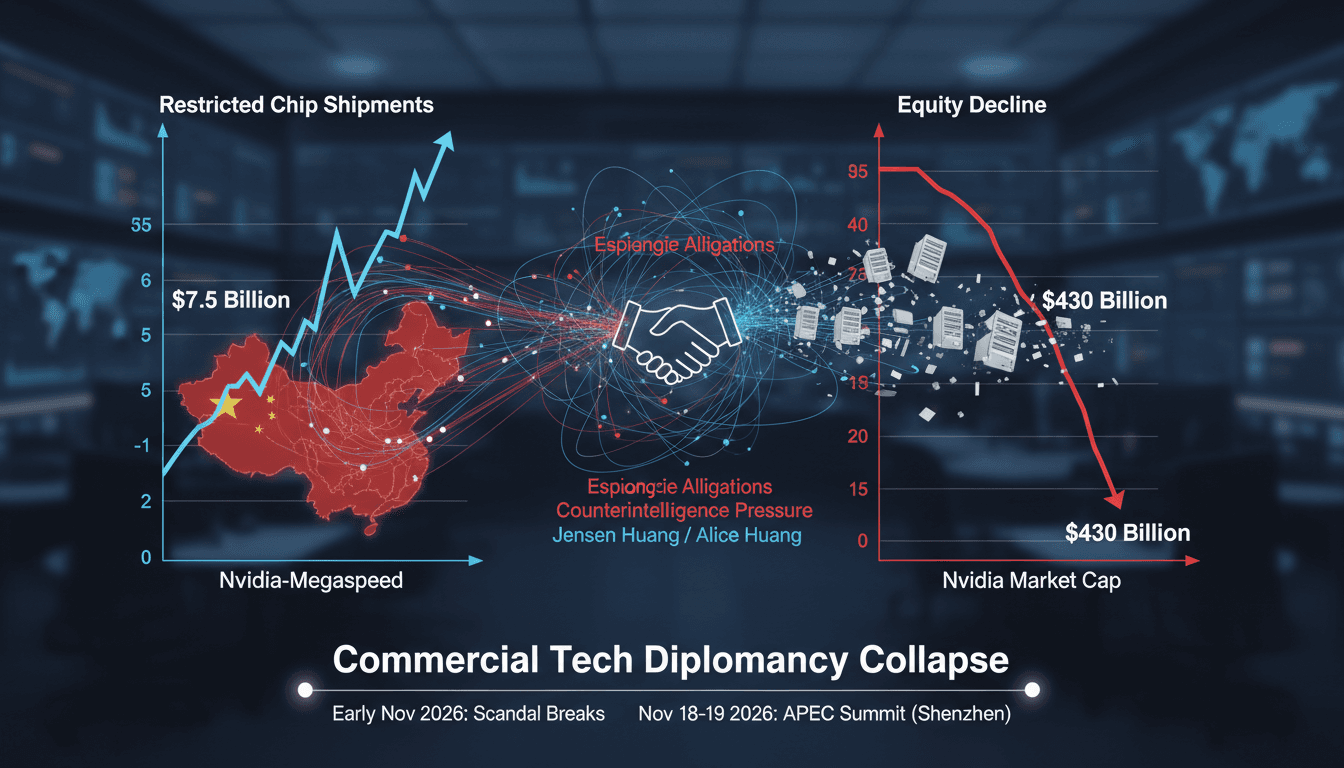
The intersection of corporate leadership exposure and national security intelligence has abruptly redirected global technology policy, wiping out more than $430 billion in equity value while forcing a structural reassessment of how advanced compute crosses geopolitical borders.
What happened (in 30 seconds)
- Executive departure: Jensen Huang resigned as Nvidia CEO following an internal board investigation into an admitted extramarital affair with Alice Huang, a former Megaspeed executive assessed by U.S. intelligence as a potential operative for China’s Ministry of State Security.
- Diverted shipments: Intelligence briefings provided to the White House linked the relationship to an estimated $7.5 billion in restricted semiconductor hardware deliveries to Chinese tech firms, including Alibaba and Tencent.
- Diplomatic separation: As U.S. President Donald Trump prepared for the November 18–19 APEC summit in Shenzhen to meet Chinese President Xi Jinping, administration officials stated the controversy would not be formally introduced into bilateral negotiations despite escalating congressional scrutiny.
The context you actually need
- Bilateral export architecture: Technology controls enacted in 2022 established strict limits on graphics processing unit (GPU) performance density shipped to China, prompting sustained corporate lobbying to preserve market share in the world’s second-largest compute economy.
- The policy concessions: Between 2025 and 2026, direct discussions between Nvidia leadership and the Trump administration yielded revised export guidelines, permitting capped shipments of advanced chips such as the H200 subject to a 25% U.S. revenue-share mechanism.
- Capital market reaction: The public disclosure of the intelligence assessment and internal board review triggered a contraction of more than $430 billion in Nvidia's market capitalization over just two trading sessions.
What's really happening
The crisis at Nvidia is fundamentally a breakdown in the corporate insulation strategy that leading semiconductor producers used to bridge Washington’s national security imperatives with Beijing’s commercial hardware demand. For four years, major technology vendors managed chip restrictions through architectural downgrades and regulatory compromise, seeking custom waivers to service enterprise clients in East Asia. The revelation that an alleged foreign intelligence asset influenced policy dialogues and secured approximately $7.5 billion in restricted hardware shipments dissolves the premise that commercial compute sales can operate independently of national intelligence oversight.
The immediate structural casualty is discretionary trade policy. Throughout 2025 and early 2026, technology diplomacy was increasingly characterized by personalized executive-branch negotiations, culminating in modified export rules for products like the H200 chip that included revenue-share arrangements for the U.S. government. That transactional model is now under institutional assault. With congressional committees and the Federal Bureau of Investigation expanding their probes into export compliance and corporate counterintelligence vulnerabilities, discretionary executive exemptions face steep bureaucratic barriers.
This shift permanently reweights regulatory power away from commercial liaisons and toward defensive agencies, including the Commerce Department's Bureau of Industry and Security, the Department of State led by Marco Rubio, and congressional oversight committees. Even though U.S. officials intentionally excluded the Nvidia matter from direct bilateral talks between President Trump and President Xi Jinping at the Shenzhen APEC summit, the domestic policy fallout back in Washington ensures that future chip export guidelines will be evaluated through a counterintelligence lens rather than a trade-balance framework.
Furthermore, Chinese cloud giants—specifically Alibaba and Tencent—face an immediate interruption in their high-performance compute access. While Beijing has formally denied the espionage allegations involving Alice Huang, the exposure of auxiliary procurement pathways through third-party hubs like Singapore will accelerate Western enforcement across intermediary jurisdictions. Enterprise buyers globally are no longer just managing component lead times; they are navigating an environment where access to tier-one compute capacity is bound to strict foreign-policy alignment.
Who feels it first (and how)
- Enterprise technology officers: Enterprise buyers across the Middle East and Asia face delayed delivery windows and heightened compliance audits when securing high-density GPU clusters through multinational channels.
- Global chip investors: Fund managers holding semiconductor equities absorb heightened portfolio volatility, as regulatory risk premiums expand beyond pure demand fundamentals.
- Cloud infrastructure providers: Data center operators in neutral digital hubs like Dubai must navigate indirect supply-chain fragmentation as secondary distribution routes face tighter oversight.
- Chinese hyperscale platforms: Technical leads at Alibaba, Tencent, and regional peers lose predictable roadmaps for acquiring cutting-edge Western AI architectures, forcing higher reliance on domestic silicon.
What to watch next
- Congressional export control legislation: Watch for draft statutory proposals in Washington that seek to strip executive-branch discretion over advanced computing export waivers and mandate standardized intelligence audits for technology executives.
- Commerce Department compliance reviews: Monitor official enforcement bulletins targeting hardware distribution through intermediary jurisdictions such as Singapore to gauge the durability of regional supply chains.
- Corporate governance restructuring: Track appointments to Nvidia’s executive suite and independent oversight board for signals on how the hardware giant plans to interface with federal counterintelligence authorities.
Jensen Huang resigned following an internal investigation into an extramarital relationship; U.S. intelligence linked Alice Huang to Chinese state security; Nvidia shed over $430 billion in market value over two sessions; the APEC bilateral summit proceeded without official inclusion of the crisis on the agenda.
Legislative committees will introduce stricter compliance mandates for semiconductor manufacturers, effectively curtailing the use of revenue-sharing mechanisms for foreign market access.
Whether federal investigative findings will invalidate existing H200 export licenses, or if Chinese cloud providers have accumulated sufficient inventory to sustain planned compute expansion through regional alternatives.
Frequently Asked Questions
- Why it matters?
- The intersection of corporate leadership exposure and national security intelligence has abruptly redirected global technology policy, wiping out more than $430 billion in equity value while forcing a structural reassessment of how advanced compute crosses geopolitical borders.
- What happened (in 30 seconds)?
- Executive departure: Jensen Huang resigned as Nvidia CEO following an internal board investigation into an admitted extramarital affair with Alice Huang, a former Megaspeed executive assessed by U.S. intelligence as a potential operative for China’s Ministry of State Security. Diverted shipments: Intelligence briefings provided to the White House linked the relationship to an estimated $7.5 billion in restricted semiconductor hardware deliveries to Chinese tech firms, including Alibaba and Tence
- What's really happening?
- The crisis at Nvidia is fundamentally a breakdown in the corporate insulation strategy that leading semiconductor producers used to bridge Washington’s national security imperatives with Beijing’s commercial hardware demand. For four years, major technology vendors managed chip restrictions through architectural downgrades and regulatory compromise, seeking custom waivers to service enterprise clients in East Asia. The revelation that an alleged foreign intelligence asset influenced policy dialo
- Who feels it first (and how)?
- Enterprise technology officers: Enterprise buyers across the Middle East and Asia face delayed delivery windows and heightened compliance audits when securing high-density GPU clusters through multinational channels. Global chip investors: Fund managers holding semiconductor equities absorb heightened portfolio volatility, as regulatory risk premiums expand beyond pure demand fundamentals. Cloud infrastructure providers: Data center operators in neutral digital hubs like Dubai must navigate indi
- What to watch next?
- Congressional export control legislation: Watch for draft statutory proposals in Washington that seek to strip executive-branch discretion over advanced computing export waivers and mandate standardized intelligence audits for technology executives. Commerce Department compliance reviews: Monitor official enforcement bulletins targeting hardware distribution through intermediary jurisdictions such as Singapore to gauge the durability of regional supply chains. Corporate governance restructuring:
Global markets, investing, and macroeconomics from a premier financial newsroom.
"Bloomberg is respected for in-depth financial reporting and data-driven analysis."
— A47 Editor
Nvidia Crisis Complicates Trump’s China Trip
Nvidia Crisis Complicates Trump's China Trip: Bloomberg reports that scrutiny surrounding Nvidia and CEO Jensen Huang is shifting the focus of President Donald Trump's upcoming China trip from trade toward chip export controls and questions about how...
Research, news, and analysis on blockchain startups, DeFi, and regulations.
"Crypto Briefing provides research, news, and analysis on blockchain startups, DeFi, and crypto regulations with investor-focused coverage."
— A47 Editor
US official says Nvidia turmoil won’t derail Trump’s Asia trip
The base report from Crypto Briefing says a US official stated that turmoil at Nvidia will not derail President Trump's planned Asia trip, even as the chipmaker faces intense scrutiny over its China dealings and leadership. The story is framed as a n...
Technology business and AI-related headlines.
"Data-driven tech newsroom with global scope."
— A47 Editor
Nvidia Crisis Fuels US and China Chip Showdown
Nvidia's crisis has escalated into a broader US-China chip showdown ahead of a Trump-Xi meeting, as the company navigates the fallout from its board ousting co-founder and CEO Jensen Huang following reports of extramarital affairs, one involving a wo...
Technology business news, market impacts, and innovation trends.
"Bloomberg is a premier financial and tech news provider, respected for its in-depth reporting and analytical rigor."
— A47 Editor
Nvidia Crisis Fuels US and China Chip Showdown
Nvidia's crisis has escalated into a broader US-China chip showdown ahead of a Trump-Xi meeting, as the company navigates the fallout from its board ousting co-founder and CEO Jensen Huang following reports of extramarital affairs, one involving a wo...