
Voyager 1 Reaches One Light-Day from Earth as Farthest Human-Made Object
What happened
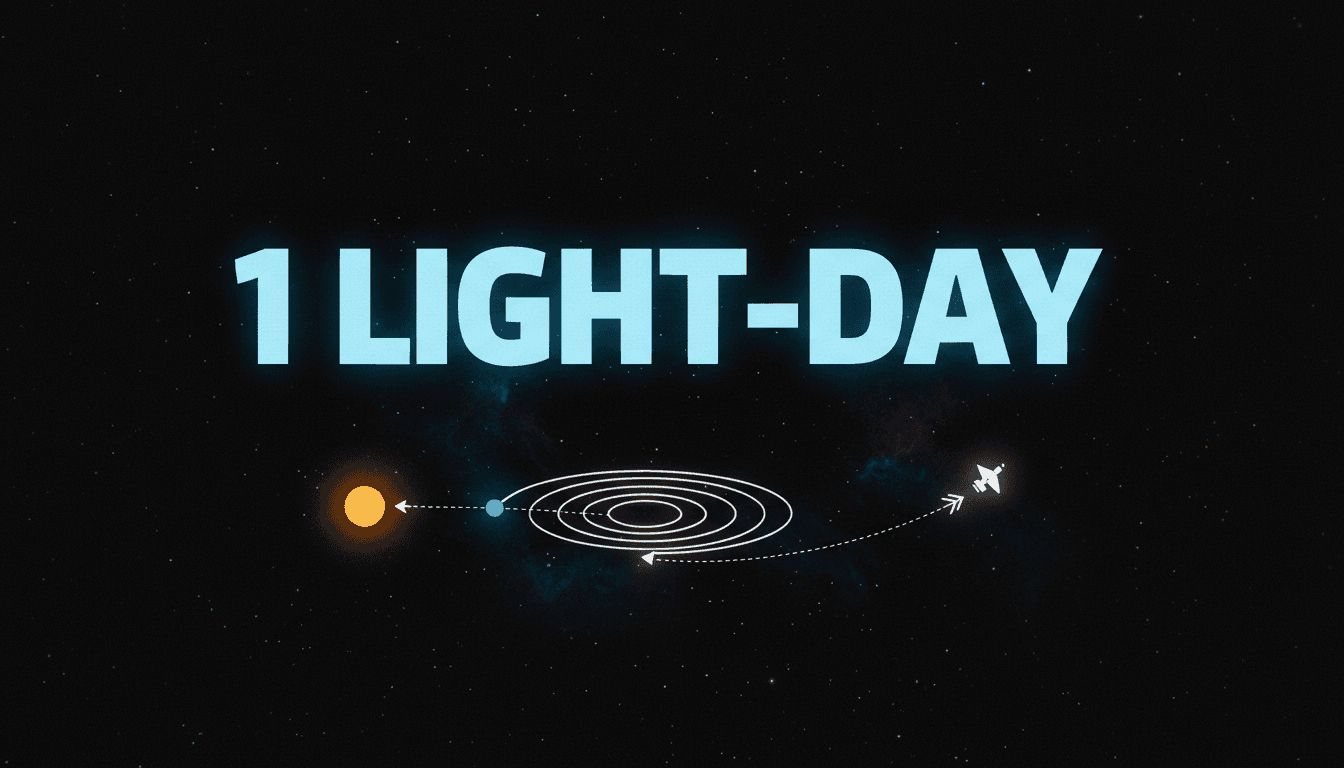
NASA's Voyager 1 became the first human-made object to reach exactly one light-day of distance from Earth at 5:16 a.m. ET on November 18, 2026.
The Context
* A 49-year trajectory: Launched in September 1977 to explore Jupiter and Saturn, the spacecraft crossed the heliopause into interstellar space in 2012 and now cruises roughly 173.1 AU out in the direction of Ophiuchus. * Strict power management: Mission engineers deactivated the Low-energy Charged Particles experiment earlier in 2026 to preserve energy, leaving two operational instruments actively relaying magnetic field and plasma wave measurements. * A 24-hour transmission lag: Reaching one light-day means any command sent from Earth now takes precisely 24 hours to arrive at the probe, requiring a full 48-hour round-trip cycle to receive data confirmation.
The Number
(25.902 billion kilometers) marks the precise distance Voyager 1 has covered from Earth to achieve this one light-day threshold, establishing a concrete distance reference for deep-space infrastructure.
Takeaway
Jet Propulsion Laboratory teams will continue managing declining power reserves to keep Voyager 1’s final two sensors operational as it charts previously unmeasured interstellar terrain.
Public radio coverage of American news and issues.
"NPR is an American public media organization known for thoughtful reporting and a slightly left-leaning editorial tone."
— A47 Editor
Far from home. Voyager 1 is now farther than anything man has sent into space
NASA's Voyager 1, the furthest man-made object from Earth, is set to reach a new milestone this week, when the probe will be roughly 16 billion miles from Earth, according to NPR reporting.
Scientific discoveries, health, technology, and natural phenomena.
"Live Science reports on scientific discoveries, health, technology, and natural phenomena with a popular science tone."
— A47 Editor
'Out there, moving into the unknown': As Voyager 1 reaches one light-day from Earth, scientists reflect on its past — and its future
Nearly 50 years after its launch, NASA's Voyager 1 probe is set to pass the one light-day mark from Earth on November 18, a symbolic milestone for the agency's longest-running mission, as scientists reflect on the Voyager program's legacy and its fut...
Scientific discoveries, health, technology, and natural phenomena.
"Live Science reports on scientific discoveries, health, technology, and natural phenomena with a popular science tone."
— A47 Editor
NASA's Voyager 1 mission forever changed our view of Jupiter
NASA's Voyager 1 mission, whose legendary photographs of Jupiter reshaped how scientists view the solar system, is being revisited by Live Science as the 49-year-old probe reaches roughly one light-day from Earth.
Global news coverage with extensive reporting on Middle Eastern conflicts and geopolitics.
"Al Jazeera is a Qatar-based broadcaster known for wide regional coverage and alternative perspectives."
— A47 Editor
NASA’s Voyager 1 to hit new space distance record of one light-day
NASA's Voyager 1 spacecraft is on course to set a new record for distance from Earth, reaching one light-day away. The probe was launched in 1977 and continues to relay space-related data back to a team of NASA scientists.
Comprehensive coverage of Middle Eastern and global issues.
"Al Jazeera is a prominent voice from the Global South, especially the Middle East, with an emphasis on underreported stories."
— A47 Editor
NASA’s Voyager 1 to hit new space distance record of one light-day
NASA's Voyager 1 spacecraft is on course to set a new record for distance from Earth, reaching one light-day away. The probe was launched in 1977 and continues to relay space-related data back to a team of NASA scientists.
International news coverage curated for readers in the UAE and Gulf region.
"Emirates 24|7 world coverage presents global developments through a UAE-facing and Gulf-relevant editorial lens."
— A47 Editor
26 billion kilometres: Voyager 1 set to reach historic one light-day milestone from Earth
NASA's Voyager 1, launched in 1977, is on the verge of crossing one light-day from Earth, a distance of about 16 billion miles (26 billion km), which light covers in 24 hours. Flying at nearly 38,000 miles per hour through interstellar space, the rob...