
Tesla Opens Invitation-Only Personal-Use Cybercab Sales Tied to Mandatory $299 Monthly Autonomy Subscription
Why it matters
The move sets a commercial precedent where private hardware lacks independent operational capability, forcing consumer adoption of ongoing software licensing models for basic function.
What happened (in 30 seconds)
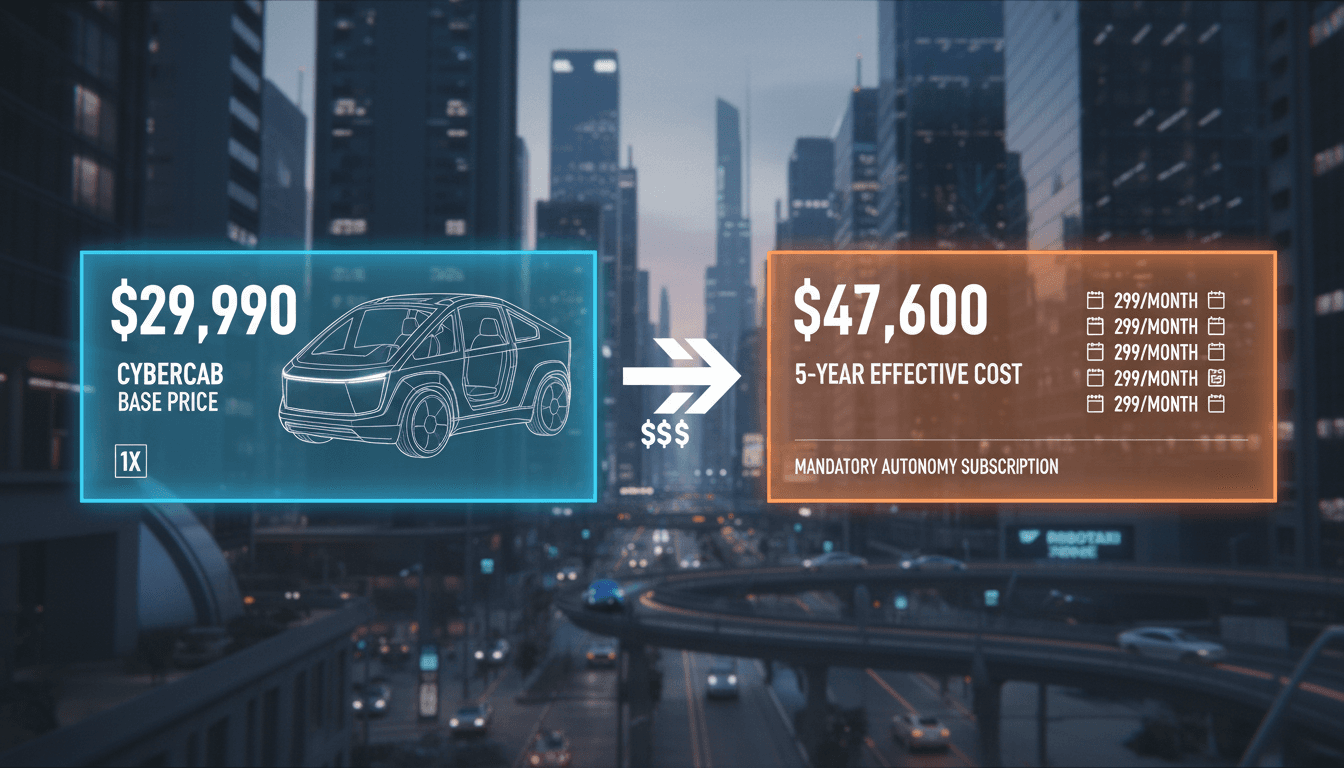
* Tesla opened customer invitations on November 13, 2026, selling personal-use Cybercab two-seaters for $29,990 with a $1,000 non-refundable deposit and Austin deliveries slated for December 2026. * Operation requires a recurring fee through a mandatory $299 monthly Autonomy Subscription, without which the pedal-free, steering-wheel-free vehicle cannot function. * Geographic utility remains locked exclusively within pre-existing Tesla Robotaxi service corridors across select cities in Texas and Florida, with commercial fleet deployment strictly barred.
The context you actually need
* The original deployment vision changed, shifting away from the October 2024 pitch where owners were told they could generate revenue by deploying their sub-$30,000 vehicles into a shared autonomous fleet. * Regulatory authorization is pending, as the National Highway Traffic Safety Administration (NHTSA) continues auditing Tesla’s October submission for safety standard compliance on a cabin without manual controls. * Total ownership costs climb substantially above the sticker price, pushing five-year direct commitments to roughly $47,600 before factoring in power, local insurance, or baseline municipal taxes.
What's really happening
The economics of the Cybercab reveal an aggressive pivot toward subscription-based asset control. Selling a vehicle for $29,990 creates an accessible entry price point. However, stripping steering controls, pedals, and manual overrides guarantees that utility exists only when the operating system is actively licensed. By requiring an ongoing $299 monthly commitment, the vehicle converts from a depreciating, standalone durable product into an end-point terminal for proprietary autonomous services.
Because Tesla retains the contractual right to modify subscription terms on 30 days’ notice, purchasing the hardware does not yield full autonomy over operational overhead. Over a 60-month lifecycle, an owner commits $17,641 directly to software maintenance and platform access fees beyond the purchase price. Even if the fee adjusts down toward the $115 monthly figure Elon Musk floated after launch, the baseline architectural dependency remains intact: missing a payment or violating platform terms renders the physical asset immobile.
Furthermore, barring early adopters from running their units on peer-to-peer or third-party taxi networks eliminates the immediate revenue-generating logic previously associated with the platform. Instead, buyers bear the upfront capital risk, local vehicle storage, and charging overhead, while Tesla gathers operational edge-case telematics across designated Texas and Florida operational perimeters.
This strategy establishes a controlled roll-out environment. Constraining operations to approved service pockets in Austin and select Florida metros allows the platform to gather structured real-world hours prior to broader federal determinations. The approach shifts initial capital deployment costs onto early retail adopters while preserving the software vendor's pricing power, geo-fenced authority, and commercial exclusivity.
Who feels it first (and how)
* Early tech adopters in Texas and Florida who absorb early vehicle platform risks while restricted entirely to predefined metropolitan driving perimeters. * Automotive fleet managers and operators evaluating total cost of ownership models as vehicle hardware transitions into fixed software-as-a-service line items. * Auto insurers and regional risk underwriters facing unestablished underwriting precedents for privately titled, fully driverless passenger transport operating without manual overrides. * Automotive retail buyers weighing nominal sticker prices against non-negotiable lifetime software overhead.
What to watch next
* NHTSA standard determinations regarding whether personal vehicles without steering wheels or manual controls satisfy federal motor vehicle safety standards. * Subscription fee revisions to see if Tesla lowers the $299 monthly requirement toward the discussed $115 level prior to widespread deliveries. * Service zone expansion filings indicating when and where operations expand beyond the inaugural Austin and Florida borders.
The purchase price sits at $29,990 with a $1,000 non-refundable deposit; functionality is limited to specific areas in Texas and Florida; operations require a mandatory $299 monthly payment; commercial ride-hail usage is barred.
The total cost structure will encourage corporate and enterprise adjustments in how personal mobility assets are financed and amortized.
The timeline for NHTSA regulatory clearance, the long-term price trajectory of the monthly software fee, and the eventual framework for personal insurance liability.
Frequently Asked Questions
- Why it matters?
- The move sets a commercial precedent where private hardware lacks independent operational capability, forcing consumer adoption of ongoing software licensing models for basic function.
- What happened (in 30 seconds)?
- Tesla opened customer invitations on November 13, 2026, selling personal-use Cybercab two-seaters for $29,990 with a $1,000 non-refundable deposit and Austin deliveries slated for December 2026. Operation requires a recurring fee through a mandatory $299 monthly Autonomy Subscription, without which the pedal-free, steering-wheel-free vehicle cannot function. Geographic utility remains locked exclusively within pre-existing Tesla Robotaxi service corridors across select cities in Texas and Florid
- What's really happening?
- The economics of the Cybercab reveal an aggressive pivot toward subscription-based asset control. Selling a vehicle for $29,990 creates an accessible entry price point. However, stripping steering controls, pedals, and manual overrides guarantees that utility exists only when the operating system is actively licensed. By requiring an ongoing $299 monthly commitment, the vehicle converts from a depreciating, standalone durable product into an end-point terminal for proprietary autonomous services
- Who feels it first (and how)?
- Early tech adopters in Texas and Florida who absorb early vehicle platform risks while restricted entirely to predefined metropolitan driving perimeters. Automotive fleet managers and operators evaluating total cost of ownership models as vehicle hardware transitions into fixed software-as-a-service line items. Auto insurers and regional risk underwriters facing unestablished underwriting precedents for privately titled, fully driverless passenger transport operating without manual overrides. Au
- What to watch next?
- NHTSA standard determinations regarding whether personal vehicles without steering wheels or manual controls satisfy federal motor vehicle safety standards. Subscription fee revisions to see if Tesla lowers the $299 monthly requirement toward the discussed $115 level prior to widespread deliveries. Service zone expansion filings indicating when and where operations expand beyond the inaugural Austin and Florida borders.
Tech news, hardware, and AI tools coverage.
"PC/tech site increasingly covering AI hardware and apps."
— A47 Editor
Tesla is selling the Cybercab to private buyers, but it won't move without a $299 monthly subscription
Tesla has begun inviting select customers to buy its two-seat, steering-wheel-free Cybercab for personal use, but the vehicle will not operate without a mandatory $299 monthly Autonomy Subscription on top of the roughly $30,000 purchase price, accord...
Consumer tech news, reviews, and buying guides for gadgets and electronics.
"TechRadar is known for comprehensive buying advice, hardware reviews, and consumer tech news targeted at mainstream audiences."
— A47 Editor
Tesla’s Cybercab goes on sale for ‘personal use’ but there are caveats
Tesla has opened orders for its self-driving two-seat Cybercab to a select group of customers for personal use, according to TechRadar, though the offer is limited and comes with caveats on availability.
Community posts including AI/ML tutorials and news.
"Open platform where developers share AI learnings."
— A47 Editor
$299/mo: Tesla's $29,990 Cybercab won't move without it
Tesla is offering select customers the opportunity to pre-order its two-seat, steering-wheel-free Cybercab for personal use at $29,990 before taxes, with a $1,000 non-refundable deposit and an estimated delivery of December 2026 in Austin, Texas. The...
Startup news with frequent AI coverage.
"Covers launches, funding, and product updates in AI."
— A47 Editor
Tesla opens Cybercab pre-orders ‘for personal use,’ with geo restrictions and a $299 monthly fee
Tesla has opened pre-orders for its two-seat, steering-wheel-free Cybercab for personal use, but buyers face a mandatory $299 monthly Cybercab Autonomy Subscription on top of the $29,990 vehicle price, with purchases limited to select customers in su...
Curated tech headlines including AI stories.
"Influential aggregator surfacing the day’s top tech/AI links."
— A47 Editor
Tesla's Cybercab Autonomy Subscription agreement states the vehicles will only work inside Tesla-enabled geofences, which the company can change at any time (Fred Lambert/Electrek)
Tesla has published the agreement attached to its $29,990 Cybercab, and according to Electrek's Fred Lambert the terms are more restrictive than the order page suggested: the vehicles will only operate inside Tesla-enabled geofences, which the compan...
U.S. business news, corporate developments, and economy.
"The Wall Street Journal is respected for deep financial and economic reporting with a center-right editorial perspective."
— A47 Editor
Tesla Opens Sales of Autonomous Cybercab for ‘Select’ Customers
Tesla has opened sales of its Cybercab autonomous vehicle, which has no steering wheel or pedals, to select customers, according to The Wall Street Journal. The move comes as the company faces a federal probe into the vehicle's autonomous technology.
Consumer tech and culture with frequent AI coverage.
"Influential tech outlet covering AI products and policy."
— A47 Editor
Tesla is inviting some people to buy a Cybercab ‘for personal use’ — but read the fine print
Tesla is inviting select customers to buy a Cybercab 'for personal use,' but the self-driving two-seater with no steering wheel will only be available in supported service areas, meaning buyers must live in one of those areas to purchase one.
Tech news, reviews, and analysis of consumer electronics, science, art, and culture.
"The Verge is a technology-focused media outlet known for in-depth reporting, product reviews, and coverage of the intersection between technology and culture."
— A47 Editor
Tesla is inviting some people to buy a Cybercab ‘for personal use’ — but read the fine print
Tesla is inviting select customers to buy a Cybercab 'for personal use,' but the self-driving two-seater with no steering wheel will only be available in supported service areas, meaning buyers must live in one of those areas to purchase one.
Consumer technology news with AI coverage.
"Gadget and tech site reporting on AI in products."
— A47 Editor
Tesla starts taking Cybercab orders for personal use
Tesla has begun sending invitations to select customers to purchase the Cybercab, its self-driving two-seat vehicle, for personal use, according to Engadget. The offer is made to a limited group rather than the general public.
Covers consumer technology, electronics, gadgets, and product reviews.
"Engadget is a trusted source for gadget reviews and consumer tech news, known for its hands-on analysis and industry coverage."
— A47 Editor
Tesla starts taking Cybercab orders for personal use
Tesla has begun sending invitations to select customers to purchase the Cybercab, its self-driving two-seat vehicle, for personal use, according to Engadget. The offer is made to a limited group rather than the general public.
UAE-based English-language newspaper covering regional politics, economics, and global affairs.
"The National reflects Emirati policy perspectives while maintaining international editorial standards."
— A47 Editor
Tesla invites select customers to order their own driverless Cybercab
Tesla has invited select customers to order its driverless Cybercab, a two-seat autonomous vehicle designed without traditional driving controls, marking a step toward commercial sales of fully autonomous vehicles to buyers. The base report, publishe...
Market-moving headlines impacting equities, bonds, and related risk assets.
"Real-time catalysts and volatility drivers across indices and sectors."
— A47 Editor
Tesla invites select customers to buy Cybercab for personal use
Tesla has invited select customers to buy its Cybercab autonomous vehicle for personal use, according to Investing.com. The Cybercab is designed with no steering wheel or pedals, and the sales opening follows reporting by The Wall Street Journal on t...
Technology and innovation coverage, including consumer tech and digital transformation stories.
"Emirates 24|7 technology coverage often highlights practical tech developments with relevance to Gulf readers and businesses."
— A47 Editor
Tesla invites select customers to buy Cybercab for personal use
Tesla said on Friday it is inviting select customers to buy its Cybercab two-seater for personal use, priced at $29,990 with an "Autonomy Subscription" of $299 a month, marking a push to deliver fully designed autonomous vehicles to buyers. The annou...
Curated tech headlines including AI stories.
"Influential aggregator surfacing the day’s top tech/AI links."
— A47 Editor
Tesla says "select customers" can now place orders for its Cybercab "for personal use", for $30K plus a required $299/month Autonomy Subscription to operate (Kara Carlson/Bloomberg)
Tesla said "select customers" can now place orders for its Cybercab robotaxi "for personal use," priced at $30,000 plus a required $299 per month Autonomy Subscription to operate the vehicle, as the company takes a step toward making its driverless c...