
Houthi Advance Seizes Bab al-Mandab Strait and Threatens Aden as Red Sea Trade Route Faces Closure Risk
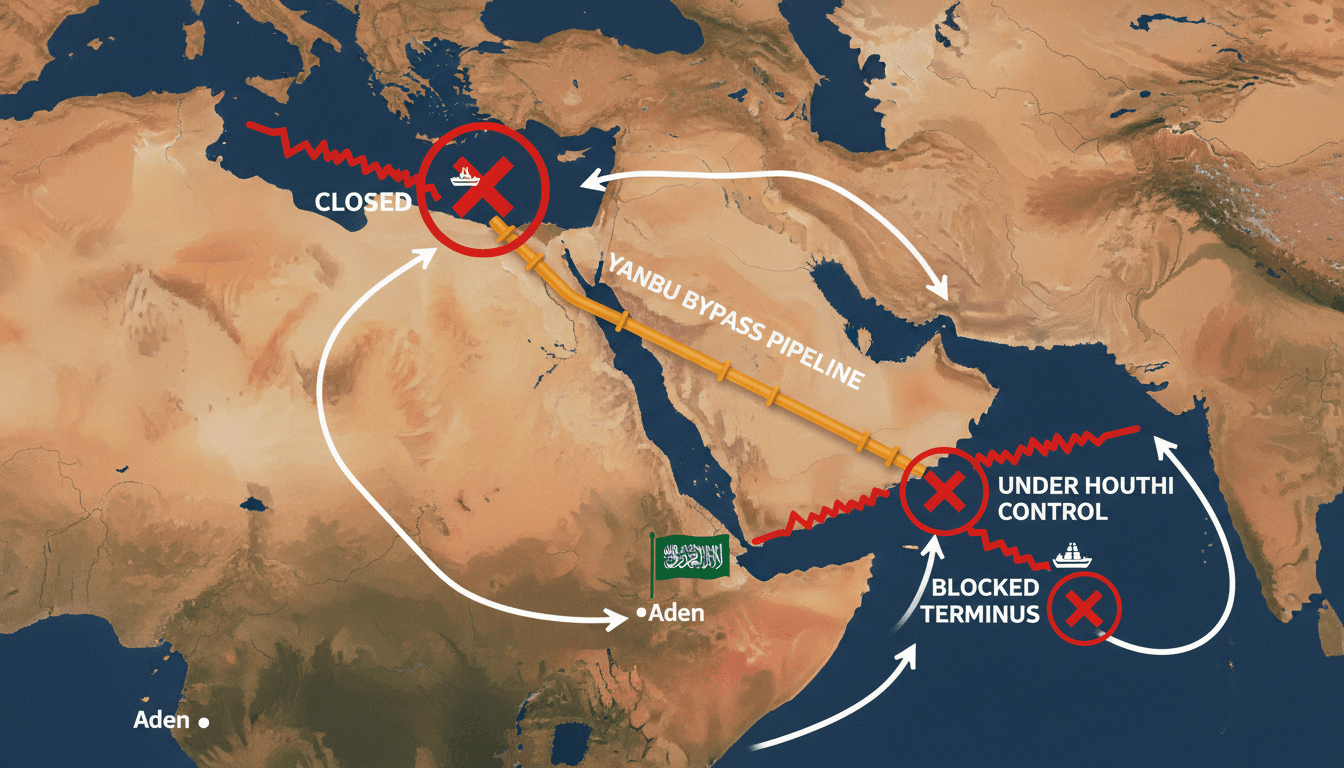
Why it matters
The physical seizure of the Bab al-Mandab Strait directly endangers 12% of global seaborne trade, cutting off an essential alternative route for Gulf energy flows at a moment when traditional maritime corridors are already constrained.
What happened (in 30 seconds)
- Coastal advance takes the strait: On or around November 16, 2026, Houthi forces completed an offensive along Yemen's western seaboard, taking physical control of the Bab al-Mandab Strait area and Dhubab airport.
- Government lines contract toward Aden: Saudi-backed Yemeni government forces withdrew from forward coastal positions to construct a defensive perimeter around the interim capital of Aden, with Houthi units advancing to within 60 to 100 kilometers of the city.
- Command structure restructured: Following the loss of coastal territory and the encirclement of Taiz, Saudi Arabia issued a royal decree replacing its top military commander overseeing coalition operations in Yemen.
The context you actually need
- The collapsed framework: A fragile ceasefire originally maintained stability until July 2026, when it broke down entirely and gave way to a renewed multi-axis ground campaign across southern and western Yemen.
- The closure of the primary corridor: Following the outbreak of the US-Iran conflict in February 2026, the Strait of Hormuz was closed, transforming the Red Sea into the primary export relief valve for Arabian Peninsula hydrocarbons.
- The Yanbu pipeline dependency: To bypass the Hormuz shutdown, Saudi Arabia redirected crude flows overland via pipeline to the Red Sea port of Yanbu, leaving energy transit acutely reliant on safe passage through the southern Bab al-Mandab exit.
What's really happening
The loss of the Bab al-Mandab corridor fundamentally rewrites commercial transit math for global logistics operators. When the Strait of Hormuz closed in February 2026, maritime logistics adapted by relying heavily on overland transfers to Yanbu on the western Saudi coast. The fundamental economic viability of that operational workaround depended on an open, navigable Bab al-Mandab exit to the Indian Ocean. With Houthi forces now established along the coastal high ground, that assumption has dissolved.
Control of this corridor grants ground forces direct leverage over 70 to 150 commercial vessels per day. This accounts for roughly 12% of total global merchandise movement. The structural problem is not merely whether commercial vessels are fired upon, but whether underwriters will insure the hull, cargo, and crew traversing a narrow channel bounded by active hostile positions. Once insurance underwriters categorize the passage as contested water, commercial freight rates reprice automatically. Cargo owners face an immediate choice: pay punitive war-risk premiums that mirror the pricing shocks of September 2026, or accept a multi-week detour around the Cape of Good Hope, absorbing substantial bunker fuel surcharges and tied-up fleet capacity.
This military shift simultaneously resets the strategic balance in southern Yemen. By advancing through Lahj province and pushing government units back toward Aden, the Houthis have fractured the defensive depth of the internationally recognized administration. Defending Aden now absorbs the entirety of available government ground assets, forcing a full tactical retreat from outlying maritime infrastructure. For Riyadh, replacing the coalition commander signals the severity of the operational setback: the buffer zone protecting critical southern waters has effectively collapsed.
Furthermore, this advance ties directly into broader regional leverage mechanisms. With the US-Iran conflict continuing to pressure Middle Eastern shipping, Iranian-aligned forces now hold operational positions near two vital maritime choke points. The commercial cost does not remain localized to the Red Sea; it immediately ripples across international manufacturing inputs, maritime logistics schedules, and worldwide energy markets sensitive to any disruption in remaining export pathways.
Who feels it first (and how)
- Maritime logistics operators and cargo owners: Instant escalation of hull and machinery war-risk insurance premiums, compounded by operational delays if shipping lines divert around southern Africa.
- Regional commercial hubs (especially Dubai): Exposure to cargo rerouting overhead, volatile bunkering expenses, and broader operational friction across Middle Eastern freight networks.
- Energy refiners and off-takers: Heightened landed costs for crude shipments that relied on Red Sea pipelines to skirt previous trade disruptions, creating downstream price volatility.
- Yemeni civilians in Lahj, Taiz, and Aden: Immediate threat of urban fighting, severed domestic supply chains, and localized shortages of imported food and essential goods.
What to watch next
- The perimeter defense of Aden: Whether Yemeni government airstrikes and defensive repositioning can hold the 60-kilometer buffer zone, or if ground fighting penetrates the city limits of the interim capital.
- Underwriter war-risk declarations: The formal advisory notices from international maritime insurance syndicates regarding passage through the Bab al-Mandab Strait, which will dictate whether commercial carriers reroute.
- Yanbu export volume adjustments: Saudi operational data indicating whether crude loading at the Red Sea terminal decelerates due to restricted access through the southern exit.
Houthi forces hold the Bab al-Mandab coastal perimeter; government forces have fallen back to Aden; Saudi Arabia has replaced its operational coalition commander; the Strait of Hormuz remains closed from the February 2026 escalation.
Commercial maritime traffic through the Red Sea will contract sharply as transit risk premiums rise, driving an immediate uptick in global shipping and energy transport costs.
Whether coalition airstrikes can effectively dislodge dug-in positions along the Bab al-Mandab coast without a protracted ground counteroffensive, and whether Aden can withstand an active siege.
Frequently Asked Questions
- Why it matters?
- The physical seizure of the Bab al-Mandab Strait directly endangers 12% of global seaborne trade, cutting off an essential alternative route for Gulf energy flows at a moment when traditional maritime corridors are already constrained.
- What happened (in 30 seconds)?
- Coastal advance takes the strait: On or around November 16, 2026, Houthi forces completed an offensive along Yemen's western seaboard, taking physical control of the Bab al-Mandab Strait area and Dhubab airport. Government lines contract toward Aden: Saudi-backed Yemeni government forces withdrew from forward coastal positions to construct a defensive perimeter around the interim capital of Aden, with Houthi units advancing to within 60 to 100 kilometers of the city. Command structure restructur
- What's really happening?
- The loss of the Bab al-Mandab corridor fundamentally rewrites commercial transit math for global logistics operators. When the Strait of Hormuz closed in February 2026, maritime logistics adapted by relying heavily on overland transfers to Yanbu on the western Saudi coast. The fundamental economic viability of that operational workaround depended on an open, navigable Bab al-Mandab exit to the Indian Ocean. With Houthi forces now established along the coastal high ground, that assumption has dis
- Who feels it first (and how)?
- Maritime logistics operators and cargo owners: Instant escalation of hull and machinery war-risk insurance premiums, compounded by operational delays if shipping lines divert around southern Africa. Regional commercial hubs (especially Dubai): Exposure to cargo rerouting overhead, volatile bunkering expenses, and broader operational friction across Middle Eastern freight networks. Energy refiners and off-takers: Heightened landed costs for crude shipments that relied on Red Sea pipelines to skir
- What to watch next?
- The perimeter defense of Aden: Whether Yemeni government airstrikes and defensive repositioning can hold the 60-kilometer buffer zone, or if ground fighting penetrates the city limits of the interim capital. Underwriter war-risk declarations: The formal advisory notices from international maritime insurance syndicates regarding passage through the Bab al-Mandab Strait, which will dictate whether commercial carriers reroute. Yanbu export volume adjustments: Saudi operational data indicating wheth
International coverage of politics, culture, and current affairs.
"BBC News is widely regarded as a reputable international news organization, known for its impartial tone and public service mandate."
— A47 Editor
Houthi rebel advance in Yemen may further destabilise global economy
The Iran-backed Houthi rebels have gained ground in Yemen, and according to the BBC's security correspondent their advance could carry dangerous consequences, including the risk of further destabilising the global economy. Reports across outlets indi...
Conservative-leaning political and national coverage.
"The Washington Times is a conservative-leaning newspaper known for its political coverage and advocacy of right-of-center viewpoints."
— A47 Editor
Houthi forces advance in Yemen after Saudi-backed forces retreat from western coast
Saudi Arabia announced it has replaced the commander overseeing its coalition forces in Yemen, as Iran-backed Houthi rebels advanced eastward after Saudi-backed forces retreated from the western coast.
Comprehensive coverage of Middle Eastern and global issues.
"Al Jazeera is a prominent voice from the Global South, especially the Middle East, with an emphasis on underreported stories."
— A47 Editor
Saudi Arabia dismisses commander of coalition forces fighting Houthis
Saudi Arabia has removed the commander of the Saudi-led coalition fighting Houthi rebels in Yemen, state media reported, as Houthi forces advanced toward the interim capital Aden. The dismissal followed a withdrawal of Saudi-backed government forces ...
Global news coverage with extensive reporting on Middle Eastern conflicts and geopolitics.
"Al Jazeera is a Qatar-based broadcaster known for wide regional coverage and alternative perspectives."
— A47 Editor
Saudi Arabia dismisses commander of coalition forces fighting Houthis
Saudi Arabia has removed the commander of the Saudi-led coalition fighting Houthi rebels in Yemen, state media reported, as Houthi forces advanced toward the interim capital Aden. The dismissal followed a withdrawal of Saudi-backed government forces ...
Top international stories selected by The Guardian editors.
"The Guardian is known for its progressive editorial stance and in-depth analysis."
— A47 Editor
Saudi Arabia strategy challenged by anti-Houthi forces in Yemen
Saudi-backed Yemeni government forces have pulled back from the Bab al-Mandab Strait area and parts of Marib to prioritise breaking the siege of Taiz and protecting Aden, the interim seat of the internationally recognised government, drawing accusati...
Regional coverage and analysis focused on politics, diplomacy, and business across the Middle East.
"Al-Monitor is known for analytical reporting on Middle East politics and policy developments."
— A47 Editor
Yemen's Saudi-backed forces retreat to defend Aden as Houthis advance: What to know
Yemen's Saudi-backed government forces have withdrawn from territory near the Bab el-Mandeb Strait to concentrate on defending Aden, the seat of the internationally recognised government, as Iran-aligned Houthi forces advance toward the city; Saudi A...
UAE-based English-language newspaper covering regional politics, economics, and global affairs.
"The National reflects Emirati policy perspectives while maintaining international editorial standards."
— A47 Editor
Saudi Arabia replaces Joint Forces commander overseeing fight with Houthis
Saudi Arabia has replaced the commander overseeing its Joint Forces campaign against the Iran-aligned Houthis, with Lt. Gen. Fayyad Al-Ruwaili, Chief of the General Staff, assuming the role on an acting basis by royal order, after Saudi-backed Yemeni...
Regional coverage and analysis focused on politics, diplomacy, and business across the Middle East.
"Al-Monitor is known for analytical reporting on Middle East politics and policy developments."
— A47 Editor
After Yemen setback, Saudi Arabia replaces military commander
Saudi Arabia replaced the commander overseeing its coalition campaign against the Iran-allied Houthis on Monday, November 16, after Saudi-backed Yemeni government forces withdrew from territory near the Bab el-Mandeb Strait, leaving the Houthis in co...
24/7 international news from a French perspective in multiple languages.
"France 24 is viewed as a globally focused outlet with balanced coverage and a European perspective."
— A47 Editor
Saudi Arabia dismisses commander of anti-Houthi coalition as rebels advance
Saudi Arabia has removed the commander of the Saudi-led coalition in Yemen, state media reported, as Iran-backed Houthi rebels advanced toward the temporary capital of Aden. The shake-up followed Houthi gains on Yemen's southern coast and a pullback ...
International coverage of politics, culture, and current affairs.
"BBC News is widely regarded as a reputable international news organization, known for its impartial tone and public service mandate."
— A47 Editor
Yemeni forces retreat to defend port city from Houthis
Yemeni Saudi-backed government forces are pulling troops back from the Bab al-Mandab Strait area to defend Aden, the interim capital, as Houthi forces advance toward the port city, according to reports on the base story.
Global business headlines with AI angles.
"General business outlet that frequently covers AI."
— A47 Editor
Houthis Advance to Within 60 Kilometers of Aden. Saudi-Backed Forces Pull Back From Strategic Red Sea Coast.
Houthi fighters have advanced to within about 60 kilometers of Aden, gaining territory in Lahj province, according to military sources, while Saudi-backed forces have pulled back from the strategic Red Sea coast. Fighting has also put additional pres...
Comprehensive coverage of Middle Eastern and global issues.
"Al Jazeera is a prominent voice from the Global South, especially the Middle East, with an emphasis on underreported stories."
— A47 Editor
Houthis advance in Yemen as government forces move to defend Aden
Houthi forces in Yemen have advanced toward Aden, the seat of the internationally recognised government, threatening one of the government's last strongholds as government troops pull back to defend the capital.
Global news coverage with extensive reporting on Middle Eastern conflicts and geopolitics.
"Al Jazeera is a Qatar-based broadcaster known for wide regional coverage and alternative perspectives."
— A47 Editor
Houthis advance in Yemen as government forces move to defend Aden
Houthi forces in Yemen have advanced toward Aden, the seat of the internationally recognised government, threatening one of the government's last strongholds as government troops pull back to defend the capital.
Regional coverage and analysis focused on politics, diplomacy, and business across the Middle East.
"Al-Monitor is known for analytical reporting on Middle East politics and policy developments."
— A47 Editor
Anti-Houthi forces retreat in Yemen as Iran strikes Bahrain
On Sunday, November 15, Saudi-backed Yemeni government forces withdrew from an area overlooking the strategic Bab el-Mandeb Strait, leaving the Iran-aligned Houthis in control of the position and pulling back to defend the temporary capital Aden, acc...