
Starshield Speed Caps Limit Ukrainian Interceptor Drones Against Russian Jet-Powered Shaheds
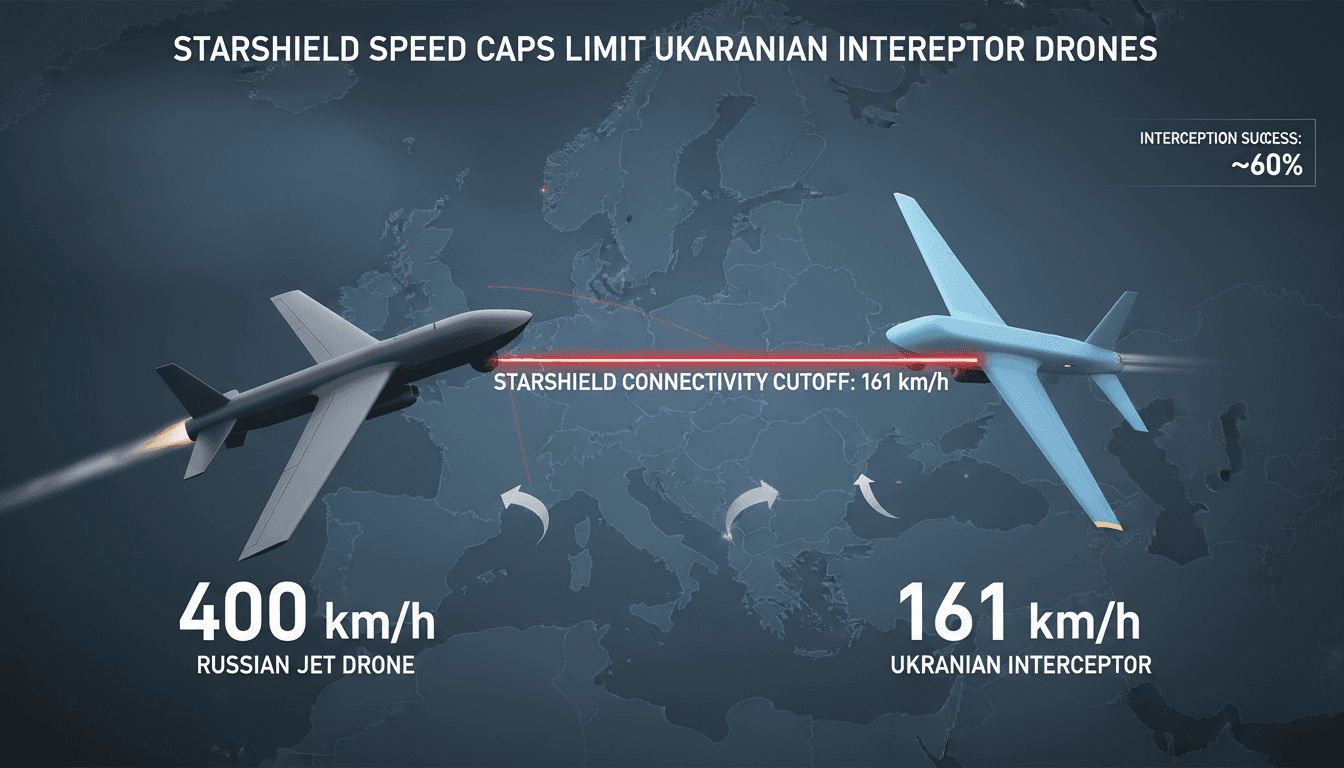
Software-defined operational thresholds in dual-use commercial infrastructure create immediate operational liabilities for any enterprise dependent on cross-border satellite communications.
Why it matters
When private telecommunications providers govern hardware velocity thresholds, sovereign defense networks face abrupt capability gaps against high-speed autonomous systems.
What happened (in 30 seconds)
- Velocity caps returned: On November 9, 2026, Ukrainian military units detected satellite communication cutoff limits enforced at 161 km/h (100 mph) along the front line and in Russian-occupied territories.
- Interceptions dropped: The 161 km/h ceiling severed terminal links to Ukrainian interceptor drones attempting to track Russian jet-powered Geran and Shahed variants flying at 400 km/h or higher.
- Infrastructure sustained hits: Ukrainian President Volodymyr Zelenskyy confirmed on November 16, 2026, that the enforced communications barrier enabled direct strikes against municipal power substations in Odesa and Koriukivka.
The context you actually need
- A multi-year platform shift: Ukraine integrated Starshield—the military-grade encrypted satellite communications variant of Starlink—in December 2024 to support unmanned aerial defense.
- Upgraded airborne threats: Russian forces integrated jet-propulsion engines into Geran-3, -4, and -5 platforms, dropping Ukrainian interception success rates from above 90% against legacy propeller drones down to 60%.
- Recurrent administrative limits: A similar 161 km/h cap appeared in mid-October 2026, was partially rolled back late that month, and returned amid parallel bilateral peace negotiations hosted in Abu Dhabi.
What's really happening
The mechanical conflict across Eastern Europe has shifted into an operational software bottleneck. Ukrainian defense doctrine relies on rapid interceptor drones guided via low-latency satellite links to run down inbound loitering munitions. Against legacy, propeller-driven Shahed models, human operators retained adequate reaction windows below standard commercial movement limits. The operational problem emerged when Russian procurement accelerated the deployment of jet-powered variants, pushing inbound cruise velocities to 400 km/h and above.
Physics demands that an interceptor fly as fast as, or faster than, its target. When an interceptor platform accelerates past 161 km/h to close the distance, Starshield transceivers registered the speed profile as an unauthorized flight mode and terminated terminal links. Consequently, Ukrainian interception efficiency against jet-powered systems dropped to 60%, even as overall volume defense held steady, such as the overnight downing of 106 out of 132 drones on November 16, 2026.
This dynamic exposes the contractual and regulatory framework governing Starshield. While manufactured by SpaceX, the Starshield architecture operates under United States government mission control and military authorization protocols. SpaceX leadership points to state oversight and technical constraints, while US executive authorities determine the parameters applied to active geofenced nodes. The enforcement of these velocity limits coincides with diplomatic engagements in Abu Dhabi, where multi-track negotiations yielded discrete concessions such as prisoner swaps rather than structural ceasefire terms.
For global systems operators, this dynamic illustrates software-defined sovereign risk. Commercial technology firms contracted for defense-grade communication pipelines remain subject to jurisdictional compliance switches. When policy authorities modify operational constraints—whether to avert technological capture, satisfy domestic export classifications, or control battlefield escalation—the end user absorbs an immediate loss of functional capability without hardware destruction. The vulnerability is structural: critical kinetic defense performance depends on a cloud configuration script held by a third-party state.
Who feels it first (and how)
- Frontline Ukrainian air defense units: Operators lose guidance and telemetry feeds the moment counter-drone interceptors throttle up to pursue targets moving above 161 km/h.
- Regional power grid operators: Municipal infrastructure engineers in regions like Odesa face repeated baseline generation and transmission losses directly tied to missed missile and drone interceptions.
- Defense procurement executives: Global acquisition directors are forced to re-evaluate single-provider satellite communication dependencies and design redundant, non-geofenced guidance architectures.
- Commercial aerospace suppliers: Dual-use hardware exporters confront tighter state-level verification checks on automated geofencing and terminal software caps.
What to watch next
- Pentagon contract revisions: Track official communications from US defense authorities regarding export parameters and software threshold exemptions for active conflict zones.
- Ukrainian network diversification: Watch for deployed secondary satellite constellations or autonomous optical tracking solutions designed to run intercept missions without satellite relays.
- Power grid resilience markers: Monitor industrial generation output across central and southern Ukraine as cold weather increases baseline civilian power draw through late 2026.
Starshield connections terminate along the front line and in occupied territories whenever ground or aerial transceivers exceed 161 km/h.
Continued speed caps will keep Ukrainian defensive intercept rates near 60% for fast-moving targets, accelerating cumulative attrition on national energy assets before winter.
Whether the velocity cap stems from a technical platform constraint, US Department of Defense operating terms, or deliberate diplomatic leverage during ongoing foreign peace talks.
Frequently Asked Questions
- Why it matters?
- When private telecommunications providers govern hardware velocity thresholds, sovereign defense networks face abrupt capability gaps against high-speed autonomous systems.
- What happened (in 30 seconds)?
- Velocity caps returned: On November 9, 2026, Ukrainian military units detected satellite communication cutoff limits enforced at 161 km/h (100 mph) along the front line and in Russian-occupied territories. Interceptions dropped: The 161 km/h ceiling severed terminal links to Ukrainian interceptor drones attempting to track Russian jet-powered Geran and Shahed variants flying at 400 km/h or higher. Infrastructure sustained hits: Ukrainian President Volodymyr Zelenskyy confirmed on November 16, 20
- What's really happening?
- The mechanical conflict across Eastern Europe has shifted into an operational software bottleneck. Ukrainian defense doctrine relies on rapid interceptor drones guided via low-latency satellite links to run down inbound loitering munitions. Against legacy, propeller-driven Shahed models, human operators retained adequate reaction windows below standard commercial movement limits. The operational problem emerged when Russian procurement accelerated the deployment of jet-powered variants, pushing
- Who feels it first (and how)?
- Frontline Ukrainian air defense units: Operators lose guidance and telemetry feeds the moment counter-drone interceptors throttle up to pursue targets moving above 161 km/h. Regional power grid operators: Municipal infrastructure engineers in regions like Odesa face repeated baseline generation and transmission losses directly tied to missed missile and drone interceptions. Defense procurement executives: Global acquisition directors are forced to re-evaluate single-provider satellite communicat
- What to watch next?
- Pentagon contract revisions: Track official communications from US defense authorities regarding export parameters and software threshold exemptions for active conflict zones. Ukrainian network diversification: Watch for deployed secondary satellite constellations or autonomous optical tracking solutions designed to run intercept missions without satellite relays. Power grid resilience markers: Monitor industrial generation output across central and southern Ukraine as cold weather increases bas
Global news coverage with extensive reporting on Middle Eastern conflicts and geopolitics.
"Al Jazeera is a Qatar-based broadcaster known for wide regional coverage and alternative perspectives."
— A47 Editor
Why Starshield limits are hurting Ukraine against jet-powered drones
Ukraine's military has relied on SpaceX's Starshield satellite internet service since December 2024 to intercept Russian drones, but restrictions imposed on the system are hampering Kyiv's ability to counter jet-powered drones, according to Al Jazeer...
Comprehensive coverage of Middle Eastern and global issues.
"Al Jazeera is a prominent voice from the Global South, especially the Middle East, with an emphasis on underreported stories."
— A47 Editor
Why Starshield limits are hurting Ukraine against jet-powered drones
Ukraine's military has relied on SpaceX's Starshield satellite internet service since December 2024 to intercept Russian drones, but restrictions imposed on the system are hampering Kyiv's ability to counter jet-powered drones, according to Al Jazeer...
24/7 international news from a French perspective in multiple languages.
"France 24 is viewed as a globally focused outlet with balanced coverage and a European perspective."
— A47 Editor
Ukraine strikes Crimea bridge as Zelensky says Starshield caps helping Russian attacks
Ukraine has struck the bridge linking Russia and Crimea across the Kerch Strait, limiting traffic flow, according to Russian-backed Crimean governor Sergei Aksyonov. The strike follows Russian attacks on energy and railway infrastructure across Ukrai...
English-language reporting on Saudi politics, policy, and society.
"Saudi Gazette reflects mainstream Saudi institutional perspectives."
— A47 Editor
Zelensky says Starlink restrictions threaten Ukraine's energy defenses
Ukrainian President Volodymyr Zelensky said on Sunday that restrictions on SpaceX's Starshield system, a military-grade Starlink service provided to Ukraine by the US government, are hindering Ukraine's ability to intercept Russian drones, and he cal...
News and current affairs from across Europe.
"The Guardian is known for its progressive editorial stance and in-depth analysis."
— A47 Editor
Ukraine war briefing: Energy attacks made possible by continuing Starshield restrictions, says Zelenskyy
Ukrainian President Volodymyr Zelenskyy said on Sunday that attacks on Ukrainian energy and railway infrastructure were being made possible partly by continuing restrictions on Ukraine's use of Elon Musk's Starshield satellite service, reiterating cr...