
Iran Suspends IAEA Nuclear Site Inspections Pending End of Middle East War and US Concessions
Why it matters
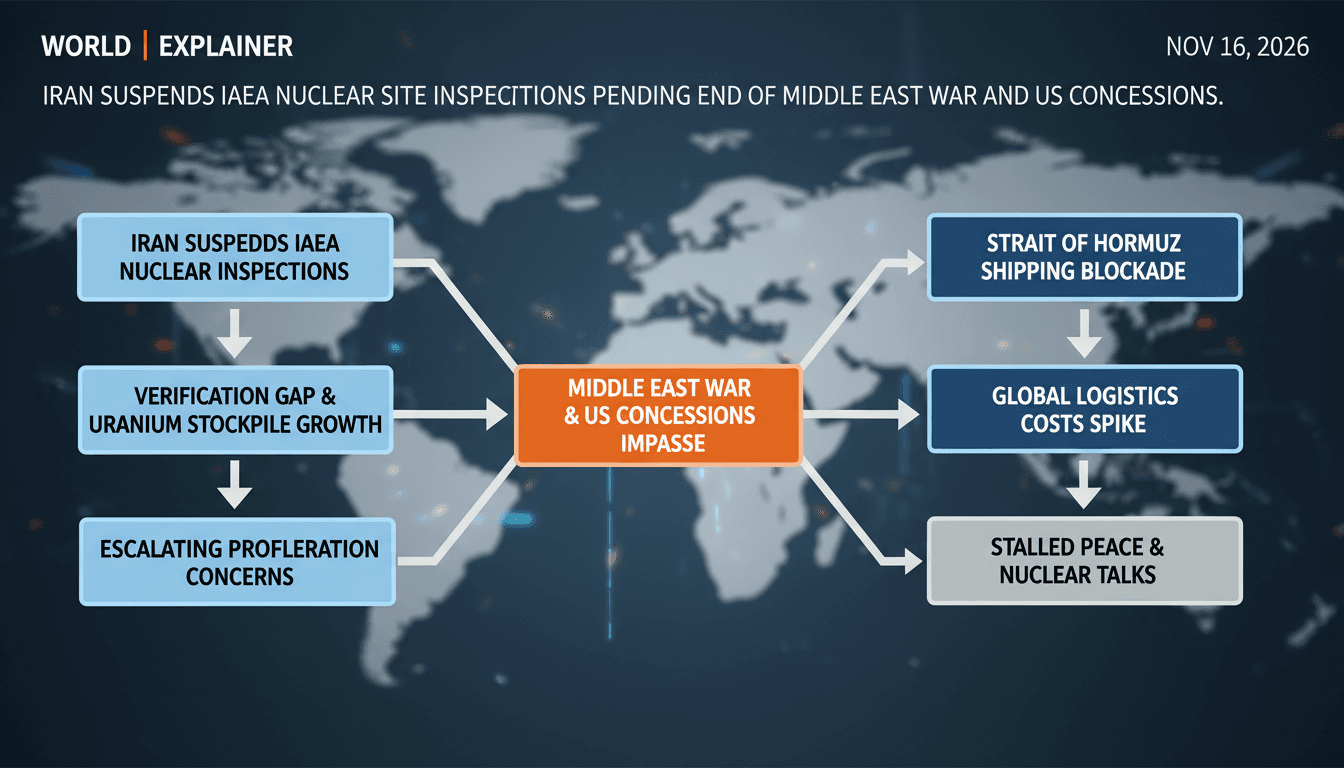
The formal linkage between international non-proliferation verification and regional conflict resolution ensures prolonged risk premiums across Gulf shipping corridors and global energy markets.
What happened (in 30 seconds)
- Inspection access denied: On November 16, 2026, Iran announced it will block International Atomic Energy Agency (IAEA) inspectors from entering damaged nuclear sites—including Natanz, Fordow, and Isfahan—until the regional war ends permanently.
- Specific preconditions demanded: Deputy Foreign Minister Kazem Gharibabadi tied atomic site monitoring and the reopening of the Strait of Hormuz directly to US concessions, including asset unfreezing and sanctions relief.
- Limited operational visibility: Aside from a single IAEA visit to the Bushehr plant in September 2026, international oversight of enriched uranium stockpiles remains suspended following previous strikes.
The context you actually need
- Preceding military escalation: The present standoff follows a 12-day conflict in 2025 involving strikes on nuclear facilities, followed by military operations on February 28, 2026, that targeted high-level leadership in Tehran.
- The Strait of Hormuz closure: Iran initiated a blockade of the primary Gulf maritime transit route during the active conflict, shutting down regular commercial access through the critical energy chokepoint.
- Proliferation verification breakdown: An IAEA confidential assessment on November 13, 2026, confirmed that the agency has lacked verification capability over Iran’s near-weapons-grade uranium stockpile since the mid-2025 kinetic strikes.
What's really happening
The diplomatic freeze over nuclear oversight reflects a calculated shift from technical non-proliferation diplomacy to multi-variable leverage. By restricting IAEA access to Natanz, Fordow, and Isfahan, Iranian decision-makers have explicitly paired the physical transparency of their nuclear program with the economic architecture of international trade.
Tehran’s framework couples three previously distinct diplomatic tracks: international atomic inspections, regional kinetic engagements, and commercial access through the Strait of Hormuz. By treating IAEA site visits not as standard regulatory compliance under international treaties, but as concessionary chips, Iranian officials aim to compel US negotiators to address economic liquidity. Specifically, Tehran seeks the unfreezing of state assets and broad sanctions relief as prerequisites before regional transit routes reopen or nuclear monitoring resumes. Deputy Foreign Minister Kazem Gharibabadi’s public assertion that IAEA inspection requests serve to evaluate Western strike effectiveness illustrates an incentive structure that views technical transparency as an operational liability during wartime.
For the international community and global markets, the structural implication is the elimination of near-term visibility over enriched material. Because the IAEA has been unable to audit inventories since June 2025, regional defense planners operate without firm data on the volume, enrichment levels, or physical disposition of near-weapons-grade uranium. This absence of verifiable data raises baseline geopolitical friction across the Middle East.
Simultaneously, maintaining the Hormuz maritime disruption guarantees that regional security concerns directly impact cross-border commerce. Rather than treating maritime freedom of navigation as an independent baseline, Iranian policy uses the chokepoint to ensure that sovereign economic stress is mirrored by trade instability for Gulf trading hubs. This alignment means progress on supply chain restoration cannot occur within commercial or maritime channels alone; it remains bound to comprehensive negotiations involving sanctions, sovereign assets, and high-level security guarantees.
Who feels it first (and how)
- Gulf-based freight operators and trading hubs: Logistics companies navigating the Strait of Hormuz face persistent route suspensions, rerouting costs, and heightened maritime insurance rates.
- Dubai commercial enterprises and import-dependent businesses: Energy-dependent operations and consumer goods importers absorb elevated fuel surcharges and unpredictable inventory lead times caused by maritime gridlock.
- Energy procurement teams and commodity traders: Corporate buyers experience continued pricing volatility driven by prolonged crude delivery uncertainty and unresolved regional security guarantees.
- International security and non-proliferation analysts: Compliance specialists lose baseline data integrity concerning fissile stockpiles, complicating regional stability assessments.
What to watch next
- Bilateral posture on frozen assets: Official statements from Washington regarding Iranian asset releases will indicate whether economic concessions are under active consideration to ease maritime blockades.
- Strait of Hormuz commercial traffic reports: Any unilateral shifts in shipping enforcement or temporary tanker convoys will signal changing tactical leverage along critical sea lanes.
- IAEA Board of Governors reporting: Formal agency updates concerning verification gaps at Natanz, Fordow, and Isfahan will indicate the technical tolerance threshold of international regulators.
Iran has officially frozen IAEA visits to damaged nuclear sites at Natanz, Fordow, and Isfahan, conditioned the resumption of monitoring on an end to the war, and demanded US sanctions relief and asset unfreezing.
Maritime insurance premiums and localized transport costs throughout the Gulf region will remain at elevated levels until bilateral negotiations yield a concrete framework on the Hormuz blockade.
The current physical volume, enrichment purity, and containment status of Iran's near-weapons-grade uranium stockpile remain completely unverified by external inspectors.
Frequently Asked Questions
- Why it matters?
- The formal linkage between international non-proliferation verification and regional conflict resolution ensures prolonged risk premiums across Gulf shipping corridors and global energy markets.
- What happened (in 30 seconds)?
- Inspection access denied: On November 16, 2026, Iran announced it will block International Atomic Energy Agency (IAEA) inspectors from entering damaged nuclear sites—including Natanz, Fordow, and Isfahan—until the regional war ends permanently. Specific preconditions demanded: Deputy Foreign Minister Kazem Gharibabadi tied atomic site monitoring and the reopening of the Strait of Hormuz directly to US concessions, including asset unfreezing and sanctions relief. Limited operational visibility: A
- What's really happening?
- The diplomatic freeze over nuclear oversight reflects a calculated shift from technical non-proliferation diplomacy to multi-variable leverage. By restricting IAEA access to Natanz, Fordow, and Isfahan, Iranian decision-makers have explicitly paired the physical transparency of their nuclear program with the economic architecture of international trade. Tehran’s framework couples three previously distinct diplomatic tracks: international atomic inspections, regional kinetic engagements, and co
- Who feels it first (and how)?
- Gulf-based freight operators and trading hubs: Logistics companies navigating the Strait of Hormuz face persistent route suspensions, rerouting costs, and heightened maritime insurance rates. Dubai commercial enterprises and import-dependent businesses: Energy-dependent operations and consumer goods importers absorb elevated fuel surcharges and unpredictable inventory lead times caused by maritime gridlock. Energy procurement teams and commodity traders: Corporate buyers experience continued pri
- What to watch next?
- Bilateral posture on frozen assets: Official statements from Washington regarding Iranian asset releases will indicate whether economic concessions are under active consideration to ease maritime blockades. Strait of Hormuz commercial traffic reports: Any unilateral shifts in shipping enforcement or temporary tanker convoys will signal changing tactical leverage along critical sea lanes. IAEA Board of Governors reporting: Formal agency updates concerning verification gaps at Natanz, Fordow, and
24/7 international news from a French perspective in multiple languages.
"France 24 is viewed as a globally focused outlet with balanced coverage and a European perspective."
— A47 Editor
Iran blocks UN nuclear site visits until war ends
Iran's foreign ministry said on Monday it will block International Atomic Energy Agency access to its damaged nuclear facilities until conditions set by Tehran for permanently ending the war are met by the United States. The move follows calls for th...
Arabic-language coverage of international news and geopolitics.
"RT Arabic is a Russian state-funded outlet often criticized for promoting Kremlin-aligned narratives."
— A47 Editor
إيران تشترط إنهاء الحرب لفتح منشآتها النووية للمفتشين
An senior Iranian official announced that Tehran will postpone allowing United Nations inspectors to visit its damaged nuclear facilities until the Middle East war ends and Washington meets its conditions, according to the base report from RT Arabic.
Jordanian news and regional updates.
"Roya News is a Jordanian outlet focused on breaking news and local affairs."
— A47 Editor
طهران تشترط إنهاء الحرب وتلبية مطالبها قبل السماح لمفتشي الأمم المتحدة بزيارة منشآتها النووية
Tehran has stated it will not allow International Atomic Energy Agency inspectors to visit its nuclear facilities until the war ends and its demands are met, according to a report by Royanews. The base article, published on 16 November 2026, centers ...