
US Naval Blockade on Iranian Ports Triggers Oil Market Surge Amid Escalating US-Iran Conflict
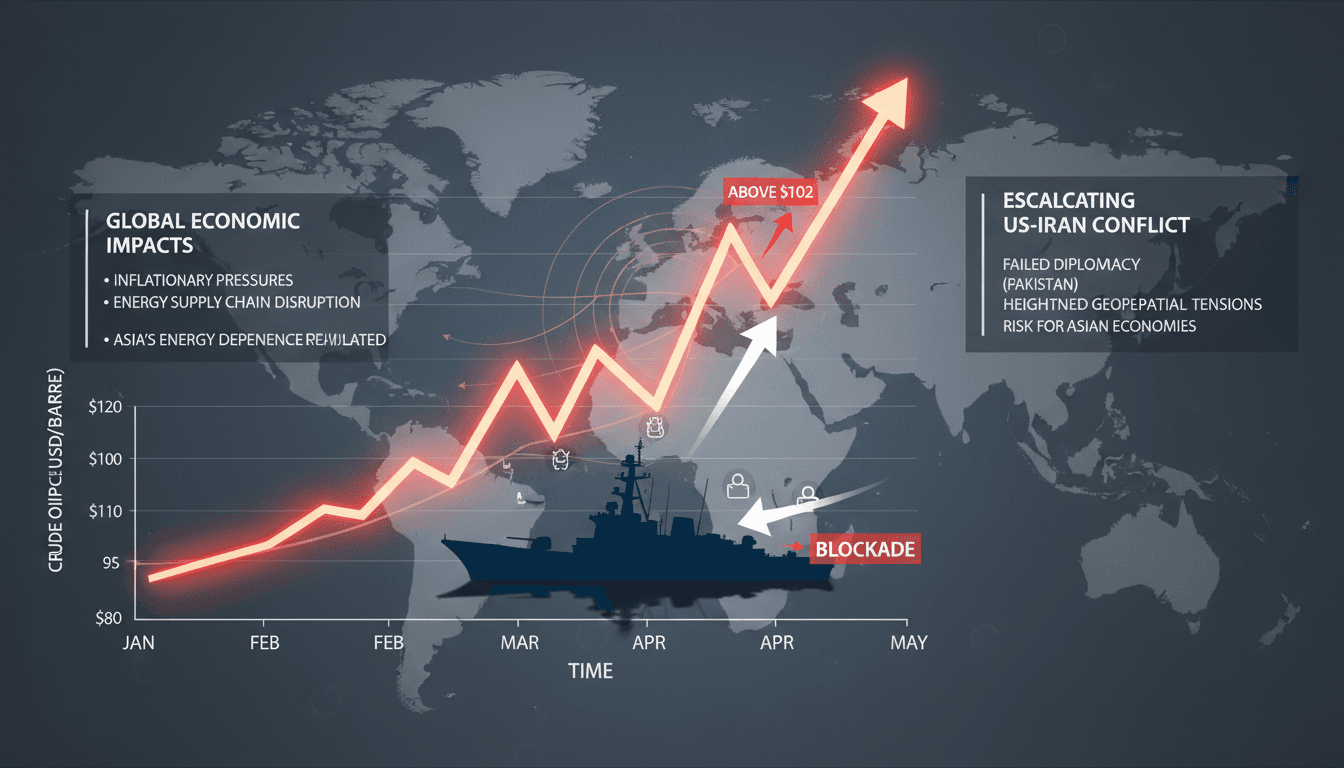
Here's what it means for you.
Rising oil prices could significantly impact your living expenses and business costs globally.
Why it matters
The ongoing US-Iran conflict is poised to disrupt global oil supply, affecting economies and consumers worldwide.
What happened (in 30 seconds)
- US President Donald Trump announced a naval blockade on Iranian ports on April 13, 2026, following failed negotiations.
- Oil prices surged, with Brent crude exceeding $102 per barrel and West Texas Intermediate hitting $104.98.
- Bloomberg Economics outlined three scenarios for oil prices, projecting a range from $85 to $170 per barrel based on conflict intensity.
The context you actually need
- The Strait of Hormuz is critical, with over 80% of Asia's energy transiting through this narrow waterway, making regional economies particularly vulnerable.
- The blockade targets Iranian-linked vessels, including those from China, escalating tensions and uncertainty in global markets.
- Asian economies, heavily reliant on oil imports, are likely to face inflationary pressures and slowed growth, impacting consumer spending and business operations.
What's really happening
The geopolitical landscape surrounding the US-Iran conflict has intensified since late February 2026, with significant disruptions in the Strait of Hormuz occurring by March. The US naval blockade, effective April 13, 2026, was a direct response to failed diplomatic efforts in Pakistan, where attempts to de-escalate tensions proved fruitless. This blockade is not just a military maneuver; it is a strategic economic decision aimed at crippling Iran's oil exports, which are vital for its economy and regional influence.
As a result of the blockade, oil prices have surged, with Brent crude rising 7.3% to over $102 per barrel and West Texas Intermediate climbing 8.71% to $104.98. The immediate impact is felt across global markets, particularly in Europe and Asia, where energy costs are directly linked to oil prices. Bloomberg Economics has projected three scenarios based on the conflict's intensity: a base low-intensity conflict scenario with oil averaging $105 per barrel, a severe escalation scenario that could push prices to $170 per barrel, and a potential ceasefire scenario that might normalize prices around $85.
The implications of these scenarios are profound. A prolonged conflict could lead to significant inflationary pressures, particularly in Asian economies that rely on the Strait of Hormuz for over 80% of their energy imports. Countries like Japan, South Korea, and China are already facing economic strain, with limited alternatives to secure energy supplies. The potential for inflation to rise to 5.4% under the escalation scenario could further dampen consumer spending and economic growth, leading to a ripple effect across global markets.
Moreover, the UAE, while not heavily reliant on oil exports, has already seen its markets lose approximately $120 billion in value due to war disruptions in aviation, property, and regional trade. As a non-oil-dependent hub, Dubai faces unique challenges, including rising living costs and supply chain interruptions that could exacerbate inflation.
Who feels it first (and how)
- Consumers in Asia: Higher fuel and energy costs directly impact household budgets.
- Businesses in the aviation and trade sectors: Increased operational costs due to rising oil prices and potential supply chain disruptions.
- Investors in global markets: Volatility in oil prices can lead to significant shifts in investment strategies and asset valuations.
What to watch next
- Oil price fluctuations: Keep an eye on Brent and WTI prices; significant increases could signal deeper economic issues.
- Asian economic indicators: Watch for changes in GDP growth rates and inflation figures, particularly in Japan and South Korea.
- Diplomatic efforts: Monitor any developments in US-Iran negotiations that could lead to a ceasefire or further escalation.
Oil prices have surged following the blockade, impacting global markets.
Asian economies will experience inflation and slowed growth due to rising energy costs.
The most probable path of conflict escalation or resolution remains uncertain.
Frequently Asked Questions
- Why it matters?
- The ongoing US-Iran conflict is poised to disrupt global oil supply, affecting economies and consumers worldwide.
- What happened (in 30 seconds)?
- US President Donald Trump announced a naval blockade on Iranian ports on April 13, 2026, following failed negotiations. Oil prices surged, with Brent crude exceeding $102 per barrel and West Texas Intermediate hitting $104.98. Bloomberg Economics outlined three scenarios for oil prices, projecting a range from $85 to $170 per barrel based on conflict intensity.
- What's really happening?
- The geopolitical landscape surrounding the US-Iran conflict has intensified since late February 2026, with significant disruptions in the Strait of Hormuz occurring by March. The US naval blockade, effective April 13, 2026, was a direct response to failed diplomatic efforts in Pakistan, where attempts to de-escalate tensions proved fruitless. This blockade is not just a military maneuver; it is a strategic economic decision aimed at crippling Iran's oil exports, which are vital for its economy a
- Who feels it first (and how)?
- Consumers in Asia: Higher fuel and energy costs directly impact household budgets. Businesses in the aviation and trade sectors: Increased operational costs due to rising oil prices and potential supply chain disruptions. Investors in global markets: Volatility in oil prices can lead to significant shifts in investment strategies and asset valuations.
- What to watch next?
- Oil price fluctuations: Keep an eye on Brent and WTI prices; significant increases could signal deeper economic issues. Asian economic indicators: Watch for changes in GDP growth rates and inflation figures, particularly in Japan and South Korea. Diplomatic efforts: Monitor any developments in US-Iran negotiations that could lead to a ceasefire or further escalation.
Arabic-language UAE newspaper coverage focused on domestic affairs, public institutions, business, society, and regional developments.
"Al Khaleej coverage generally reflects a mainstream UAE editorial lens with strong attention to public affairs, institutions, and regional developments."
— A47 Editor
أسواق النفط.. 3 سيناريوهات للحرب والاقتصاد العالمي
The decision by U.S. President Donald Trump to impose a blockade on Iranian ports, potentially extending to a stricter blockade of the Strait of Hormuz, threatens to exacerbate the already worsening economic crisis faced by energy-dependent Asian eco...
Arabic-language coverage of political affairs and current events.
"Okaz political coverage typically follows mainstream Saudi framing on national and regional affairs."
— A47 Editor
توقف الملاحة في مضيق هرمز بعد إعلان الحصار البحري على إيران
Navigation in the Strait of Hormuz has halted following Washington's announcement of maritime sanctions against Iran. This suspension of shipping activity occurred immediately after U.S. President Donald Trump declared the implementation of a maritim...