
Saudi Arabia's Non-Oil Exports to GCC Surge by 28.9% in February 2026
Here's what it means for you.
If you rely on goods from the Gulf region, expect more stable supply chains and potentially lower prices.
Why it matters
This surge in non-oil exports signals a strategic shift in regional trade dynamics, impacting supply chains across the GCC.
What happened (in 30 seconds)
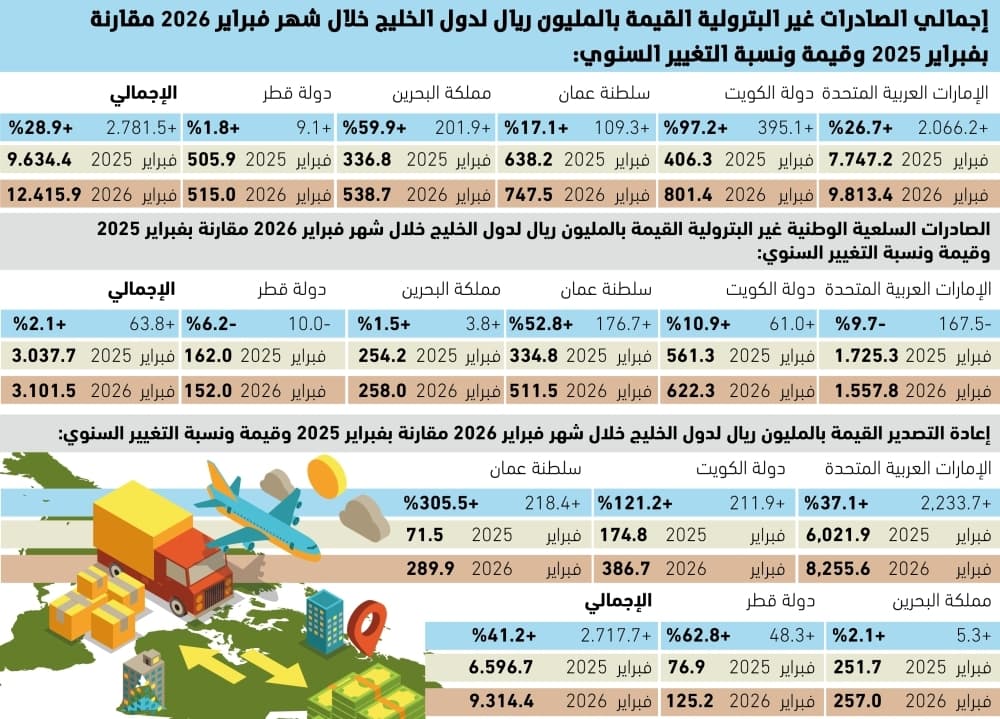
- Saudi Arabia's non-oil exports to GCC countries rose 28.9% in February 2026 compared to the previous year, totaling 12,415.9 million SAR.
- Re-exports led the growth, increasing by 41.2% to 9,314.4 million SAR, while national exports saw a modest rise of 2.1%.
- The UAE was the largest recipient, receiving 9,813.4 million SAR, reflecting a 26.7% increase in trade.
The context you actually need
- Vision 2030 alignment: Saudi Arabia's push for non-oil export diversification is part of its broader Vision 2030 strategy to reduce oil dependency.
- Geopolitical factors: The ongoing American-Iranian war has positioned Saudi Arabia as a secure logistics hub, enhancing its attractiveness for regional trade.
- Infrastructure investments: Significant upgrades to ports and logistics infrastructure, such as King Abdullah Port and Jeddah Islamic Port, have facilitated this export growth.
What's really happening
In February 2026, Saudi Arabia's non-oil exports to GCC countries reached 12,415.9 million SAR, marking a substantial 28.9% increase from the previous year. This growth is primarily driven by re-exports, which surged by 41.2% to 9,314.4 million SAR, while national exports saw a modest increase of 2.1% to 3,101.5 million SAR. The UAE emerged as the largest recipient of these exports, receiving 9,813.4 million SAR, a 26.7% increase, followed by Kuwait, Oman, Bahrain, and Qatar.
This export boom is not merely a statistical anomaly; it reflects a strategic pivot in Saudi Arabia's economic landscape. The Kingdom's Vision 2030 initiative aims to diversify its economy away from oil dependency, and the recent growth in non-oil exports is a clear indicator of progress in this direction. The geopolitical backdrop, particularly the tensions stemming from the American-Iranian war, has further catalyzed this shift. As alternative trade routes become less viable due to conflict, Saudi Arabia has positioned itself as a reliable transshipment corridor for GCC trade, enhancing its role as a regional logistics hub.
Investments in logistics infrastructure have played a crucial role in this transformation. Ports like King Abdullah Port and Jeddah Islamic Port have undergone significant upgrades, allowing for increased capacity and efficiency in handling exports. This infrastructure development not only supports the current surge in exports but also lays the groundwork for sustained growth in the future.
The implications of this trade growth extend beyond mere numbers. For businesses and consumers in the GCC, particularly in the UAE, this means greater access to a variety of goods and potentially lower prices due to improved supply chain stability. As Saudi Arabia continues to enhance its logistics capabilities, the ripple effects will likely be felt across various sectors, from retail to manufacturing.
Who feels it first (and how)
- Importers in the UAE: They will benefit from increased availability of goods and potentially lower costs.
- Logistics companies: Enhanced trade routes will create new opportunities for logistics and transport firms.
- Manufacturers in Saudi Arabia: They may see increased demand for their products as exports rise.
What to watch next
- Infrastructure developments: Monitor ongoing investments in Saudi ports and logistics facilities, as these will influence future export capabilities.
- Geopolitical stability: Changes in the American-Iranian conflict could impact trade routes and logistics strategies in the region.
- Trade agreements: Watch for new trade agreements within the GCC that could further enhance Saudi Arabia's export potential.
Saudi Arabia's non-oil exports to GCC countries increased by 28.9% in February 2026.
Continued growth in non-oil exports as Saudi Arabia enhances its logistics infrastructure and navigates geopolitical tensions.
The long-term impact of geopolitical developments on trade routes and regional economic stability.
Insights by A47 Intelligence
Saudi newspaper coverage spanning local, national, and public-interest stories.
"Makkah Newspaper generally reflects mainstream Saudi editorial priorities with an emphasis on domestic issues."
— A47 Editor
«الصادرات السعودية غير النفطية».. أرقام صاروخية
The Saudi economy is undergoing a significant transformation, with non-oil exports reaching impressive figures, marking a tangible success story in the country's economic diversification efforts. This shift reflects a broader strategy to reduce relia...
Pan-Arab news coverage spanning politics, business, sports, and regional affairs.
"Asharq Al-Awsat reflects a broad Arab editorial perspective with strong attention to regional geopolitics."
— A47 Editor
محللون: «رؤية 2030» تمضي في مسار تشكيل اقتصاد السعودية بتسارع التنويع
Saudi Arabia has successfully transformed its economic base in recent years, shifting from a model heavily reliant on oil to a more diversified and sustainable economy. This transition aligns with the goals outlined in the Vision 2030 initiative, whi...
Pan-Arab news coverage spanning politics, business, sports, and regional affairs.
"Asharq Al-Awsat reflects a broad Arab editorial perspective with strong attention to regional geopolitics."
— A47 Editor
«رؤية 2030»: حكاية التحول من الإدارة التقليدية إلى الريادة الرقمية العالمية
Saudi Arabia has embarked on a digital transformation journey and knowledge-based economy, leveraging advanced digital infrastructure and a foundation of accumulated knowledge developed over many years, enhancing its competitive capabilities.
Culture, society, and public-interest stories for Arabic-speaking readers.
"This Al Watan feed appears section-specific, and the label is kept broad enough to avoid overclaiming the exact mapping."
— A47 Editor
28.9% نمو بصادرات المملكة لدول الخليج
Saudi non-oil exports to Gulf countries saw a significant increase in February 2026, rising by 2.78 billion Riyals from 9.63 billion Riyals in February 2025 to 12.41 billion Riyals, marking a 28.9% annual growth, as reported by Al Watan based on the ...
Sports reporting with a focus on Saudi and regional competitions.
"Okaz sports coverage is broad and audience-friendly, with strong attention to Saudi teams and leagues."
— A47 Editor
«غير النفطي السعودي» يتجاوز 50%.. الصادرات تخطت 363 مليار ريال
The annual report for Saudi Vision 2030 in 2025 highlights that non-oil sectors now account for over 50% of the Saudi economy, with non-oil exports exceeding 363 billion riyals, marking a significant growth from 178 billion riyals in 2016. This refle...
Sports reporting with a focus on Saudi and regional competitions.
"Okaz sports coverage is broad and audience-friendly, with strong attention to Saudi teams and leagues."
— A47 Editor
«فوربس»: الاقتصاد السعودي يتجاوز النفط.. 1.3 تريليون دولار ونمو يقوده التنويع
Forbes reported that the Saudi economy is no longer solely dependent on oil, projecting a strong growth of 4.5% in 2025, with the GDP reaching approximately $1.3 trillion, driven by non-oil activities despite OPEC+ production constraints.