
Artemis II Crew Sets New Record for Human Distance from Earth During Lunar Flyby
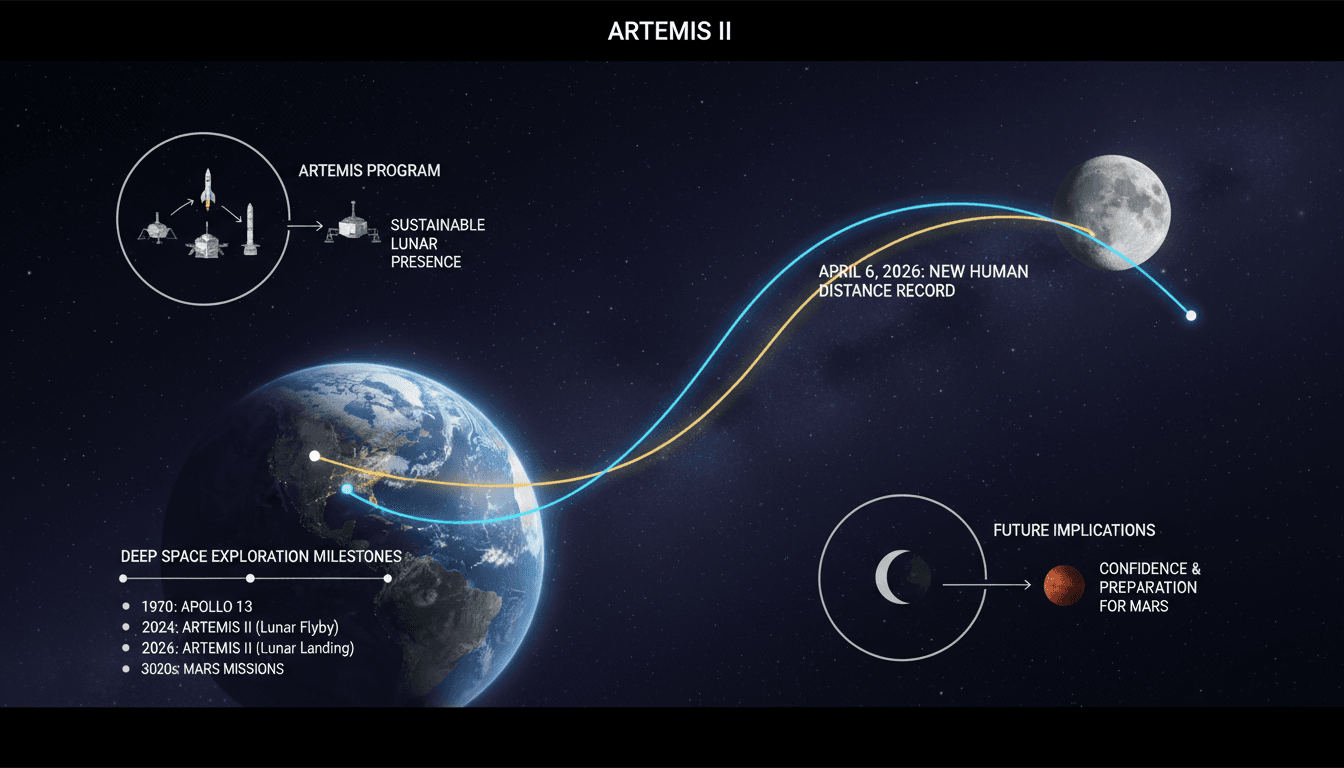
Here's what it means for you.
As humanity pushes the boundaries of space exploration, industries tied to technology, research, and investment in lunar initiatives stand to gain significantly.
Why it matters
This milestone reinforces the viability of deep-space missions, potentially unlocking new economic opportunities in space-related sectors.
What happened (in 30 seconds)
- On April 6, 2026, the Artemis II crew surpassed the Apollo 13 record for the farthest distance traveled by humans from Earth, reaching approximately 252,757 miles (406,773 km).
- The crew, consisting of Reid Wiseman, Victor Glover, Christina Koch, and Jeremy Hansen, conducted a lunar flyby while performing geological observations and capturing images of the Moon's surface.
- NASA's Artemis program aims to establish a sustainable human presence on the Moon, with Artemis II serving as a crucial step towards future lunar landings.
The context you actually need
- Artemis II is the first crewed flight of NASA's Space Launch System (SLS) rocket and Orion spacecraft, following the uncrewed Artemis I mission in 2022.
- The mission tests essential systems for deep-space travel, including life support, navigation, and communication, preparing for Artemis III's planned lunar landing.
- Dubai's involvement in the Artemis Accords and local media coverage reflects the UAE's commitment to lunar exploration and its growing role in global space initiatives.
What's really happening
The Artemis II mission, launched from Kennedy Space Center on April 1, 2026, marks a significant advancement in human spaceflight. The crew's achievement of surpassing the Apollo 13 distance record is not just a matter of pride; it validates NASA's technological capabilities and strategic vision for sustained lunar exploration.
As the first crewed mission of the Artemis program, Artemis II serves multiple purposes. It tests critical systems necessary for deep-space missions, including life support, navigation, and communication. The successful execution of these tests is essential for future missions, particularly Artemis III, which aims to land astronauts on the Moon. This mission is pivotal as it lays the groundwork for a sustainable human presence on the Moon, which is a key objective of NASA's broader space exploration strategy.
The implications of this milestone extend beyond NASA. The Artemis program is designed to foster international collaboration and stimulate economic growth in the space sector. As private companies increasingly engage in lunar exploration and related technologies, the potential for a new lunar economy emerges. This includes opportunities in mining, research, and tourism, which could reshape industries on Earth.
Moreover, the excitement surrounding Artemis II has already influenced market dynamics. Stocks in space-related companies have seen an uptick as investors express confidence in the future of lunar exploration. The mission's success not only enhances NASA's reputation but also boosts the credibility of private sector players involved in space technologies.
In the context of global space exploration, the Artemis II mission is a clear signal that humanity is ready to venture further into the cosmos. The advancements made during this mission will inform future endeavors, including potential manned missions to Mars and beyond. As nations and private entities invest in space capabilities, the race for lunar and interplanetary exploration is set to accelerate, leading to innovations that could benefit various sectors on Earth.
Who feels it first (and how)
- Aerospace engineers: Increased demand for advanced technologies and systems for deep-space missions.
- Investors: Heightened interest in space-related stocks and ventures, anticipating growth in the lunar economy.
- Research institutions: Opportunities for collaboration on lunar studies and experiments, enhancing scientific knowledge.
- Local media: Increased coverage of space events, reflecting public interest and national pride in space exploration initiatives.
What to watch next
- Upcoming Artemis missions: Monitor the progress of Artemis III and subsequent missions, as they will further define the future of lunar exploration.
- Private sector involvement: Watch for announcements from companies planning lunar missions, which could signal new investment opportunities and partnerships.
- Technological advancements: Keep an eye on innovations emerging from the Artemis program that may have applications in other industries, such as telecommunications and materials science.
Artemis II has set a new record for human distance from Earth during a lunar flyby.
Increased investment and interest in the lunar economy will emerge as a result of this mission.
The long-term impact of Artemis II on international collaboration in space exploration remains to be seen.
Frequently Asked Questions
- Why it matters?
- This milestone reinforces the viability of deep-space missions, potentially unlocking new economic opportunities in space-related sectors.
- What happened (in 30 seconds)?
- On April 6, 2026, the Artemis II crew surpassed the Apollo 13 record for the farthest distance traveled by humans from Earth, reaching approximately 252,757 miles (406,773 km). The crew, consisting of Reid Wiseman, Victor Glover, Christina Koch, and Jeremy Hansen, conducted a lunar flyby while performing geological observations and capturing images of the Moon's surface. NASA's Artemis program aims to establish a sustainable human presence on the Moon, with Artemis II serving as a crucial st
- What's really happening?
- The Artemis II mission, launched from Kennedy Space Center on April 1, 2026, marks a significant advancement in human spaceflight. The crew's achievement of surpassing the Apollo 13 distance record is not just a matter of pride; it validates NASA's technological capabilities and strategic vision for sustained lunar exploration. As the first crewed mission of the Artemis program, Artemis II serves multiple purposes. It tests critical systems necessary for deep-space missions, including life sup
- Who feels it first (and how)?
- Aerospace engineers: Increased demand for advanced technologies and systems for deep-space missions. Investors: Heightened interest in space-related stocks and ventures, anticipating growth in the lunar economy. Research institutions: Opportunities for collaboration on lunar studies and experiments, enhancing scientific knowledge. Local media: Increased coverage of space events, reflecting public interest and national pride in space exploration initiatives.
- What to watch next?
- Upcoming Artemis missions: Monitor the progress of Artemis III and subsequent missions, as they will further define the future of lunar exploration. Private sector involvement: Watch for announcements from companies planning lunar missions, which could signal new investment opportunities and partnerships. Technological advancements: Keep an eye on innovations emerging from the Artemis program that may have applications in other industries, such as telecommunications and materials science.
Arabic-language UAE newspaper coverage focused on domestic affairs, public institutions, business, society, and regional developments.
"Al Khaleej coverage generally reflects a mainstream UAE editorial lens with strong attention to public affairs, institutions, and regional developments."
— A47 Editor
رواد «أرتيميس 2» خلف القمر.. رقم قياسي جديد لأبعد مسافة للبشر في الفضاء
The four astronauts of the Artemis 2 mission have surpassed the previous record for the farthest distance traveled by humans in space, achieving a new milestone as they explore uncharted areas of the Moon. This historic journey marks the first crewed...
Pan-Arab political news and analysis.
"Al-Quds Al-Arabi is a London-based Arabic newspaper known for political coverage."
— A47 Editor
رواد “أرتيميس” يحطمون الرقم القياسي لأبعد مسافة يجتازها البشر في الفضاء
Four astronauts from the Artemis 2 mission have surpassed the record for the farthest distance traveled by humans in space, previously set by Apollo 13 in 1970, by reaching over 400,171 kilometers from Earth. They are now preparing to spend hours fly...
Arabic-language digital news outlet covering UAE, regional, and international developments with broad general-news coverage.
"Al Ain News coverage typically blends UAE-focused reporting with wider Arab regional and international news."
— A47 Editor
مهمة «أرتيميس 2» تكسر الرقم القياسي لأبعد رحلة بشرية إلى القمر
The Artemis 2 mission is set to achieve a historic milestone by surpassing the previous record for the farthest distance traveled by humans in space since 1972, previously held by the Apollo 13 crew. This mission marks the first crewed lunar mission ...
Pan-Arab news coverage spanning politics, business, sports, and regional affairs.
"Asharq Al-Awsat reflects a broad Arab editorial perspective with strong attention to regional geopolitics."
— A47 Editor
رواد «أرتيميس 2» يحطمون الرقم القياسي لأبعد مسافة يقطعها بشر في الفضاء
The four astronauts of the Artemis 2 mission have successfully surpassed the previous record for the farthest distance traveled by humans in space, reaching a point beyond what the Apollo crew achieved in 1970. This historic milestone allows them to ...
Arabic-language digital news outlet covering UAE, regional, and international developments with broad general-news coverage.
"Al Ain News coverage typically blends UAE-focused reporting with wider Arab regional and international news."
— A47 Editor
مهمة «أرتميس 2» تقترب من الوصول إلى أبعد مسافة عن الأرض
The Artemis 2 mission, led by NASA, has successfully entered the Moon's gravitational field as of early Monday, marking a significant milestone in its journey. This mission features four astronauts who are set to conduct a series of tests and observa...
Arabic-language coverage of international news and geopolitics.
"RT Arabic is a Russian state-funded outlet often criticized for promoting Kremlin-aligned narratives."
— A47 Editor
أبعد البشر عن الأرض منذ 56 عاما.. مهمة "أرتميس 2" ترصد الجانب المجهول للقمر
The Artemis 2 mission, which is set to reach the far side of the Moon, marks a historic moment as astronauts will become the farthest humans from Earth in 56 years. This mission is significant as it represents the first crewed lunar expedition since ...