
Monetary Authority of Singapore Tightens Monetary Policy in Response to Middle East Energy Crisis
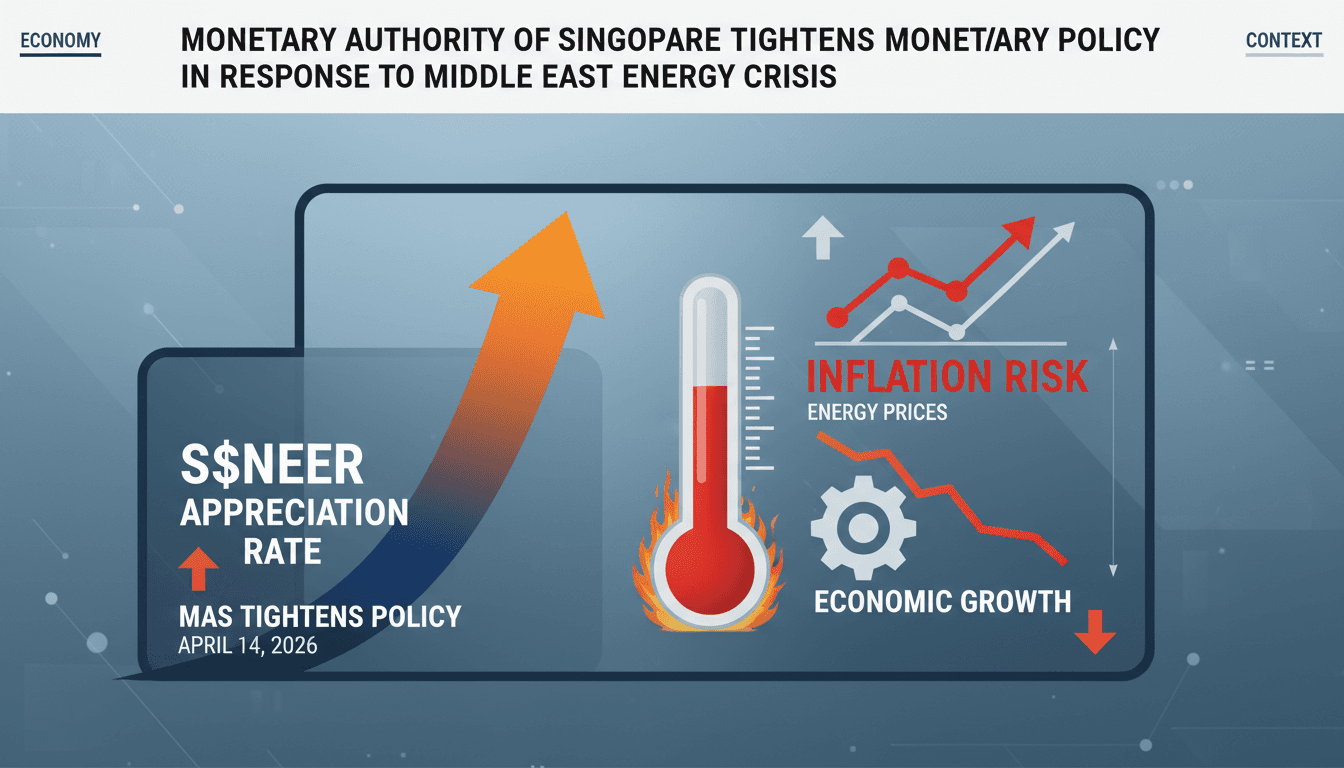
Here's what it means for you.
Rising inflation in Singapore could impact your cost of living and business expenses.
What happened
On April 14, 2026, the Monetary Authority of Singapore (MAS) tightened monetary policy by increasing the S$NEER appreciation rate.
The Context
- Inflation Risks: The MAS raised its 2026 inflation forecasts to 1.5–2.5% due to energy price fluctuations from Middle East conflicts.
- Economic Growth: Singapore's Q1 2026 GDP grew 4.6% year-on-year but contracted 0.3% quarter-on-quarter, indicating economic moderation.
- Policy Mechanism: MAS manages monetary policy through the S$NEER rather than interest rates, aiming to stabilize inflation expectations.
The Number
— This revised inflation forecast range signals potential increases in consumer prices, affecting purchasing power and business costs.
Takeaway
If inflation persists, further tightening of monetary policy could occur, impacting economic conditions in Singapore and beyond.
Arabic-language political and world news coverage for UAE readers.
"Emarat Al Youm world coverage usually presents international developments through a UAE and Arab audience lens."
— A47 Editor
سنغافورة تشدد سياستها النقدية سنغافورة تشدد سياستها النقدية
The Monetary Authority of Singapore has tightened its monetary policy and raised its inflation forecasts, responding to the volatility caused by the ongoing conflict in the Middle East. This decision reflects concerns over economic stability and infl...
Social/economic commentary and analysis relevant to business and markets.
"WSJ blends data-driven economic insight with commentary on policy and society."
— A47 Editor
Singapore Central Bank Tightens Policy as It Braces for Slower Growth, Higher Prices
Singapore's central bank has tightened its monetary policy for the first time in over three years, responding to economic challenges posed by the ongoing conflict in the Middle East, which is expected to lead to slower growth and higher prices.
Macro commentary, policy analysis, growth/inflation themes, and global outlooks.
"Contextual macro coverage that complements day-to-day market headlines."
— A47 Editor
Singapore tightens monetary policy as Iran war fuels inflation risks
Singapore's central bank has tightened its monetary policy for the first time in over three years, responding to inflation risks exacerbated by the ongoing conflict in Iran, which has driven up energy prices and import costs.
Editor-curated FT homepage stories spanning markets, business, world, and opinion.
"The Financial Times is a globally respected business publication with a centrist/center-left tone and strong markets focus."
— A47 Editor
Singapore tightens monetary policy as energy shock hits Asia
Singapore has tightened its monetary policy in response to rising energy prices and inflationary pressures, driven by the ongoing conflict in the Middle East, particularly in Iran. This marks a significant shift for the trade-dependent nation, which ...