
UK Budget Cost-of-Living Package Rated Poorly Targeted as Winter Energy Bills Exceed 2022-23 Shock Levels
Why it matters
The policy mechanics demonstrate the limits of broad-based fiscal interventions: when relief mechanisms rely on municipal property bands rather than adjusted income metrics, capital is reallocated from institutional balance sheets without neutralizing structural price shocks for vulnerable consumers.
What happened (in 30 seconds)
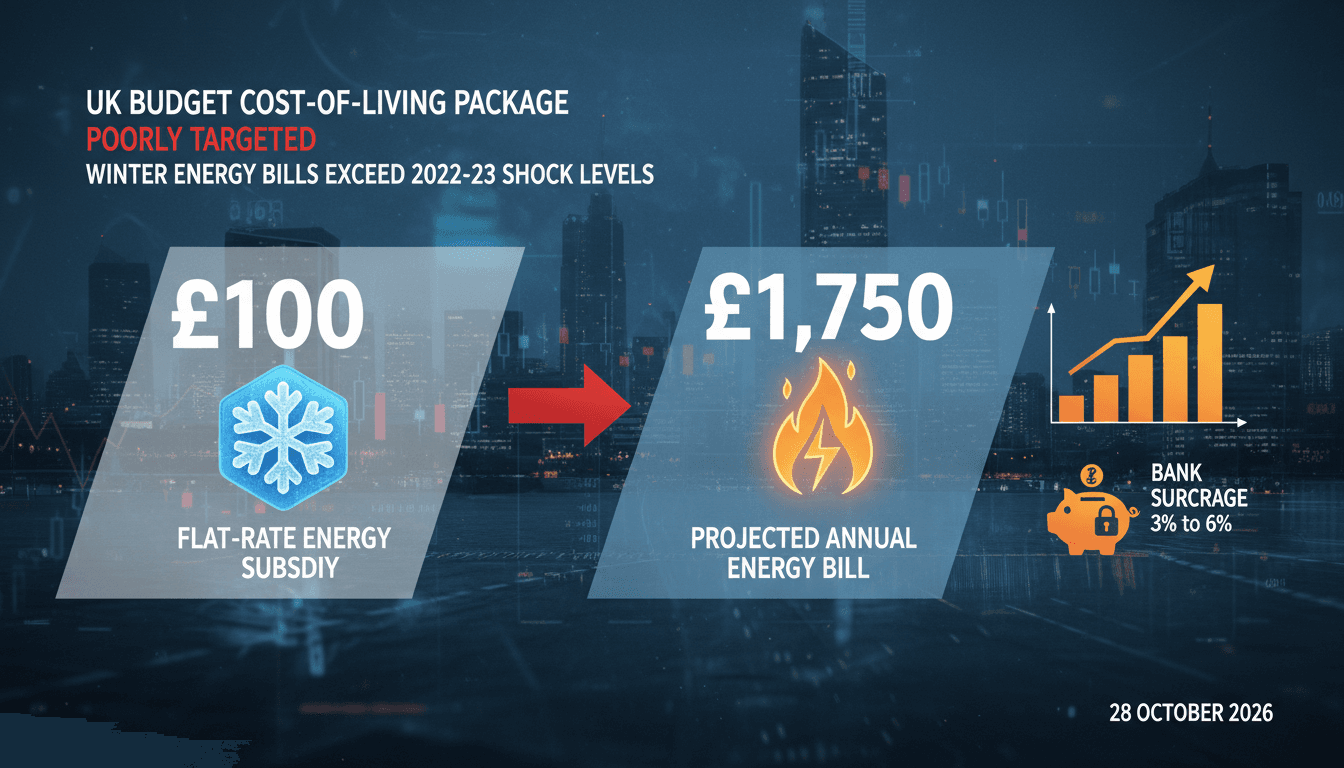
- A £4.4 billion package was enacted: Chancellor of the Exchequer John Healey introduced a support measure on 28 October 2026, delivering a £100 winter energy payment to roughly 20 million households occupying council tax bands A through D.
- The funding relies on corporate and wealth levies: The intervention is financed by doubling the bank corporation tax surcharge from 3% to 6%, alongside targeted tax increases applied to landlords and savers.
- Independent analysts challenged the distribution: On 29 October 2026, the Resolution Foundation stated the relief is poorly targeted, as the bottom 50% of income earners receive on average only £14 more than the top 50%.
The context you actually need
- Net energy costs remain elevated above baseline shocks: Typical household energy bills net of government assistance are projected at £1,750 for 2026–27, surpassing the £1,685 real-terms benchmark recorded during the 2022–23 price spike.
- Upstream volatility continues to drive domestic pressure: Middle East conflicts continue to exert upward pressure on wholesale energy inputs, creating persistent domestic retail inflation that offsets flat-rate subsidies.
- Corporate financial performance remains divergent: As the Treasury doubled the banking surcharge, Lloyds Banking Group reported doubled profits, while Shell announced record quarterly earnings tied to wholesale commodity margins.
What's really happening
The underlying issue is structural: the UK Treasury selected council tax valuation bands as a proxy for household need. This mechanism sacrifices targeted efficiency for operational speed. Because property bands A through D encompass nearly 20 million residences across the wealth distribution, the £100 relief mechanism functions as a quasi-universal subsidy. Consequently, the bottom half of the household income distribution captures an average net advantage of just £14 over the top half.
For the macro-level operator, the mechanics reveal an asymmetric transmission of fiscal resources. A total of £4.4 billion is transferred from institutional balance sheets into consumer checking accounts. Yet, because the capital is dispersed thinly across 20 million nodes, it yields a negligible cushioning effect against the macro cost curve. With net household energy expenses forecast at £1,750 for 2026–27—higher in real terms than the £1,685 seen during the 2022–23 energy price shock—the £100 allocation absorbs less than 6% of the typical household's total annual energy liability.
The funding model establishes structural precedents for corporate capital planning. Doubling the banking sector surcharge to 6% signals that fiscal consolidation strategies are shifting toward targeted sectoral levies during consumer-side pressure events. Institutional lenders must now account for increased tax burdens even during cycles of strong performance, as demonstrated by Lloyds Banking Group doubling its profits under the updated tax schedule. The CFO of Lloyds explicitly noted institutional hopes that the 6% rate remains temporary, reflecting corporate vulnerability to recurrent windfall adjustments.
At the same time, upstream commodity producers like Shell continue to post record quarterly figures due to global commodity dynamics driven by Middle East disruptions. Because the fiscal measure targets domestic bank margins, landlords, and savings income rather than neutralizing the external drivers of import prices, it fails to alter the underlying inflation path. The result is a cycle where balance-sheet surcharges fail to lower net consumer utility costs, maintaining downward pressure on four-year living standards while elevating the cost of capital across the domestic financial system.
Who feels it first (and how)
- Low-income households in council tax bands A–D: Receive an average of £14 more in net relief than top-half earners, leaving them fully exposed to a £1,750 real-terms net energy bill.
- UK domestic banking institutions: Face an immediate 100% increase in their sectoral surcharge (moving from 3% to 6%), reducing retained earnings available for regulatory capital buffers.
- Private residential landlords and high-balance savers: Absorb higher baseline rates on rental yields and asset returns, reducing aggregate margins across leveraged real estate portfolios.
- Energy-intensive consumer industries: Face suppressed non-discretionary retail spending as household budgets absorb energy charges that remain above historical price-shock levels.
What to watch next
- Bank surcharge duration signals: Watch for Treasury commentary regarding whether the 6% banking surcharge will sunset or become a structural fixture of fiscal policy.
- Household consumption metrics: Track UK discretionary consumer spending entering Q1 2027 to see if the projected £1,750 energy bills trigger private demand contractions.
- Upstream commodity spreads: Monitor wholesale energy input volatility driven by Middle East events to evaluate if real-terms household utility costs breach the £1,750 forecast.
The government committed £4.4 billion to provide £100 energy handouts to 20 million households in council tax bands A–D, funded by a 6% bank surcharge and higher taxes on landlords and savers.
The marginal £14 difference between rich and poor households will leave lower-income groups dependent on additional departmental spending allocations to offset standard-of-living declines.
Whether institutional lenders will reprice consumer credit and mortgage lines to recover balance-sheet capacity lost to the doubled surcharge.
Frequently Asked Questions
- Why it matters?
- The policy mechanics demonstrate the limits of broad-based fiscal interventions: when relief mechanisms rely on municipal property bands rather than adjusted income metrics, capital is reallocated from institutional balance sheets without neutralizing structural price shocks for vulnerable consumers.
- What happened (in 30 seconds)?
- A £4.4 billion package was enacted: Chancellor of the Exchequer John Healey introduced a support measure on 28 October 2026, delivering a £100 winter energy payment to roughly 20 million households occupying council tax bands A through D. The funding relies on corporate and wealth levies: The intervention is financed by doubling the bank corporation tax surcharge from 3% to 6%, alongside targeted tax increases applied to landlords and savers. Independent analysts challenged the distribution: On
- What's really happening?
- The underlying issue is structural: the UK Treasury selected council tax valuation bands as a proxy for household need. This mechanism sacrifices targeted efficiency for operational speed. Because property bands A through D encompass nearly 20 million residences across the wealth distribution, the £100 relief mechanism functions as a quasi-universal subsidy. Consequently, the bottom half of the household income distribution captures an average net advantage of just £14 over the top half. For th
- Who feels it first (and how)?
- Low-income households in council tax bands A–D: Receive an average of £14 more in net relief than top-half earners, leaving them fully exposed to a £1,750 real-terms net energy bill. UK domestic banking institutions: Face an immediate 100% increase in their sectoral surcharge (moving from 3% to 6%), reducing retained earnings available for regulatory capital buffers. Private residential landlords and high-balance savers: Absorb higher baseline rates on rental yields and asset returns, reducing a
- What to watch next?
- Bank surcharge duration signals: Watch for Treasury commentary regarding whether the 6% banking surcharge will sunset or become a structural fixture of fiscal policy. Household consumption metrics: Track UK discretionary consumer spending entering Q1 2027 to see if the projected £1,750 energy bills trigger private demand contractions. Upstream commodity spreads: Monitor wholesale energy input volatility driven by Middle East events to evaluate if real-terms household utility costs breach the £1,
UK and international business news, economics, and corporate coverage.
"The Guardian’s business section covers finance and markets with a progressive editorial tone."
— A47 Editor
Healey’s £4.4bn cost living support package ‘badly targeted,’ says Resolution Foundation – business live
The Resolution Foundation has described the £4.4bn cost of living support package delivered in Chancellor John Healey's first Budget on Wednesday as "badly targeted", warning that even families receiving help face higher energy bills than during the ...
International coverage from The Guardian's global desks.
"The Guardian is known for its progressive editorial stance and in-depth analysis."
— A47 Editor
‘I earn £126,000 – but nothing’s left at the end of the month’: readers react to the budget
The Guardian gathered reactions from readers to the UK's first Budget under Chancellor John Healey, with a London chef, Louie, 24, saying many people in their 20s have "written off the idea of even considering getting a property". One reader earning ...
UK and international business news, economics, and corporate coverage.
"The Guardian’s business section covers finance and markets with a progressive editorial tone."
— A47 Editor
‘I earn £126,000 – but nothing’s left at the end of the month’: readers react to the budget
The Guardian gathered reactions from readers to the UK's first Budget under Chancellor John Healey, with a London chef, Louie, 24, saying many people in their 20s have "written off the idea of even considering getting a property". One reader earning ...
Global markets, investing, and macroeconomics from a premier financial newsroom.
"Bloomberg is respected for in-depth financial reporting and data-driven analysis."
— A47 Editor
UK Budget Is Bond-Friendly But Healey Warns of Hard Decisions Ahead
Chancellor John Healey delivered his first UK Budget on 28 October 2026, setting out household support including a £100 energy payment funded by a bank windfall tax, while Bloomberg reported that the package was viewed as bond-friendly but Healey war...
Global markets, investing, and macroeconomics from a premier financial newsroom.
"Bloomberg is respected for in-depth financial reporting and data-driven analysis."
— A47 Editor
Healey Defends UK Budget, Warns 'Tough Decisions' Ahead
Chancellor of the Exchequer John Healey defended his first UK budget against criticism that it lacked ambition, warning that the country would face "tough decisions" on spending priorities in the years ahead. Speaking to Bloomberg's Caroline Hepker, ...
United Kingdom-focused news including local politics, business, and social issues.
"BBC News is widely regarded as a reputable international news organization, known for its impartial tone and public service mandate."
— A47 Editor
The Papers: 'Healey offers cold comfort' and 'A £100 trick or treat?'
John Healey delivered his first Budget as Chancellor, centred on cost-of-living support, most notably a £100 payment towards energy bills for around 20 million households in council tax bands A to D in England, funded by a bank tax, as reported acros...
UK and international business news, economics, and corporate coverage.
"The Guardian’s business section covers finance and markets with a progressive editorial tone."
— A47 Editor
How will John Healey’s energy support package affect you?
Chancellor John Healey unveiled his first Budget, a support package for households hit by what he called "global economic storms", including a £100 one-off energy payment for around 20 million households in council tax bands A to D in England, low-ca...
International coverage from The Guardian's global desks.
"The Guardian is known for its progressive editorial stance and in-depth analysis."
— A47 Editor
How will John Healey’s energy support package affect you?
Chancellor John Healey unveiled his first Budget, a support package for households hit by what he called "global economic storms", including a £100 one-off energy payment for around 20 million households in council tax bands A to D in England, low-ca...