
Zelenskyy Conditions Any US-Brokered Russia-Europe Security Framework on Prior Ukraine Settlement and Sovereignty Guarantees
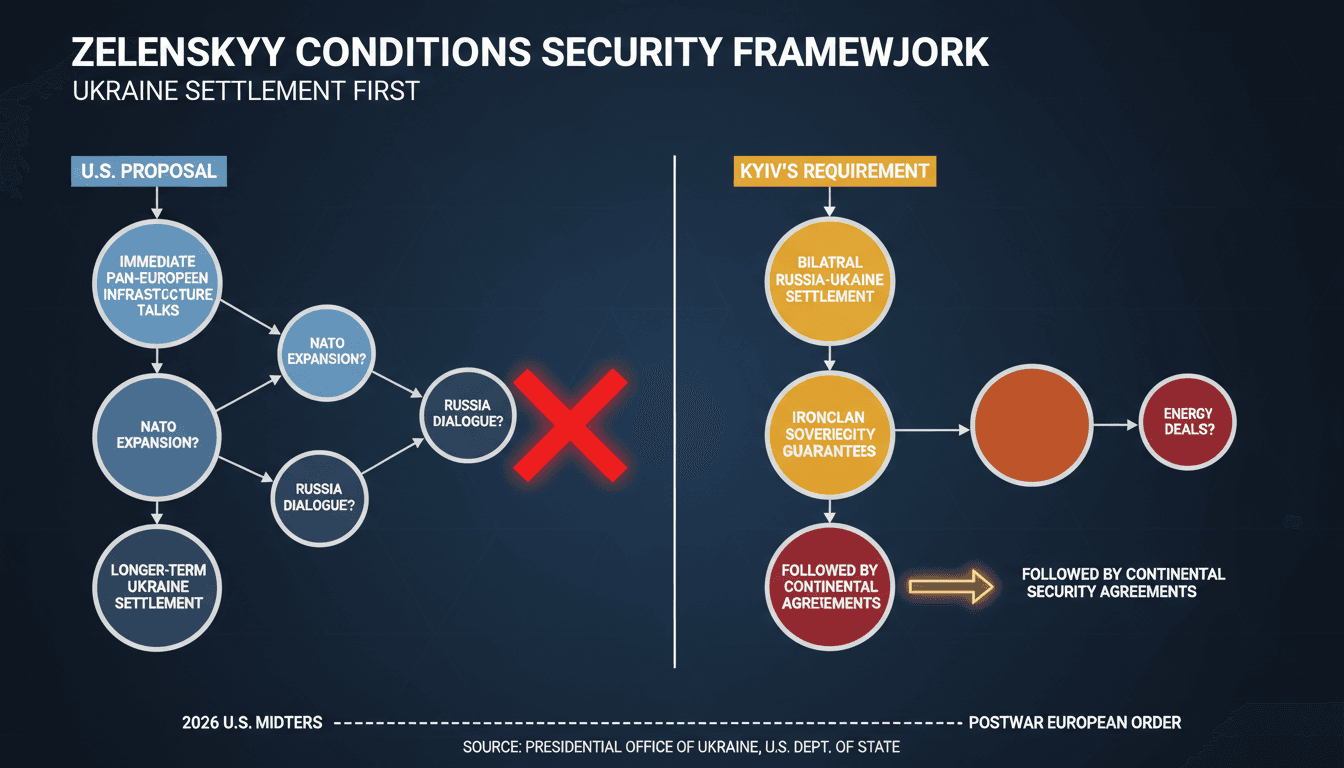
Diplomatic sequencing will determine whether cross-border supply chains, regional sanctions regimes, and European capital allocations stabilize gradually or face recurrent geopolitical disruption.
Why it matters
The dispute over whether sovereign Ukrainian guarantees must precede a wider Russia-Europe security architecture directly dictates the durability, legal enforceability, and risk premium of any eventual settlement.
What happened (in 30 seconds)
- A firm stance on diplomatic sequencing: On November 7, 2026, Ukrainian President Volodymyr Zelenskyy made clear that any U.S.-brokered security architecture between Russia and Europe must follow, rather than precede, a definitive end to the war and concrete security guarantees for Ukraine.
- Leverage from U.S. midterm results: Speaking in a CNN interview, Zelenskyy highlighted that Democratic gains in the 2026 U.S. midterm elections provide legislative backing that could expand military and financial assistance, reinforcing Kyiv's negotiating position.
- Caution surrounding White House peace initiatives: While acknowledging diplomatic missions led by U.S. envoys Steve Witkoff and Jared Kushner—including meetings with Russian representatives such as Kirill Dmitriev—Zelenskyy warned against a "Yalta II" scenario that might compromise Ukrainian sovereignty for broader continental arrangements.
The context you actually need
- A conflict entering its fifth year: The Russia-Ukraine war reached late 2026 amid prolonged active frontlines and extensive transatlantic coordination, with the U.S. administration intensifying mediation efforts to deliver a settlement.
- Multilateral preliminary engagements: Before this diplomatic inflection point, negotiators from Ukraine, Russia, and the United States held exploratory discussions across multiple venues, including Oslo, St. Petersburg, and Abu Dhabi, examining technical frameworks for humanitarian measures, energy corridors, and potential ceasefires.
- A divided Washington policy environment: The 2026 U.S. midterm elections transferred control of the U.S. Congress to Democrats, altering the legislative dynamics around foreign assistance allocations and creating a counterweight to unilateral executive branch dealmaking.
What's really happening
The core tension in current diplomacy is not whether talks should occur, but the order of operations governing the outcome.
Under the Trump administration, special envoys Steve Witkoff and Jared Kushner have advanced discussions centered on a comprehensive European security architecture. This model envisions institutionalized, permanent consultations and mutual transparency measures between Western capitals and Moscow. The strategic incentive for Washington is straightforward: resolve the systemic friction across the continent in one macro-level agreement, thereby stabilizing European defense commitments and allowing the United States to reallocate strategic bandwidth.
For Kyiv, however, this top-down approach introduces severe systemic risk. If a continental framework is negotiated before the specific legal parameters of Ukraine's territorial integrity and defensive commitments are settled, Ukraine risks becoming an input rather than an equal party in the security design. President Zelenskyy’s explicit invocation of a "Yalta II" outcome illustrates this structural concern: an arrangement where primary powers negotiate regional spheres of influence at the expense of frontline states.
Kyiv's leverage has shifted due to the 2026 U.S. midterm results. With Democrats taking control of Congress, the legislative purse strings for defense appropriations are held by lawmakers who favor institutionalized support for Ukrainian sovereignty. This congressional shift enables Zelenskyy to reject rapid concessions that might appeal to White House dealmakers seeking an immediate diplomatic milestone. By insisting that bilateral security guarantees and an end to hostilities must come first, Kyiv is anchoring the baseline for any future talks.
At the same time, high-level contacts involving Russian representative Kirill Dmitriev and U.S. envoys confirm that direct backchannels remain operational. Previous technical tracks in Oslo, St. Petersburg, and Abu Dhabi showed that both sides will engage on operational issues such as energy flows and humanitarian arrangements. The friction point remains structural: Ukraine will not accept a generic European non-aggression pact that treats its sovereign defensive architecture as a secondary consideration. The path forward depends on whether U.S. mediation will decouple the bilateral Ukrainian settlement from broader continent-wide diplomacy, or continue attempting to resolve both tracks simultaneously.
Who feels it first (and how)
- European defense contractors and public procurement leads: Budget commitments remain elevated and rigid as long as negotiations hinge on sovereign security guarantees rather than an overarching demilitarization framework.
- Multinational infrastructure and reconstruction funds: Capital deployment into Ukrainian rebuilding programs remains frozen until enforceable, treaty-backed security guarantees replace speculative ceasefire discussions.
- Energy trading desks managing European gas and electricity inputs: Prolonged debates over negotiation sequencing delay the normalization of cross-border grid transit and keep regional risk premiums active.
- Cross-border risk and compliance officers: Sanctions screening, supply chain routing, and legal exposure models must account for a settlement process that is segmented rather than resolved through a single multilateral accord.
What to watch next
- Trilateral meetings planned for November 2026: Scheduled engagements involving U.S., Ukrainian, and Russian representatives will reveal whether Washington adapts its negotiating agenda to prioritize bilateral guarantees or continues pushing for an all-encompassing European security blueprint.
- Congressional budget actions on Ukraine defense appropriations: The newly installed Democratic legislative majority will signal how quickly it intends to translate midterm campaign pledges into hard legislative allocations, testing the administration’s leverage over Kyiv.
- European capital reactions to the "Yalta II" warning: Formal responses from key European defense ministries will indicate whether continental allies align with Kyiv’s sequencing demands or favor a broader pan-European security compromise.
President Zelenskyy has explicitly conditioned Ukrainian participation in broader European security structures on first securing firm sovereign guarantees and concluding the war; U.S. envoys Steve Witkoff and Jared Kushner have conducted direct discussions with Russian representatives including Kirill Dmitriev; Democrats won control of Congress in the 2026 midterms.
The legislative transition in Washington will constrain executive-level efforts to conclude a rapid, top-down security settlement that bypasses Ukrainian preconditions.
Whether the planned trilateral talks in November 2026 can produce a consensus agenda on technical items without first resolving the sequencing conflict over broader continental architecture.
Frequently Asked Questions
- Why it matters?
- The dispute over whether sovereign Ukrainian guarantees must precede a wider Russia-Europe security architecture directly dictates the durability, legal enforceability, and risk premium of any eventual settlement.
- What happened (in 30 seconds)?
- A firm stance on diplomatic sequencing: On November 7, 2026, Ukrainian President Volodymyr Zelenskyy made clear that any U.S.-brokered security architecture between Russia and Europe must follow, rather than precede, a definitive end to the war and concrete security guarantees for Ukraine. Leverage from U.S. midterm results: Speaking in a CNN interview, Zelenskyy highlighted that Democratic gains in the 2026 U.S. midterm elections provide legislative backing that could expand military and financ
- What's really happening?
- The core tension in current diplomacy is not whether talks should occur, but the order of operations governing the outcome. Under the Trump administration, special envoys Steve Witkoff and Jared Kushner have advanced discussions centered on a comprehensive European security architecture. This model envisions institutionalized, permanent consultations and mutual transparency measures between Western capitals and Moscow. The strategic incentive for Washington is straightforward: resolve the syst
- Who feels it first (and how)?
- European defense contractors and public procurement leads: Budget commitments remain elevated and rigid as long as negotiations hinge on sovereign security guarantees rather than an overarching demilitarization framework. Multinational infrastructure and reconstruction funds: Capital deployment into Ukrainian rebuilding programs remains frozen until enforceable, treaty-backed security guarantees replace speculative ceasefire discussions. Energy trading desks managing European gas and electricity
- What to watch next?
- Trilateral meetings planned for November 2026: Scheduled engagements involving U.S., Ukrainian, and Russian representatives will reveal whether Washington adapts its negotiating agenda to prioritize bilateral guarantees or continues pushing for an all-encompassing European security blueprint. Congressional budget actions on Ukraine defense appropriations: The newly installed Democratic legislative majority will signal how quickly it intends to translate midterm campaign pledges into hard legisla
Global business headlines with AI angles.
"General business outlet that frequently covers AI."
— A47 Editor
Zelenskyy Walks Diplomatic Tightrope Amidst New Attempts By Washington To Resolve Ukraine War
Volodymyr Zelenskyy expressed cautious optimism about increased U.S. support under a Democrat-controlled Congress, while warning that any U.S.-brokered security agreement between Russia and Europe should not precede an end to the war and negotiated s...
24/7 international news from a French perspective in multiple languages.
"France 24 is viewed as a globally focused outlet with balanced coverage and a European perspective."
— A47 Editor
What Trump’s midterms debacle could mean for US support for Ukraine
Democrats won control of both the US Senate and the House in the November 3, 2026 midterm elections, a result widely described as a 'blue wave' that delivered a sharp rebuke to President Donald Trump and the Republican Party. Ukrainian President Volo...
Capitol Hill news, legislation, and policy insight.
"The Hill specializes in U.S. politics and policy, with a focus on Capitol Hill developments and a reputation for insider reporting."
— A47 Editor
Zelensky: Ukraine may receive increased U.S. assistance following ‘new political infrastructure’
Ukrainian President Volodymyr Zelensky said Thursday that the chances have increased for Ukraine to receive additional U.S. assistance, reacting to Democrats' overwhelming victories in the midterm elections. In an interview with a Ukrainian news chan...
RT is a Russian state-funded network covering global events from a Russian perspective.
"RT is widely criticized for promoting pro-Kremlin narratives and is considered by many to be a state propaganda outlet."
— A47 Editor
Zelensky claims US still owes Kiev $16 billion
Ukrainian President Volodymyr Zelensky has claimed that the United States still owes Kyiv around $16 billion, according to RT (Russia Today), and he expects America to be more generous with taxpayer money following the Democrats' midterm victory on N...
Global news coverage with extensive reporting on Middle Eastern conflicts and geopolitics.
"Al Jazeera is a Qatar-based broadcaster known for wide regional coverage and alternative perspectives."
— A47 Editor
Zelenskyy hopes Democratic Congress will bring more US help for Ukraine
Ukrainian President Volodymyr Zelenskyy has said he hopes the incoming Democratic-led US Congress will deliver more American support for Ukraine in its war with Russia, now in its fifth year. The European Union has also urged the new Congress to incr...
Comprehensive coverage of Middle Eastern and global issues.
"Al Jazeera is a prominent voice from the Global South, especially the Middle East, with an emphasis on underreported stories."
— A47 Editor
Zelenskyy hopes Democratic Congress will bring more US help for Ukraine
Ukrainian President Volodymyr Zelenskyy has said he hopes the incoming Democratic-led US Congress will deliver more American support for Ukraine in its war with Russia, now in its fifth year. The European Union has also urged the new Congress to incr...