
Trump Weighs Renewed Iran Strikes After GOP Midterm Losses and Narrow Pre-Congress Window
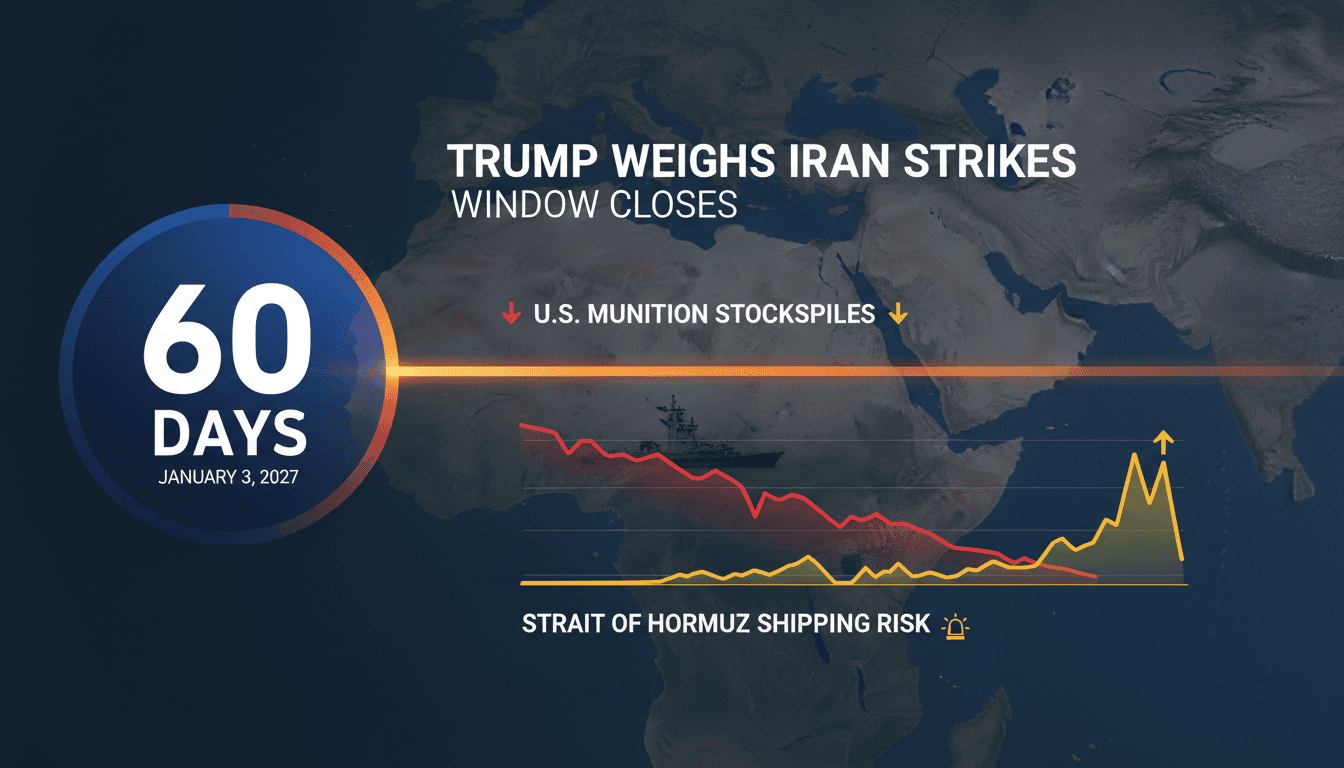
Why it matters
A two-month legislative deadline is forcing executive deliberations on regional military operations, directly linking internal U.S. budgetary constraints to commercial shipping stability across Middle Eastern trade corridors.
What happened (in 30 seconds)
- A compressed operational timeline emerged: Following November 2026 midterm election losses, the White House began assessing renewed military strikes against Iranian nuclear and military assets before a new legislative majority convenes on January 3, 2027.
- Internal division surfaced over campaign continuation: Vice President JD Vance publicly identified the eight-month conflict as an economic driver of electoral setbacks and opposed continuation, while Defense Secretary Pete Hegseth faces proposed impeachment articles from Representative Thomas Massie over maritime risk assessments and command leadership adjustments.
- Tehran signaled an escalatory posture: Iranian parliamentary speaker Mohammad Bagher Qalibaf warned of severe countermeasures to any renewed campaign, emphasizing public opposition expressed in the recent U.S. vote.
The context you actually need
- Eight months of sustained attrition: Active hostilities began in February 2026, creating an operational environment defined by intermittent air operations, a U.S. naval blockade of Iranian ports, and active Iranian transit limits across the Strait of Hormuz without a formal ceasefire.
- Depleted strategic inventories: Sustained defense operations over the eight-month conflict have substantially consumed critical U.S. munitions stockpiles, narrowing operational flexibility for extended multi-front engagements.
- The congressional funding pivot: Democratic strategists confirmed plans to use incoming legislative majorities starting January 3, 2027, to introduce statutory funding restrictions or leverage broader government funding mechanisms to halt military expenditures in the theater.
What's really happening
The strategic reality driving deliberations in Washington is defined by an institutional countdown: roughly 60 days remain before political shifts in Congress alter the executive branch's capacity to finance operations in the Middle East.
This mechanism is dictated by the appropriations calendar. When the newly elected congressional majorities take power on January 3, 2027, the legislative balance of power changes the funding structure for prolonged foreign engagements. Incoming leadership has signaled an intent to deny supplemental defense appropriations or attach restrictive riders to stop operational financing. Consequently, executive decision-makers face a structural choice: conclude operations, establish an enduring deterrence baseline through concentrated strikes before statutory funding mechanisms close, or risk entering 2027 with depleted munition reserves and an uncooperative legislature.
At the same time, the administration's internal calculations reflect diverging institutional incentives. The conflict has reached an eight-month duration without achieving a formal ceasefire or treaty framework. Sustained naval patrols, interceptor deployments, and blockade enforcement have significantly lowered inventory levels for high-end guided munitions. Rebuilding these specialized defense stocks requires long lead times within the defense industrial base. Vice President JD Vance's public resistance to extending the conflict highlights an economic calculation: prolonging maritime attrition continues to exert upward pressure on commodity markets and consumer indices. Conversely, defense leadership under Secretary Hegseth operates under the strategic imperative to neutralize nuclear advancements and establish military deterrence before legislative guardrails restrict deployment authority.
For global commerce, this structural dynamic transfers direct friction to the Strait of Hormuz. Because Iran cannot match conventional blue-water naval deployments, its defense architecture relies on asymmetric counter-measures, specifically tightening commercial passage through regional chokepoints. When executive deliberations accelerate in Washington, asymmetric pressure rises in the Gulf. Iranian restrictions on maritime corridors serve as their primary counterweight against economic blockades. The result is an operational bottleneck where short-term political incentives in Washington rapidly reshape freight rates, insurance surcharges, and bulk commodity transit across the Middle East.
Who feels it first (and how)
- Gulf logistics and maritime fleet operators: Commercial vessels traversing the Strait of Hormuz face immediate operational adjustments, higher security premiums, and rerouting delays tied to retaliatory maritime interdictions.
- Dubai-based corporate treasurers and procurement teams: Regional supply chain managers encounter pricing volatility in imported components and raw materials driven by higher war-risk maritime surcharges.
- Energy sector analysts and physical commodity traders: Crude oil and LNG desks must price a discrete 60-day geopolitical risk premium into Q1 2027 delivery contracts ahead of the congressional transfer of power.
- Defense procurement and manufacturing executives: Industrial suppliers experience urgent demand signals to replenish complex munitions stockpiles strained by eight months of high-intensity operations.
What to watch next
- The December 2026 defense appropriations draft: Track whether current congressional leaders attempt an emergency stopgap defense supplemental to fund Middle East operations before the January 3, 2027 transition.
- Strait of Hormuz commercial traffic advisories: Monitor transit volumes and maritime insurance risk tiers issued by international shipping registries, which act as a live proxy for regional operational escalation.
- House floor action on executive leadership: Watch for procedural advancement of Representative Thomas Massie's privileged impeachment resolution against Defense Secretary Hegseth, serving as a primary barometer of intra-party cohesion.
The conflict between the United States and Iran has run continuously for eight months since February 2026; U.S. munitions inventories are substantially depleted; legislative control of Congress flips on January 3, 2027; and executive branch leaders are split on operational strategy.
Hostilities or expanded strike packages initiated prior to January 2027 will provoke reciprocal transit restrictions or commercial vessel targeting across Gulf energy corridors.
Whether the executive branch can execute targeted strikes on Iranian nuclear assets within the 60-day window without triggering sustained maritime attrition that outlasts current defense appropriations.
Frequently Asked Questions
- Why it matters?
- A two-month legislative deadline is forcing executive deliberations on regional military operations, directly linking internal U.S. budgetary constraints to commercial shipping stability across Middle Eastern trade corridors.
- What happened (in 30 seconds)?
- A compressed operational timeline emerged: Following November 2026 midterm election losses, the White House began assessing renewed military strikes against Iranian nuclear and military assets before a new legislative majority convenes on January 3, 2027. Internal division surfaced over campaign continuation: Vice President JD Vance publicly identified the eight-month conflict as an economic driver of electoral setbacks and opposed continuation, while Defense Secretary Pete Hegseth faces propose
- What's really happening?
- The strategic reality driving deliberations in Washington is defined by an institutional countdown: roughly 60 days remain before political shifts in Congress alter the executive branch's capacity to finance operations in the Middle East. This mechanism is dictated by the appropriations calendar. When the newly elected congressional majorities take power on January 3, 2027, the legislative balance of power changes the funding structure for prolonged foreign engagements. Incoming leadership has
- Who feels it first (and how)?
- Gulf logistics and maritime fleet operators: Commercial vessels traversing the Strait of Hormuz face immediate operational adjustments, higher security premiums, and rerouting delays tied to retaliatory maritime interdictions. Dubai-based corporate treasurers and procurement teams: Regional supply chain managers encounter pricing volatility in imported components and raw materials driven by higher war-risk maritime surcharges. Energy sector analysts and physical commodity traders: Crude oil and
- What to watch next?
- The December 2026 defense appropriations draft: Track whether current congressional leaders attempt an emergency stopgap defense supplemental to fund Middle East operations before the January 3, 2027 transition. Strait of Hormuz commercial traffic advisories: Monitor transit volumes and maritime insurance risk tiers issued by international shipping registries, which act as a live proxy for regional operational escalation. House floor action on executive leadership: Watch for procedural advanceme
U.S. national news with a West Coast perspective.
"The Los Angeles Times is a major West Coast newspaper offering in-depth reporting with a liberal editorial tone and strong regional focus."
— A47 Editor
Trump, weighing new Iran strikes, faces a divided party and a ticking clock
Trump, weighing new strikes on Iran, faces a divided Republican Party and a shrinking window before Democrats take control of Congress, as a bipartisan push to oust Defense Secretary Pete Hegseth could constrain his options.
International news with cultural insight.
"The Los Angeles Times is a major West Coast newspaper offering in-depth reporting with a liberal editorial tone and strong regional focus."
— A47 Editor
Trump, weighing new Iran strikes, faces a divided party and a ticking clock
Trump, weighing new strikes on Iran, faces a divided Republican Party and a shrinking window before Democrats take control of Congress, as a bipartisan push to oust Defense Secretary Pete Hegseth could constrain his options.
Right-of-center views on political news.
"The Washington Times is a conservative-leaning newspaper known for its political coverage and advocacy of right-of-center viewpoints."
— A47 Editor
Comer: Trump has to decide whether to keep Hegseth after midterms show frustration over war
Republican Rep. James Comer criticized Defense Secretary Pete Hegseth and placed blame for GOP losses in the November 3 midterm elections on the war with Iran, saying President Donald Trump must decide whether to keep Hegseth in his post.
Global business headlines with AI angles.
"General business outlet that frequently covers AI."
— A47 Editor
The Iran War is Being Blamed For the GOP's Midterms Loss. Now Trump is Reportedly Asking Whether Hegseth Should Go.
President Donald Trump is reportedly consulting advisers about the future of Defense Secretary Pete Hegseth as Republicans blame the Iran war and rising gas prices for their midterm election losses, according to International Business Times.
English-language reporting on Saudi politics, policy, and society.
"Saudi Gazette reflects mainstream Saudi institutional perspectives."
— A47 Editor
‘Knives out’ at Pentagon after Republicans' midterms rout
Senior Pentagon officials faced sharp questioning after Republicans lost control of Congress in the midterm elections, with Democrats seizing both the House and Senate. The unpopular Iran war was widely cited as a factor, and Democrats moved quickly ...