
Guinea-Bissau Junta Postpones Elections to November 2028 Extending Military Rule by Two Years
Why it matters
The postponement of national elections until late 2028 institutionalizes an extended military-led transition, altering regulatory predictability and sovereign engagement models across the ECOWAS corridor.
What happened (in 30 seconds)
- Decree signed: On November 26, 2026, transitional president Major-General Horta N'Tam issued a decree rescheduling presidential and parliamentary elections from December 6, 2026, to November 26, 2028.
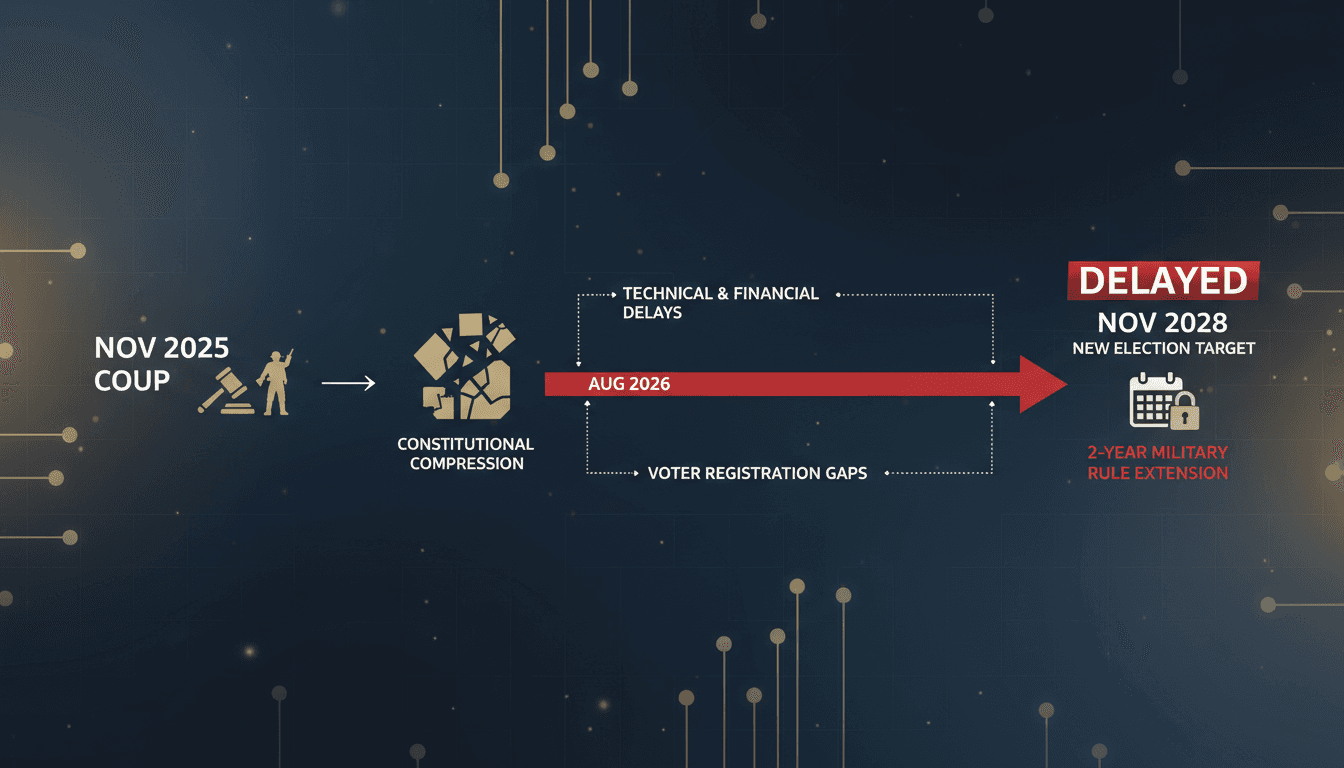
- Timeline extended: The decision adds approximately two years to the military government's initial 12-month commitment to restore civilian governance following the November 26, 2025, ouster of President Umaro Sissoco Embaló.
- Logistical deficit cited: Authorities formally pointed to deficient technical, material, and budgetary frameworks required to organize transparent nationwide balloting and upcoming local elections.
The context you actually need
- The November 2025 intervention: Soldiers seized executive power three days after contested national elections and roughly 24 hours ahead of scheduled provisional result announcements, setting an initial 12-month transitional clock.
- Constitutional restructuring: An August 2026 referendum—boycotted by segments of the domestic opposition—passed structural adjustments that consolidated executive authority and cut parliamentary representation from 29 constituencies down to 12.
- Diplomatic friction: ECOWAS has consistently pressed Bissau for a tight, time-bound transfer back to constitutional order, while Moroccan-based former president Embaló was formally barred from returning in October 2026 on stated security grounds.
What's really happening
The two-year postponement moves Guinea-Bissau from a brief, stopgap administration into an extended period of structural state redesign. When transitional authorities annulled the January 2026 decree that had initially locked in a December 2026 vote, they institutionalized a governance timeline heavily reshaped by institutional and administrative bottlenecks. Prime Minister Ilídio Vieira Té signaled as early as October 2026 that the state lacked the practical machinery to execute a national vote.
At the operational core lies an overhauled electoral architecture. Following the August 2026 constitutional revisions, the state must redraw electoral boundaries, compressing the national map from 29 constituencies to 12. That geographic consolidation requires comprehensive voter re-registration across a population of 2.2 million people, paired with logistical supply chains that the current treasury and electoral administration cannot immediately underwrite. Running parallel to this is the state’s stated ambition to organize the country's first-ever local government elections, adding another complex tier of civic administration before legislative and presidential ballots are cast.
The political incentives run parallel to these material gaps. Under the transitional charter, the transitional president is barred from contesting the presidential election. A prolonged transition defers the transfer of authority while the executive branch operates under newly expanded constitutional powers. Furthermore, the decision to bar former president Umaro Sissoco Embaló from re-entering the country removes a primary political axis, muting immediate electoral contestation while the executive branch embeds administrative reforms.
For external partners and multilateral bodies, the development tests regional enforcement mechanisms. ECOWAS has historically leveraged diplomatic and economic frameworks to compel West African transitional regimes toward compressed timelines. However, local technical deficits offer transitional authorities an operational justification to decouple from external deadlines. With the domestic market showing no immediate disruptions, the junta's economic incentive is to prioritize internal administrative continuity over external diplomatic timelines, keeping institutional control centralized until at least the final quarter of 2028.
Who feels it first (and how)
- Sovereign Risk and Compliance Analysts: Must price in an additional 24 months of transitional legal frameworks, decree-based governance, and potential regional policy friction.
- Regional Logistics and Cross-Border Operators: Face prolonged uncertainty regarding ECOWAS-level policy responses or trade-monitoring mechanisms directed at Bissau.
- Local Political Formations and Electoral Coalitions: Contenders are sidelined from legislative access until late 2028 under a consolidated 12-constituency map that will sharply intensify competition for fewer legislative seats.
- Guinea-Bissau Civil Administration: Bureaucracies face the operational mandate to conduct voter registration drives and establish new local election frameworks with limited sovereign funding.
What to watch next
- ECOWAS Extraordinary Summits: Watch for formal communiqués or potential economic resolutions targeting Guinea-Bissau's revised 2028 target.
- Local Government Polling Dates: Look for official decrees establishing the operational calendar for municipal elections, which serve as the preparatory baseline for general elections.
- Electoral Map Implementation: Track budgetary disbursements toward redrawing the 12 constituencies and modernizing the national voter registry.
The national general election is officially scheduled for November 26, 2028, per presidential decree; the national legislative footprint is reduced from 29 constituencies to 12; transitional president Major-General Horta N'Tam remains barred from running under the transitional charter.
Regional diplomatic bodies such as ECOWAS will maintain sustained diplomatic pressure, demanding interim benchmarks before 2028.
Whether transitional authorities will secure the external financial backing required to complete comprehensive voter registration and municipal polling ahead of the new 2028 deadline.
Frequently Asked Questions
- Why it matters?
- The postponement of national elections until late 2028 institutionalizes an extended military-led transition, altering regulatory predictability and sovereign engagement models across the ECOWAS corridor.
- What happened (in 30 seconds)?
- Decree signed: On November 26, 2026, transitional president Major-General Horta N'Tam issued a decree rescheduling presidential and parliamentary elections from December 6, 2026, to November 26, 2028. Timeline extended: The decision adds approximately two years to the military government's initial 12-month commitment to restore civilian governance following the November 26, 2025, ouster of President Umaro Sissoco Embaló. Logistical deficit cited: Authorities formally pointed to deficient technic
- What's really happening?
- The two-year postponement moves Guinea-Bissau from a brief, stopgap administration into an extended period of structural state redesign. When transitional authorities annulled the January 2026 decree that had initially locked in a December 2026 vote, they institutionalized a governance timeline heavily reshaped by institutional and administrative bottlenecks. Prime Minister Ilídio Vieira Té signaled as early as October 2026 that the state lacked the practical machinery to execute a national vote
- Who feels it first (and how)?
- Sovereign Risk and Compliance Analysts: Must price in an additional 24 months of transitional legal frameworks, decree-based governance, and potential regional policy friction. Regional Logistics and Cross-Border Operators: Face prolonged uncertainty regarding ECOWAS-level policy responses or trade-monitoring mechanisms directed at Bissau. Local Political Formations and Electoral Coalitions: Contenders are sidelined from legislative access until late 2028 under a consolidated 12-constituency map
- What to watch next?
- ECOWAS Extraordinary Summits: Watch for formal communiqués or potential economic resolutions targeting Guinea-Bissau's revised 2028 target. Local Government Polling Dates: Look for official decrees establishing the operational calendar for municipal elections, which serve as the preparatory baseline for general elections. Electoral Map Implementation: Track budgetary disbursements toward redrawing the 12 constituencies and modernizing the national voter registry.
Arabic-language coverage of international news and geopolitics.
"RT Arabic is a Russian state-funded outlet often criticized for promoting Kremlin-aligned narratives."
— A47 Editor
غينيا بيساو.. العكسر يؤجلون الانتخابات إلى 2028
Guinea-Bissau's presidential and parliamentary elections have been postponed to November 26, 2028, by decree of the transitional president, extending military rule by roughly three years.
International coverage of politics, culture, and current affairs.
"BBC News is widely regarded as a reputable international news organization, known for its impartial tone and public service mandate."
— A47 Editor
Guinea-Bissau's military leaders delay return to civilian rule until 2028
Guinea-Bissau's military leaders have postponed the return to civilian rule until 2028, a year after a military coup, despite earlier promises to restore civilian governance within 12 months, according to BBC News. Al Jazeera reports that presidentia...
Conservative-leaning political and national coverage.
"The Washington Times is a conservative-leaning newspaper known for its political coverage and advocacy of right-of-center viewpoints."
— A47 Editor
Guinea-Bissau's military junta postpones elections until 2028, extending its rule by two years
Guinea-Bissau's military government announced on Thursday that presidential and legislative elections have been postponed until November 2028, extending the promised yearlong transition to civilian rule by roughly two years.
Global news coverage with extensive reporting on Middle Eastern conflicts and geopolitics.
"Al Jazeera is a Qatar-based broadcaster known for wide regional coverage and alternative perspectives."
— A47 Editor
Guinea-Bissau military leaders delay presidential election until 2028
Military leaders in Guinea-Bissau have announced that the presidential and legislative elections scheduled for December 6 will instead take place in November 2028, according to a report published by Al Jazeera. The decision postpones the vote by near...
Comprehensive coverage of Middle Eastern and global issues.
"Al Jazeera is a prominent voice from the Global South, especially the Middle East, with an emphasis on underreported stories."
— A47 Editor
Guinea-Bissau military leaders delay presidential election until 2028
Military leaders in Guinea-Bissau have announced that the presidential and legislative elections scheduled for December 6 will instead take place in November 2028, according to a report published by Al Jazeera. The decision postpones the vote by near...