
NASA Extends Voyager 2's Operational Life by One Year
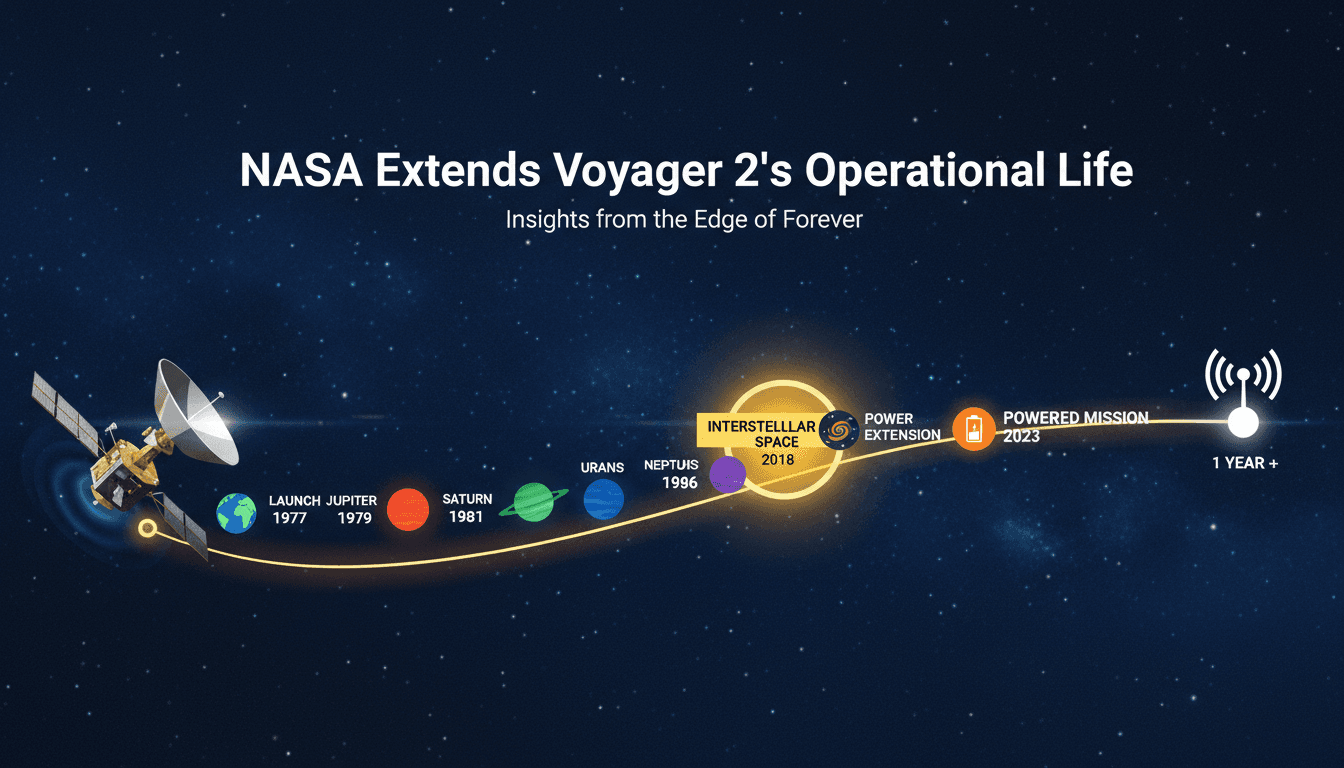
What happened
NASA has successfully extended the operational life of the Voyager 2 probe, which was launched in 1977, by employing a power management maneuver known as the "Big Bang." This strategic operation allows the spacecraft to continue functioning and transmitting valuable scientific data from interstellar space. The maneuver is a significant achievement, ensuring that Voyager 2 can utilize its last remaining science instruments for another year.
The probe has been operational for nearly 49 years, making it a remarkable example of longevity in space technology. Engineers have worked diligently for years to ensure that Voyager 2 remains a vital source of information as it travels through the cosmos.
The Context
Voyager 2 is the second spacecraft to travel into interstellar space, following its launch in 1977. The probe has provided invaluable insights into our solar system and beyond, and its continued operation is crucial for ongoing scientific research. The recent power reduction operation was essential for maintaining power to the spacecraft, allowing it to keep sending data back to Earth.
NASA's engineering team has been focused on extending the life of Voyager 2 for several years, showcasing their dedication to maximizing the mission's scientific output. As the probe continues its journey, it serves as a testament to the advancements in space exploration and the importance of long-term missions.
Takeaway
The continued operation of Voyager 2 highlights NASA's commitment to exploring and understanding the outer reaches of our solar system. As scientists anticipate further insights from the probe, future updates on its scientific findings will be closely monitored. Additionally, developments in NASA's other space exploration missions will provide context for the ongoing significance of Voyager 2's contributions.
This extension not only reinforces the value of Voyager 2 but also sets the stage for future explorations that may yield groundbreaking discoveries about our universe.
Tech startup news, programming trends, and discussions shared by the developer community.
"Hacker News is a community-driven source highlighting influential tech discussions, startup launches, and programming insights."
— A47 Editor
NASA to keep its 48-year-old Voyager 2 probe running for yet another year
NASA has announced that it will continue to operate its Voyager 2 probe, which has been in service for 48 years, for an additional year. This decision underscores the agency's ongoing commitment to its historic space exploration missions.
News in science and technology, with a focus on consumer and innovation stories.
"Popular Science simplifies complex scientific topics for general audiences and celebrates innovation."
— A47 Editor
NASA successfully gives Voyager 2 another year of life
NASA has successfully extended the operational life of the Voyager 2 spacecraft by another year through a maneuver known as the 'Big Bang.' This maneuver was critical for maintaining power to the 49-year-old spacecraft, which continues to provide val...
Space science news, astronomy updates, and spaceflight developments.
"Space.com delivers space science news, astronomy updates, and spaceflight developments with engaging coverage."
— A47 Editor
NASA figured out how to keep its 48-year-old Voyager 2 probe running for yet another year
NASA has successfully extended the operational life of its Voyager 2 probe, which has been in space since 1977, by performing a power reduction operation that allows it to continue running its last scientific instruments for another year.
Capitol Hill news, legislation, and policy insight.
"The Hill specializes in U.S. politics and policy, with a focus on Capitol Hill developments and a reputation for insider reporting."
— A47 Editor
Scientists extend instrument life on Voyager 2 probe
Scientists have successfully extended the life of instruments on the Voyager 2 probe, which was launched in 1977 and has since traveled into interstellar space. This achievement highlights ongoing efforts to maintain and enhance the functionality of ...