
BIPM General Conference Votes to Abolish Leap Seconds Effective May 2027
Why it matters
The decision to abolish leap seconds reflects a critical shift in global timekeeping that impacts technology infrastructure and financial markets.
What happened (in 30 seconds)
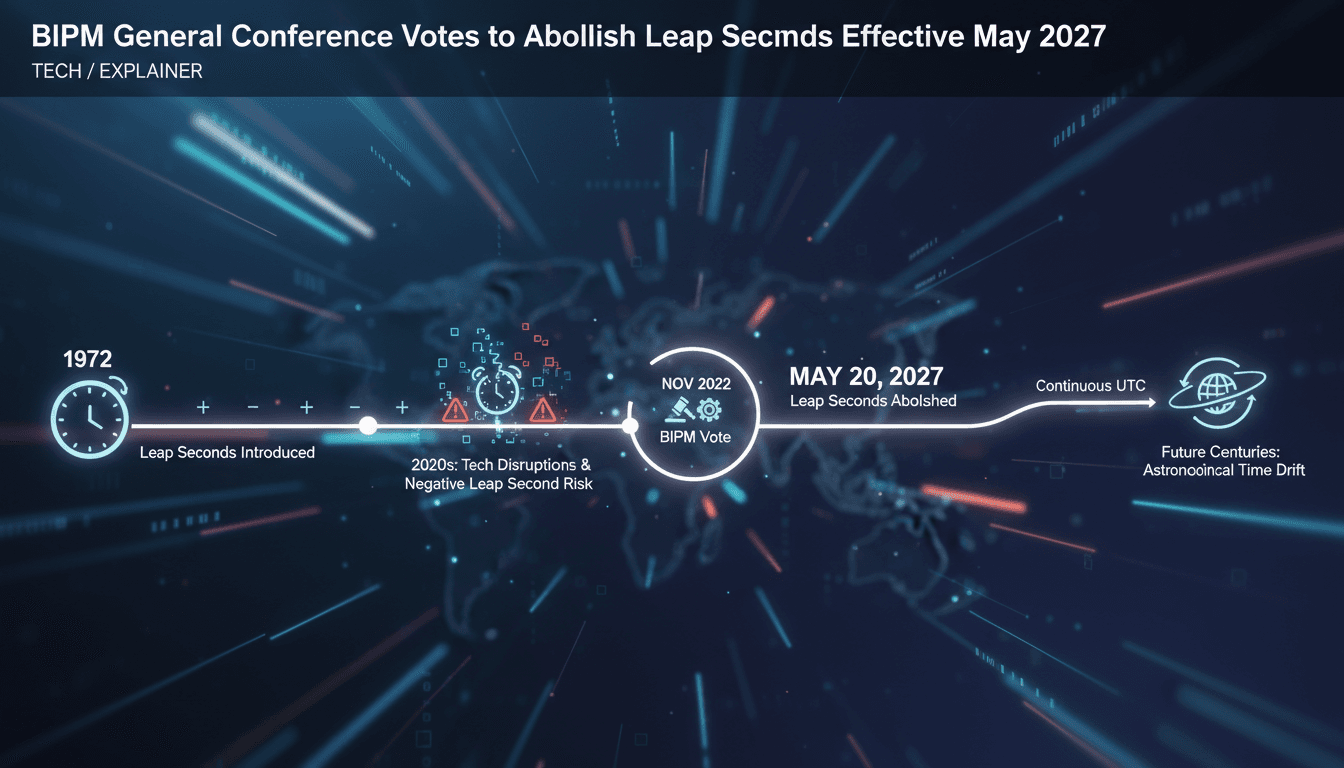
- On October 15, 2026, the General Conference on Weights and Measures voted to discontinue leap seconds.
- Effective May 20, 2027, Coordinated Universal Time (UTC) will drift continuously from astronomical time, allowing a maximum difference of one hour.
- This decision was driven by the risk of a negative leap second due to accelerated Earth rotation and the need for stable time synchronization in technology.
The context you actually need
- Leap seconds were introduced in 1972 to align atomic time with Earth's irregular rotation, with 27 positive adjustments made until 2016.
- The 2022 CGPM resolution initially set a 2035 deadline for discontinuation, but recent observations of faster Earth rotation accelerated the timeline.
- The tech sector has long debated the disruptive effects of leap seconds on systems, prompting this decisive action to ensure continuity and reliability.
What's really happening
The decision to abolish leap seconds marks a significant evolution in how the world keeps time, driven by both technological needs and astronomical realities. Since their introduction in 1972, leap seconds have been a necessary adjustment to align atomic time (UTC) with the Earth's rotation (UT1). However, the increasing frequency of adjustments—27 leap seconds added through 2016—has raised concerns about their impact on technology and financial systems.
The 2022 resolution to phase out leap seconds by 2035 was already a response to these concerns, but the urgency increased when scientists observed that the Earth's rotation is accelerating. This led to fears of a negative leap second, which would involve subtracting a second from UTC for the first time, potentially causing chaos in systems reliant on precise timekeeping.
By allowing UTC to drift up to one hour from UT1, the BIPM's decision effectively replaces the ad hoc nature of leap seconds with a more predictable framework. This means that instead of making frequent one-second adjustments, the system will tolerate gradual drift, deferring any necessary corrections to a leap hour that could be centuries away.
The implications of this change are profound. For industries that depend on precise timing—such as telecommunications, finance, and navigation—this move reduces the risk of synchronization failures that could disrupt operations. Tech giants like Meta, Google, Microsoft, and Amazon, which have been vocal about the challenges posed by leap seconds, are likely to benefit from a more stable timekeeping system.
However, not everyone is on board. Russia's opposition highlights concerns about compatibility with satellite systems, indicating that while the majority welcomes the change, there are still significant discussions to be had about its implementation. As governments and standards bodies begin planning for the transition, the long-term shift to a leap-hour framework ensures that the world can adapt to the evolving nature of timekeeping without the disruptions that leap seconds have historically caused.
Who feels it first (and how)
- Tech companies: Firms relying on precise time synchronization will benefit from reduced risks of disruptions.
- Financial markets: Institutions that depend on accurate timestamps for transactions will see improved operational stability.
- Telecommunications: Providers will experience fewer synchronization issues, enhancing service reliability.
- Satellite operators: Some may face challenges adapting to the new system, particularly those in regions opposing the change.
What to watch next
- Implementation planning: Monitor how governments and standards bodies prepare for the transition to continuous UTC, as this will affect global operations.
- Industry adaptation: Watch for how tech firms adjust their systems and protocols in response to the new timekeeping framework.
- Potential backlash: Keep an eye on any emerging concerns from countries or sectors that may struggle with the transition, particularly regarding satellite systems.
Leap seconds will be abolished effective May 20, 2027.
Tech and financial sectors will adapt quickly to the new timekeeping system, reducing synchronization risks.
The long-term effects on satellite systems and international cooperation in timekeeping remain to be seen.
Frequently Asked Questions
- Why it matters?
- The decision to abolish leap seconds reflects a critical shift in global timekeeping that impacts technology infrastructure and financial markets.
- What happened (in 30 seconds)?
- On October 15, 2026, the General Conference on Weights and Measures voted to discontinue leap seconds. Effective May 20, 2027, Coordinated Universal Time (UTC) will drift continuously from astronomical time, allowing a maximum difference of one hour. This decision was driven by the risk of a negative leap second due to accelerated Earth rotation and the need for stable time synchronization in technology.
- What's really happening?
- The decision to abolish leap seconds marks a significant evolution in how the world keeps time, driven by both technological needs and astronomical realities. Since their introduction in 1972, leap seconds have been a necessary adjustment to align atomic time (UTC) with the Earth's rotation (UT1). However, the increasing frequency of adjustments—27 leap seconds added through 2016—has raised concerns about their impact on technology and financial systems. The 2022 resolution to phase out leap s
- Who feels it first (and how)?
- Tech companies: Firms relying on precise time synchronization will benefit from reduced risks of disruptions. Financial markets: Institutions that depend on accurate timestamps for transactions will see improved operational stability. Telecommunications: Providers will experience fewer synchronization issues, enhancing service reliability. Satellite operators: Some may face challenges adapting to the new system, particularly those in regions opposing the change.
- What to watch next?
- Implementation planning: Monitor how governments and standards bodies prepare for the transition to continuous UTC, as this will affect global operations. Industry adaptation: Watch for how tech firms adjust their systems and protocols in response to the new timekeeping framework. Potential backlash: Keep an eye on any emerging concerns from countries or sectors that may struggle with the transition, particularly regarding satellite systems.
Consumer tech and culture with frequent AI coverage.
"Influential tech outlet covering AI products and policy."
— A47 Editor
Time is a-changin’: say goodbye to the leap second
The International Bureau of Weights and Measures (BIPM) has voted to eliminate the leap second, a time adjustment that has been used to align atomic time with the Earth's rotation. This decision aims to enhance global timekeeping standards and preven...
Reports on science policy, discoveries, and public debate in the scientific realm.
"The Guardian’s science section is known for thoughtful and critical reporting on global research, ethics, and public understanding of science."
— A47 Editor
How an accelerating Earth led experts to adopt the leap hour
International delegates from 69 countries have voted to replace the leap second with a leap hour at a conference held by the International Bureau of Weights and Measures in France. This decision comes after extensive discussions regarding the challen...
Tech culture, product news, and critical takes on the tech industry's social impact.
"The Guardian's tech coverage blends mainstream news, critical analysis, and cultural commentary on emerging technologies and digital trends."
— A47 Editor
How an accelerating Earth led experts to adopt the leap hour
International delegates from 69 countries have voted to replace the leap second with a leap hour at a conference held by the International Bureau of Weights and Measures in France. This decision comes after extensive discussions regarding the challen...
Top international stories selected by The Guardian editors.
"The Guardian is known for its progressive editorial stance and in-depth analysis."
— A47 Editor
How an accelerating Earth led experts to adopt the leap hour
International delegates from 69 countries have voted to replace the leap second with a leap hour at a conference held by the International Bureau of Weights and Measures in France. This decision comes after extensive discussions regarding the challen...
Science and technology stories including AI.
"Longstanding science magazine with thoughtful AI coverage."
— A47 Editor
Scientists vote to end leap seconds, redefining how the world keeps time
Scientists have voted to end the practice of leap seconds, introducing a new system known as the 'leap hour,' which will allow the Earth's rotation and official time to diverge by a full hour. This decision marks a significant shift in how time is me...
Scientific research, technology, environment, and society.
"Scientific American is one of the oldest and most authoritative science magazines, known for deep dives into science, technology, and society."
— A47 Editor
Scientists vote to end leap seconds, redefining how the world keeps time
Scientists have voted to end the practice of leap seconds, introducing a new system known as the 'leap hour,' which will allow the Earth's rotation and official time to diverge by a full hour. This decision marks a significant shift in how time is me...