
GLP-1 Receptor Agonists Show Preliminary Signals in Addiction Dementia and Oncology Beyond Metabolic Indications
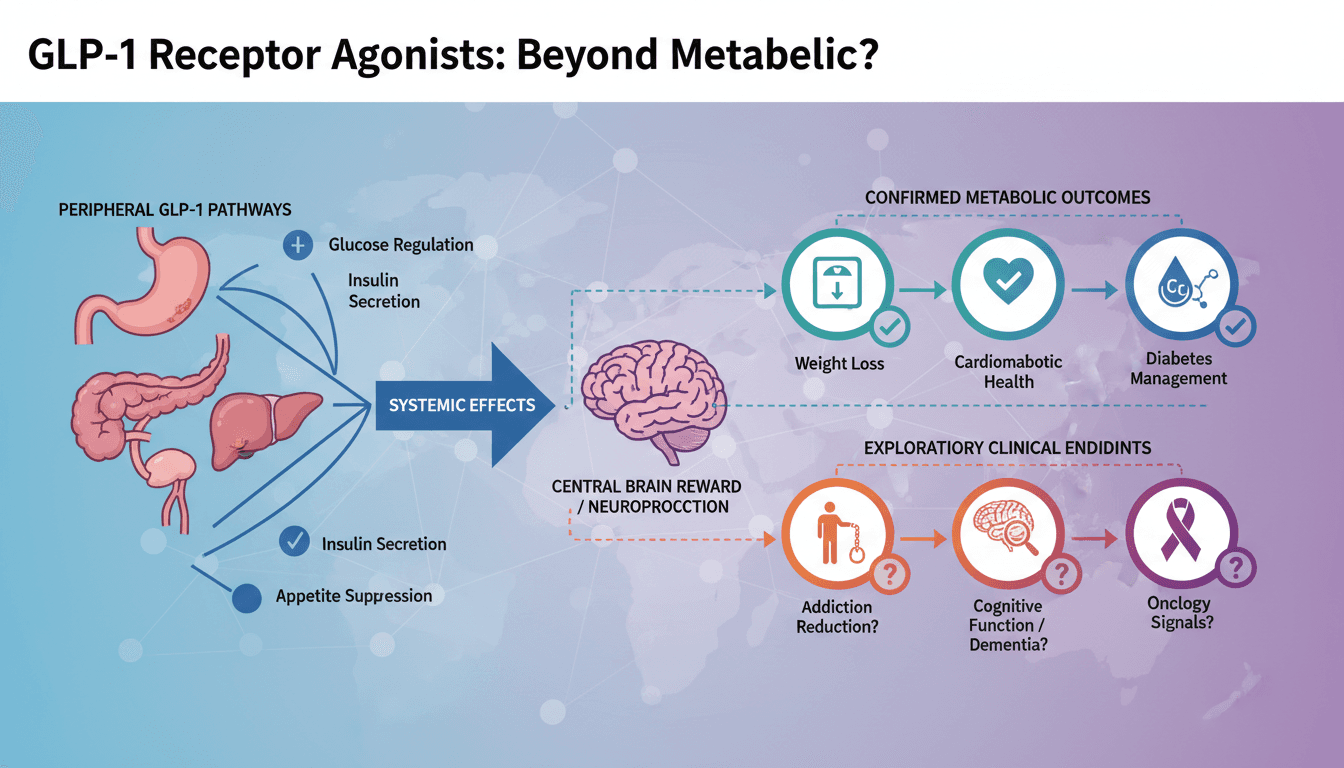
Why it matters
Evidence that GLP-1 receptor agonists alter central reward mechanisms and systemic neuroinflammation signals a transition from single-target metabolic therapies to foundational interventions across systemic and cognitive pathology.
What happened (in 30 seconds)
- Clinical scope expanded: A synthesis published in November 2026 highlights preliminary data linking GLP-1 receptor agonists to decreased rates of substance use disorders, reduced systemic inflammation, and lower incidence of specific obesity-related malignancies.
- Large-scale real-world signals emerged: A March 2026 Veterans Affairs observational analysis of more than 600,000 patients documented a 14% lower risk of developing substance use disorders among veterans with type 2 diabetes on GLP-1 therapies relative to those on alternative regimens.
- Trial endpoints produced divergent results: Novo Nordisk’s phase 3 EVOKE and EVOKE+ trials for early Alzheimer's disease demonstrated biomarker modulation as of November 2025, yet failed to halt clinical progression in early-stage cognitive decline.
The context you actually need
- First-line legacy began decades ago: Originally approved as exenatide for type 2 diabetes in 2005, glucagon-like peptide-1 analogues progressively secured regulatory clearances for chronic weight management, cardiovascular risk reduction, obstructive sleep apnea, and chronic kidney disease.
- Addiction signals show substance specificity: Within the VA study cohort, patients taking GLP-1 medications exhibited an 18% lower risk for alcohol use disorder and a 25% lower risk for opioid use disorder compared to cohort peers on alternative diabetes drugs.
- Mechanisms extend beyond gut peptides: GLP-1 receptors populate both peripheral metabolic organs and central dopamine-mediated reward circuitry, prompting active investigations led by institutions such as NIDA, NIAAA, and academic medical centers into dopamine attenuation.
What's really happening
The shift of GLP-1 receptor agonists from metabolic regulators into neuropsychiatry and oncology rests on biological mechanisms that transcend glycemic control and gastric emptying. Peripheral administration of these gut hormone mimetics communicates directly with central pathways governing dopamine release and reward anticipation. By moderating the neural feedback loop that reinforces repetitive consumption, GLP-1 receptor activation appears to dampen the compulsion cycle characteristic of addiction. This framework explains why real-world evidence from the Veterans Health Administration observed a 14% lower incidence of substance use disorders broadly, alongside focused reductions of 18% for alcohol and 25% for opioid use disorders.
Concurrently, systemic and central inflammation suppression forms the secondary mechanism driving neurodegenerative and oncological research. Chronic neuroinflammation accelerates cognitive deterioration in neurodegenerative disorders such as Alzheimer's disease, while persistent systemic metabolic inflammation creates an environment conducive to obesity-associated tumorigenesis. Observational datasets demonstrate a correlated decline in specific obesity-linked cancers among prolonged GLP-1 users.
However, translating biomarker modification into definitive functional clinical outcomes remains a core hurdle. Novo Nordisk’s phase 3 EVOKE and EVOKE+ trials evaluated semaglutide in early-stage Alzheimer’s disease, reporting biological target engagement and biomarker shifts by late 2025, yet observing no statistically verified slowing of clinical cognitive deterioration. These divergent findings expose the limits of observational cohorts: while real-world databases illustrate clear population-level correlations, they often struggle to control for healthy-user biases and baseline socioeconomic access factors.
Pharmaceutical developers and institutional research bodies, including investigators like Ziyad Al-Aly, Lorenzo Leggio, and Jeffrey Cummings, are responding by initiating controlled randomized trials that isolate specific addiction pathways and early prevention windows for cognitive decline. Commercial incentives remain aligned with this research expansion. As manufacturing capacity scales and competitive entrants pressure standard weight-loss pricing, pharmaceutical firms face strong economic motives to validate secondary and tertiary indications. Securing regulatory approvals for substance dependence or neurodegenerative prevention would insulate pricing power, broaden statutory insurance reimbursement frameworks, and reshape standard care protocols across overlapping chronic disease states.
Who feels it first (and how)
- Substance use and behavioral health clinicians: Face immediate demand to navigate off-label inquiries and monitor ongoing trial data evaluating GLP-1s for alcohol and opioid dependence management.
- Biopharmaceutical portfolio managers: Must recalibrate commercial risk models following the divergence between successful metabolic indications and mixed neurodegenerative endpoints, such as the EVOKE phase 3 trial readouts.
- Corporate health plan sponsors: Confront sustained budget requirements as indications expand beyond diabetes and obesity into long-term behavioral and chronic neurological risk mitigation.
- Public health and institutional health networks: Benefit from scalable observational data analytics (exemplified by the Veterans Health Administration) to track secondary preventive outcomes across population cohorts with complex comorbidities.
What to watch next
- Randomized controlled trial readouts for addiction: Interventional studies managed through NIAAA and NIDA will clarify whether observational reductions in alcohol and opioid use disorders translate to reproducible clinical efficacy under blinded conditions.
- Secondary neurodegeneration prevention protocols: Follow-up trials targeting pre-symptomatic cognitive decline rather than established early-stage Alzheimer's disease will determine whether anti-inflammatory mechanisms have efficacy prior to structural neuronal loss.
- Labeling expansion and payer formulary decisions: Global regulatory reviews of exploratory oncology and behavioral endpoints will determine whether national health systems and private payers broaden baseline reimbursement access.
GLP-1 receptor agonists reduce systemic metabolic dysfunction and carry verified regulatory clearances for type 2 diabetes, obesity, cardiovascular risk reduction, obstructive sleep apnea, and chronic kidney disease. In large observational cohorts, their use correlates with an 18% lower risk of alcohol use disorder and a 25% lower risk of opioid use disorder.
The dampening of central dopaminergic reward pathways will establish these agents as meaningful adjunctive candidates in controlled trials targeting behavioral reinforcement and compulsive consumption.
Whether the biological anti-inflammatory and vascular benefits of GLP-1 therapies can measurably halt clinical cognitive decline in dementia once neuropathology is established, given the negative clinical progression endpoints observed in the EVOKE trials.
Frequently Asked Questions
- Why it matters?
- Evidence that GLP-1 receptor agonists alter central reward mechanisms and systemic neuroinflammation signals a transition from single-target metabolic therapies to foundational interventions across systemic and cognitive pathology.
- What happened (in 30 seconds)?
- Clinical scope expanded: A synthesis published in November 2026 highlights preliminary data linking GLP-1 receptor agonists to decreased rates of substance use disorders, reduced systemic inflammation, and lower incidence of specific obesity-related malignancies. Large-scale real-world signals emerged: A March 2026 Veterans Affairs observational analysis of more than 600,000 patients documented a 14% lower risk of developing substance use disorders among veterans with type 2 diabetes on GLP-1 th
- What's really happening?
- The shift of GLP-1 receptor agonists from metabolic regulators into neuropsychiatry and oncology rests on biological mechanisms that transcend glycemic control and gastric emptying. Peripheral administration of these gut hormone mimetics communicates directly with central pathways governing dopamine release and reward anticipation. By moderating the neural feedback loop that reinforces repetitive consumption, GLP-1 receptor activation appears to dampen the compulsion cycle characteristic of addi
- Who feels it first (and how)?
- Substance use and behavioral health clinicians: Face immediate demand to navigate off-label inquiries and monitor ongoing trial data evaluating GLP-1s for alcohol and opioid dependence management. Biopharmaceutical portfolio managers: Must recalibrate commercial risk models following the divergence between successful metabolic indications and mixed neurodegenerative endpoints, such as the EVOKE phase 3 trial readouts. Corporate health plan sponsors: Confront sustained budget requirements as indi
- What to watch next?
- Randomized controlled trial readouts for addiction: Interventional studies managed through NIAAA and NIDA will clarify whether observational reductions in alcohol and opioid use disorders translate to reproducible clinical efficacy under blinded conditions. Secondary neurodegeneration prevention protocols: Follow-up trials targeting pre-symptomatic cognitive decline rather than established early-stage Alzheimer's disease will determine whether anti-inflammatory mechanisms have efficacy prior to
In-depth stories ranging from natural history to cutting-edge research.
"Smithsonian Magazine delivers respected and engaging content rooted in the Smithsonian Institution’s scientific and cultural authority."
— A47 Editor
GLP-1s Are Showing Promise Beyond Weight Loss. Could They Be 'Wonder Drugs' for Ailments Like Addiction, Dementia and Cancer?
GLP-1 medications, originally developed for weight loss and diabetes, are drawing growing scientific interest for potential benefits beyond metabolic health, according to a Smithsonian Magazine report. The drugs appear to act on the brain's reward ci...
Canadian and international health news, medicine, public policy, and research.
"Global News is a mainstream Canadian outlet generally considered to have a centrist editorial stance, covering news with a focus on factual reporting and national interest."
— A47 Editor
Stopping GLP-1 drugs could increase heart attack risk for some, study says
A study reported by Global News found that people who stop taking GLP-1 drugs may face an increased risk of heart attack, with the effect appearing more pronounced among those considered medically obese than among those at a normal weight.
National coverage of politics and current events across Canada.
"Global News is a mainstream Canadian outlet with a centrist editorial stance, focusing on factual reporting."
— A47 Editor
Stopping GLP-1 drugs could increase heart attack risk for some, study says
A study reported by Global News found that people who stop taking GLP-1 drugs may face an increased risk of heart attack, with the effect appearing more pronounced among those considered medically obese than among those at a normal weight.
Breaking news, politics, business, and entertainment from the U.S. and around the world.
"The New York Post is a tabloid-format newspaper known for its sensationalist headlines and conservative-leaning editorial tone."
— A47 Editor
Some people are having hallucinations and other psychotic symptoms after stopping GLP-1 drugs
Some people taking GLP-1 drugs are reporting hallucinations and other psychotic symptoms after stopping the medications, according to a New York Post report. The article notes that stopping these drugs can cause weight to return quickly, and that new...