
Jensen Huang Resigns as Nvidia CEO Following Personal Conduct Investigation Amid Board Transition
Why it matters
The sudden vacancy atop the dominant supplier of artificial intelligence silicon destabilizes executive deal-making, tests investor tolerance for capital expenditure, and opens regulatory vulnerabilities across critical geopolitical corridors.
What happened (in 30 seconds)
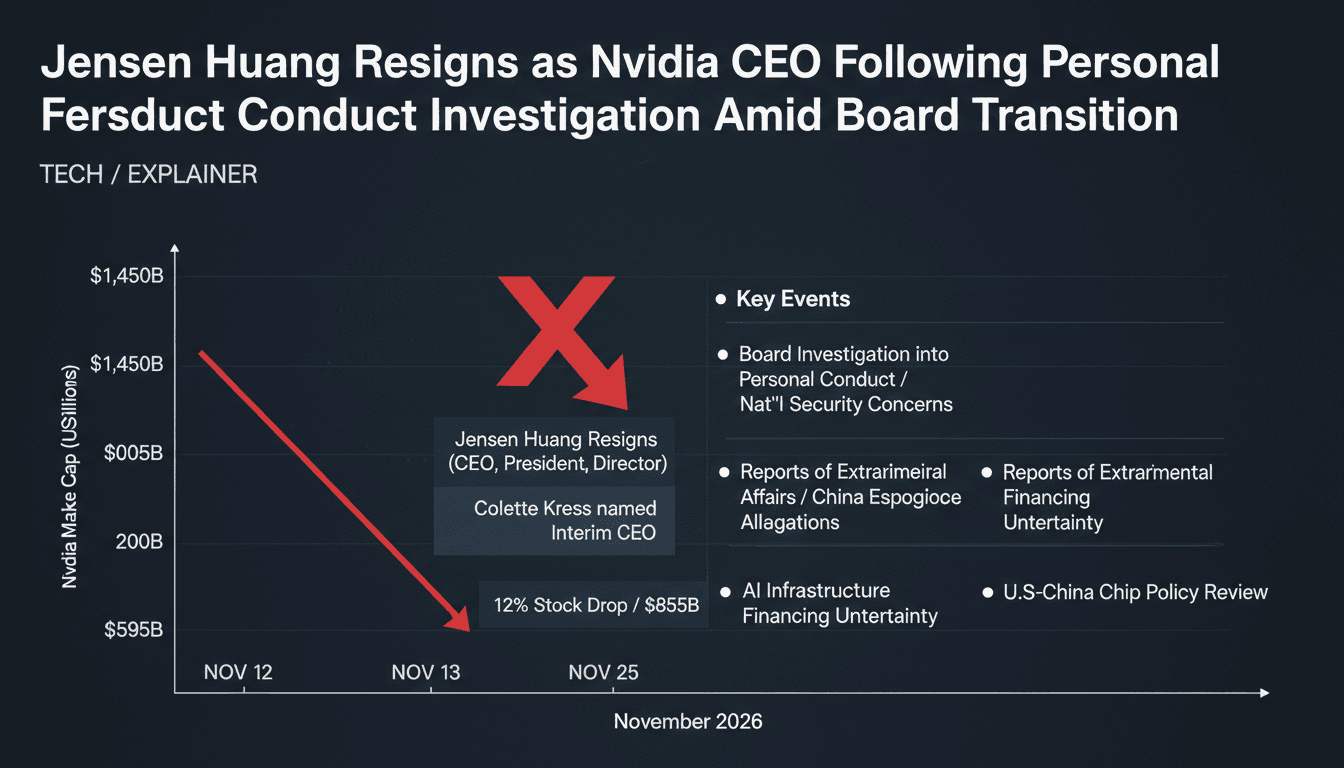
- The sudden departure: Jensen Huang resigned as president, CEO, and board director of Nvidia on November 12, 2026, stepping down from the Santa Clara company he co-founded in 1993 following reports of personal relationships, including one under scrutiny by U.S. intelligence regarding ties to Chinese espionage and another with a direct report.
- The immediate leadership shift: The Nvidia Board of Directors named Chief Financial Officer Colette Kress as interim CEO while initiating a search for a permanent successor and appointing Harvey C. Jones as the board’s first independent chair.
- The market repricing: Nvidia shares fell nearly 12% on November 12, 2026, contributing to an overall decline of more than $855 billion in corporate market capitalization as trading volatility spread across the sector.
The context you actually need
- Hardware dominance: Nvidia established near-total control over the hardware stack powering contemporary AI workloads, transforming its graphics processing units (GPUs) into the core operational asset for both model training and commercial inference.
- Bespoke trade diplomacy: Huang acted as the primary negotiator between Silicon Valley and global policymakers, consistently working to maintain commercial access to the Chinese market while navigating evolving U.S. chip export restrictions.
- Ecosystem patronage: Beyond hardware delivery, Nvidia deployed balance-sheet capital directly into customers and early-stage ventures, using strategic equity investments to anchor foundational AI developers inside its proprietary compute architecture.
What's really happening
Nvidia’s rapid ascent created an unprecedented governance vulnerability: the concentration of the entire artificial intelligence supply chain within the personal capital, customer relationships, and policy navigation of a single founder.
Huang operated not merely as an operating chief executive, but as the premier dealmaker across venture networks, sovereign technology initiatives, and international trade lines. When leadership changes occur in traditional corporate environments, institutional processes absorb the shock. At Nvidia, key strategic initiatives—such as defending cross-border market access under tightened U.S. export controls and securing massive hardware allocations for sovereign and corporate infrastructure projects—were executed through Huang's direct engagement.
His immediate removal exposes three distinct structural pressures.
First, institutional risk tolerance has shifted overnight. In dropping nearly 12% in a single trading session, shedding part of an $855 billion valuation contraction, Nvidia is being repriced for an operating environment without founder-led narrative dominance. Financial markets must now assess whether the enterprise can maintain its pricing power and software-lock ecosystem margins under administrative rather than visionary guidance. Colette Kress provides operational continuity from the CFO seat, but interim management teams face structural limitations when defending multi-year hardware margins against aggressive hyperscaler buyers developing custom in-house accelerators.
Second, U.S.-China technology policy faces an institutional vacuum. Huang spent years actively managing regulatory friction, designing compliant chip variants to preserve business in mainland China while balancing Washington’s national security directives. The involvement of an external scrutiny vector regarding foreign intelligence links removes Nvidia's ability to soft-pedal export friction. U.S. congressional bodies are already increasing inquiries into the company’s past China transactions. Without Huang's leverage, the company faces tighter oversight and reduced flexibility to challenge future export bans.
Third, the AI venture financing loop loses its primary architect. Nvidia has routinely underwritten the foundational model economy by converting GPU supply into strategic venture investments. That mechanism kept startups tethered to the proprietary CUDA software environment and guaranteed forward bookings for hardware. With Harvey C. Jones installed as board chair to implement rigorous governance reviews, these non-standard investment arrangements will face traditional fiduciary oversight. If Nvidia reduces its direct capital participation in downstream AI startups, the software ecosystem will see cash cycles tighten and alternative compute platforms gain room to compete.
Who feels it first (and how)
- Enterprise infrastructure procurement officers: Face potential renegotiations or extended delivery timelines as allocation models transition from founder relationships to strict contractual queueing.
- Artificial intelligence startup founders: Experience capital and compute constraints if Nvidia’s ecosystem investments, hardware subsidies, and partnership programs pause under board audit.
- Hyperscale cloud operators (AWS, Microsoft Azure, Google Cloud): Gain temporary leverage to renegotiate volume GPU purchasing terms and accelerate customer adoption of custom internal silicon.
- Technology portfolio managers and equity traders: Endure immediate volatility as structural multiple contractions hit semiconductor equities exposed to enterprise AI capital expenditures.
- Cross-border trade and compliance counsels: Must prepare for aggressive regulatory audits as U.S. congressional committees examine legacy sales and regulatory adherence in the Greater China region.
What to watch next
- The permanent successor announcement: Whether the board selects an internal operational executive or an external software veteran will signal whether Nvidia intends to consolidate its infrastructure monopoly or pivot toward defensive compliance and software services.
- Congressional committee formalization: The scope and timeline of potential U.S. congressional inquiries into Nvidia’s China dealings will determine whether export regulations tighten further for remaining commercial GPU shipments.
- Capital expenditure commitments from major customers: Forward-looking procurement guidance from Tier-1 cloud providers during upcoming earnings releases will confirm whether enterprise demand holds steady despite leadership churn at their primary supplier.
Jensen Huang stepped down as president, CEO, and director on November 12, 2026; Colette Kress is interim CEO; Harvey C. Jones is board chair; Nvidia stock fell nearly 12% in immediate response, contributing to a drop exceeding $855 billion in market value.
Scrutiny from U.S. export and national security officials will increase, limiting Nvidia’s capacity to negotiate special commercial carve-outs for overseas sales.
Whether Nvidia's practice of taking equity stakes in customer startups to anchor its computing ecosystem will survive comprehensive board governance and risk reviews.
Frequently Asked Questions
- Why it matters?
- The sudden vacancy atop the dominant supplier of artificial intelligence silicon destabilizes executive deal-making, tests investor tolerance for capital expenditure, and opens regulatory vulnerabilities across critical geopolitical corridors.
- What happened (in 30 seconds)?
- The sudden departure: Jensen Huang resigned as president, CEO, and board director of Nvidia on November 12, 2026, stepping down from the Santa Clara company he co-founded in 1993 following reports of personal relationships, including one under scrutiny by U.S. intelligence regarding ties to Chinese espionage and another with a direct report. The immediate leadership shift: The Nvidia Board of Directors named Chief Financial Officer Colette Kress as interim CEO while initiating a search for a per
- What's really happening?
- Nvidia’s rapid ascent created an unprecedented governance vulnerability: the concentration of the entire artificial intelligence supply chain within the personal capital, customer relationships, and policy navigation of a single founder. Huang operated not merely as an operating chief executive, but as the premier dealmaker across venture networks, sovereign technology initiatives, and international trade lines. When leadership changes occur in traditional corporate environments, institutional
- Who feels it first (and how)?
- Enterprise infrastructure procurement officers: Face potential renegotiations or extended delivery timelines as allocation models transition from founder relationships to strict contractual queueing. Artificial intelligence startup founders: Experience capital and compute constraints if Nvidia’s ecosystem investments, hardware subsidies, and partnership programs pause under board audit. Hyperscale cloud operators (AWS, Microsoft Azure, Google Cloud): Gain temporary leverage to renegotiate volume
- What to watch next?
- The permanent successor announcement: Whether the board selects an internal operational executive or an external software veteran will signal whether Nvidia intends to consolidate its infrastructure monopoly or pivot toward defensive compliance and software services. Congressional committee formalization: The scope and timeline of potential U.S. congressional inquiries into Nvidia’s China dealings will determine whether export regulations tighten further for remaining commercial GPU shipments. C
Technology business news, market impacts, and innovation trends.
"Bloomberg is a premier financial and tech news provider, respected for its in-depth reporting and analytical rigor."
— A47 Editor
Huang’s Exit Leaves Silicon Valley Unsure About AI Boom’s Future
Nvidia co-founder and CEO Jensen Huang has resigned as chief executive, president and board member with immediate effect after the company's board accepted his departure, following reports of extramarital relationships, including one with Alice Huang...
Curated tech headlines including AI stories.
"Influential aggregator surfacing the day’s top tech/AI links."
— A47 Editor
Some investors and founders say they lost an ally in Jensen Huang; Nvidia held $48B in 229 private companies as of July and offered $165B in cloud backstops (New York Times)
Nvidia co-founder and CEO Jensen Huang has resigned as chief executive, president and board member with immediate effect, after the board opened an investigation into reports of extramarital relationships, including one with Alice Huang, a Megaspeed ...
Business, investment, entrepreneurship, leadership, and innovation.
"Forbes is known for its coverage of business leaders, market trends, and entrepreneurial ventures with a pro-business editorial stance."
— A47 Editor
Billionaire Investor KoGuan Says He’ll End Nvidia Stock Buys After Huang Exit—Musk And Others Back Ex-CEO
KoGuan, a billionaire investor, said he will stop buying Nvidia stock following the departure of co-founder and CEO Jensen Huang, who resigned with immediate effect after an internal, board-led investigation prompted by reports citing U.S. intelligen...
Business and tech news excluding paywalled content.
"High-volume business/tech outlet with frequent AI coverage."
— A47 Editor
At a major Silicon Valley AI conference, VCs and CEOs grapple with a future without Jensen Huang
Nvidia co-founder and CEO Jensen Huang has resigned as CEO, president and board member, effective immediately, after the company's board moved to remove him following reports of extramarital relationships, including one with Alice Huang, a Megaspeed ...
Curated tech headlines including AI stories.
"Influential aggregator surfacing the day’s top tech/AI links."
— A47 Editor
Sources: Nvidia faced pressure to boost its 25% residual value support backstop on a planned $500B AI financing vehicle with asset managers before Huang's exit (Bloomberg)
Nvidia faced pressure from its board to strengthen a 25% residual value support backstop tied to a planned $500 billion AI financing vehicle with asset managers before CEO Jensen Huang's exit, according to Bloomberg sources. Huang resigned as CEO, pr...
U.S. business news, corporate developments, and economy.
"The Wall Street Journal is respected for deep financial and economic reporting with a center-right editorial perspective."
— A47 Editor
Jensen Huang’s Downfall Is a Sign of Silicon Valley’s Power Drain
Nvidia co-founder and CEO Jensen Huang resigned as CEO, president and board member with immediate effect after an internal board-led investigation and reports, citing a New York Times account and U.S. intelligence assessments, that he had a romantic ...
Corporate leadership, finance, technology, and market trends.
"Fortune covers financial trends, leadership, and innovation with a pragmatic editorial approach."
— A47 Editor
‘A dark day’: Jensen Huang’s sex drive threatens to pop the AI bubble, and the industry isn’t sure what’s next
Nvidia co-founder and CEO Jensen Huang has been pushed out of the company after reports, citing a New York Times account and U.S. intelligence assessments, that he had a romantic relationship with Alice Huang, a Chinese businesswoman whom U.S. offici...
Startup news with frequent AI coverage.
"Covers launches, funding, and product updates in AI."
— A47 Editor
Jensen Huang’s exit puts Nvidia’s support for open source in question
Nvidia co-founder and CEO Jensen Huang resigned as CEO, president and board member after the company's board accepted his resignation following reports of extramarital affairs, including one with Alice Huang, a Megaspeed executive whom U.S. officials...
UAE-based English-language newspaper covering regional politics, economics, and global affairs.
"The National reflects Emirati policy perspectives while maintaining international editorial standards."
— A47 Editor
Nvidia handed downgrade on Jensen Huang and AI uncertainty
The base report describes how Nvidia shares were handed a downgrade amid uncertainty surrounding CEO and co-founder Jensen Huang, following reports citing a New York Times account that U.S. intelligence believed he was targeted by a Chinese intellige...