
Nvidia CEO Jensen Huang Resigns Amid Alleged Chinese Intelligence Operation Tied to AI Chip Export Controls
Why it matters
The sudden resignation of Nvidia’s chief executive amid allegations of intelligence-linked processor diversions signals that technology export curbs are shifting from trade border controls to direct counterintelligence enforcement on multinational hardware supply networks.
What happened (in 30 seconds)
- Leadership exit: Nvidia Chief Executive Officer Jensen Huang resigned on November 12, 2026, amid scrutiny over alleged Chinese Ministry of State Security (MSS) ties involving Singapore-based intermediary Megaspeed International.
- Capital flows: Singapore-registered Megaspeed acquired over $4.8 billion in high-performance Nvidia hardware since June 2024, prompting congressional inquiries into inventory gaps involving approximately 50,000 units.
- Regulatory friction: While Nvidia initiated internal reviews and located hardware in regional warehouses, lawmakers escalated calls to eliminate remote compute loopholes and tighten Southeast Asian distribution channels.
The context you actually need
- Export restrictions: Since October 2022, U.S. frameworks have restricted exports of top-tier accelerators—including H100, H200, and Blackwell architectures—to limit foreign military and advanced AI development.
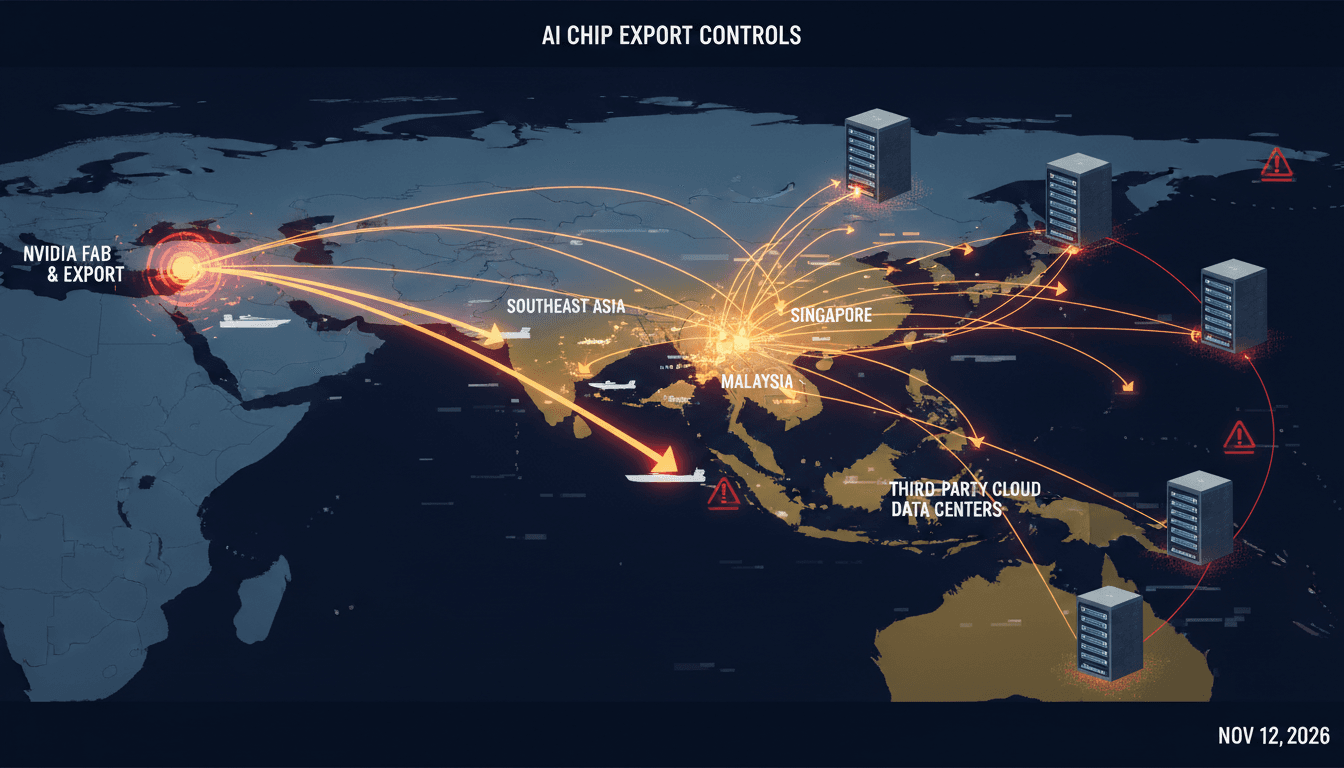
- Jurisdictional routing: To bridge compute deficits, international actors established third-party hubs in Southeast Asia, using regional data centers to host hardware or route remote access away from direct oversight.
- Corporate exposure: Alice Huang, an executive associated with Megaspeed, cultivated personal access to Jensen Huang, while Singapore authorities investigated operations, barred her reentry, but brought no local criminal charges due to insufficient evidence.
What's really happening
The incident exposes the structural difficulty of enforcing physical chip containment when enterprise software demand is fluid, global, and cloud-native. The U.S. regulatory architecture relies on geographical chokepoints: restricting physical shipments of microchips possessing specified interconnect bandwidths and compute density thresholds. However, economic incentives run in the opposite direction. Advanced AI models require compute clusters running tens of thousands of synchronized processors. Because direct domestic access was restricted, demand shifted toward neutral third-party hubs.
Southeast Asia—specifically Singapore and Malaysia—emerged as the primary operational bridge. Cloud providers and procurement intermediaries in these territories legally procured commercial hardware to supply rapidly scaling data centers. In the case of Megaspeed International, transactions totaled $4.8 billion in Nvidia processors starting in mid-2024. The operational friction emerged when physical deployments diverged from reported supply logs. U.S. intelligence agencies assessed that Alice Huang functioned as an MSS intelligence asset, using access to Jensen Huang to streamline procurement pipelines that could facilitate diversion or provide remote compute sessions to mainland entities.
Although Nvidia located substantial chip volumes across regional warehouses, discrepancies involving roughly 50,000 processors highlighted the limits of corporate self-policing. When enterprise hardware is sold to an offshore intermediary, physical custody audits become difficult to maintain across secondary facilities. Furthermore, remote access bypasses traditional customs controls entirely: a server physically mounted in Southeast Asia can train an overseas model without a single processor crossing a border.
The resulting compliance crisis forced an immediate executive transition at the world's primary AI chip manufacturer. Market actors are adjusting to a regime where commercial semiconductor vendors must assume operational responsibility not merely for direct buyer verification, but for secondary data routing, third-party leasing, and warehouse custody within international partner nations.
Who feels it first (and how)
- Global AI infrastructure operators: Firms operating compute clusters in Southeast Asia face immediate know-your-customer (KYC) compliance reviews and software auditing requirements from hardware manufacturers.
- Enterprise compute procurement teams: Organizations reliant on Nvidia’s Blackwell and H-series supply allocations experience delivery friction as secondary logistics pathways undergo end-user verification.
- Technology risk and compliance officers: Leadership teams at semiconductor suppliers must allocate capital toward forensic supply-chain tracking and counterintelligence risk mitigation.
- Hardware investors: Market participants holding positions in semiconductor leaders must factor structural regulatory overhead and executive transition risks into operational valuations.
What to watch next
- Hardware-level tracking mandates: Watch whether the U.S. Department of Commerce implements compulsory cryptographic chip tracking to monitor processor locations post-delivery.
- Remote compute restrictions: Monitor forthcoming legislative packages for rules prohibiting foreign entities from accessing high-tier compute through cross-border cloud instances.
- Southeast Asia hub realignment: Track data center capital expenditure patterns in Singapore and Malaysia to assess whether cloud infrastructure projects face revised licensing standards.
Jensen Huang resigned on November 12, 2026; Megaspeed purchased $4.8 billion in Nvidia hardware since June 2024; no criminal charges have been filed against the principal figures as of mid-November 2026.
U.S. export enforcement will expand from export terminal checks to continuous operational monitoring of third-party international data centers.
Whether independent verification will account for the full inventory of missing processors or substantiate direct remote access by Chinese military entities.
Frequently Asked Questions
- Why it matters?
- The sudden resignation of Nvidia’s chief executive amid allegations of intelligence-linked processor diversions signals that technology export curbs are shifting from trade border controls to direct counterintelligence enforcement on multinational hardware supply networks.
- What happened (in 30 seconds)?
- Leadership exit: Nvidia Chief Executive Officer Jensen Huang resigned on November 12, 2026, amid scrutiny over alleged Chinese Ministry of State Security (MSS) ties involving Singapore-based intermediary Megaspeed International. Capital flows: Singapore-registered Megaspeed acquired over $4.8 billion in high-performance Nvidia hardware since June 2024, prompting congressional inquiries into inventory gaps involving approximately 50,000 units. Regulatory friction: While Nvidia initiated internal
- What's really happening?
- The incident exposes the structural difficulty of enforcing physical chip containment when enterprise software demand is fluid, global, and cloud-native. The U.S. regulatory architecture relies on geographical chokepoints: restricting physical shipments of microchips possessing specified interconnect bandwidths and compute density thresholds. However, economic incentives run in the opposite direction. Advanced AI models require compute clusters running tens of thousands of synchronized processor
- Who feels it first (and how)?
- Global AI infrastructure operators: Firms operating compute clusters in Southeast Asia face immediate know-your-customer (KYC) compliance reviews and software auditing requirements from hardware manufacturers. Enterprise compute procurement teams: Organizations reliant on Nvidia’s Blackwell and H-series supply allocations experience delivery friction as secondary logistics pathways undergo end-user verification. Technology risk and compliance officers: Leadership teams at semiconductor suppliers
- What to watch next?
- Hardware-level tracking mandates: Watch whether the U.S. Department of Commerce implements compulsory cryptographic chip tracking to monitor processor locations post-delivery. Remote compute restrictions: Monitor forthcoming legislative packages for rules prohibiting foreign entities from accessing high-tier compute through cross-border cloud instances. Southeast Asia hub realignment: Track data center capital expenditure patterns in Singapore and Malaysia to assess whether cloud infrastructure
Conservative-leaning coverage of current events.
"Fox News is a highly influential conservative news outlet known for right-leaning political commentary and coverage."
— A47 Editor
China’s great AI chip loophole: How American espionage stopped China — this time
Fox News reports that U.S. intelligence uncovered a suspected Chinese espionage operation targeting Nvidia's AI chips through data centers in Singapore and Malaysia, a case that has since become entangled with an investigation into Nvidia CEO Jensen ...
Macro commentary, policy analysis, growth/inflation themes, and global outlooks.
"Contextual macro coverage that complements day-to-day market headlines."
— A47 Editor
Exclusive-Chinese AI firms rush to secure Nvidia chip capacity as spy scandal stirs fear of US curbs
Chinese AI firms are rushing to secure Nvidia chip capacity as a spy scandal involving Nvidia CEO Jensen Huang stirs fears of tighter US curbs. Reports citing U.S. intelligence assessments say Huang had a romantic relationship with Alice Huang, an al...
Editor-curated FT homepage stories spanning markets, business, world, and opinion.
"The Financial Times is a globally respected business publication with a centrist/center-left tone and strong markets focus."
— A47 Editor
How Singapore became a linchpin of China’s AI chip trade
The Financial Times reports that Singapore has become a key hub in China's trade in advanced AI chips, with a suspected Chinese spy, Alice Huang, linked to Singapore-based datacenter firms and a deal that has drawn scrutiny of Asian networks testing ...