
Nvidia Leadership Scandal Prompts Regulatory Scrutiny of Southeast Asia AI Chip Flows and Data Center Expansion
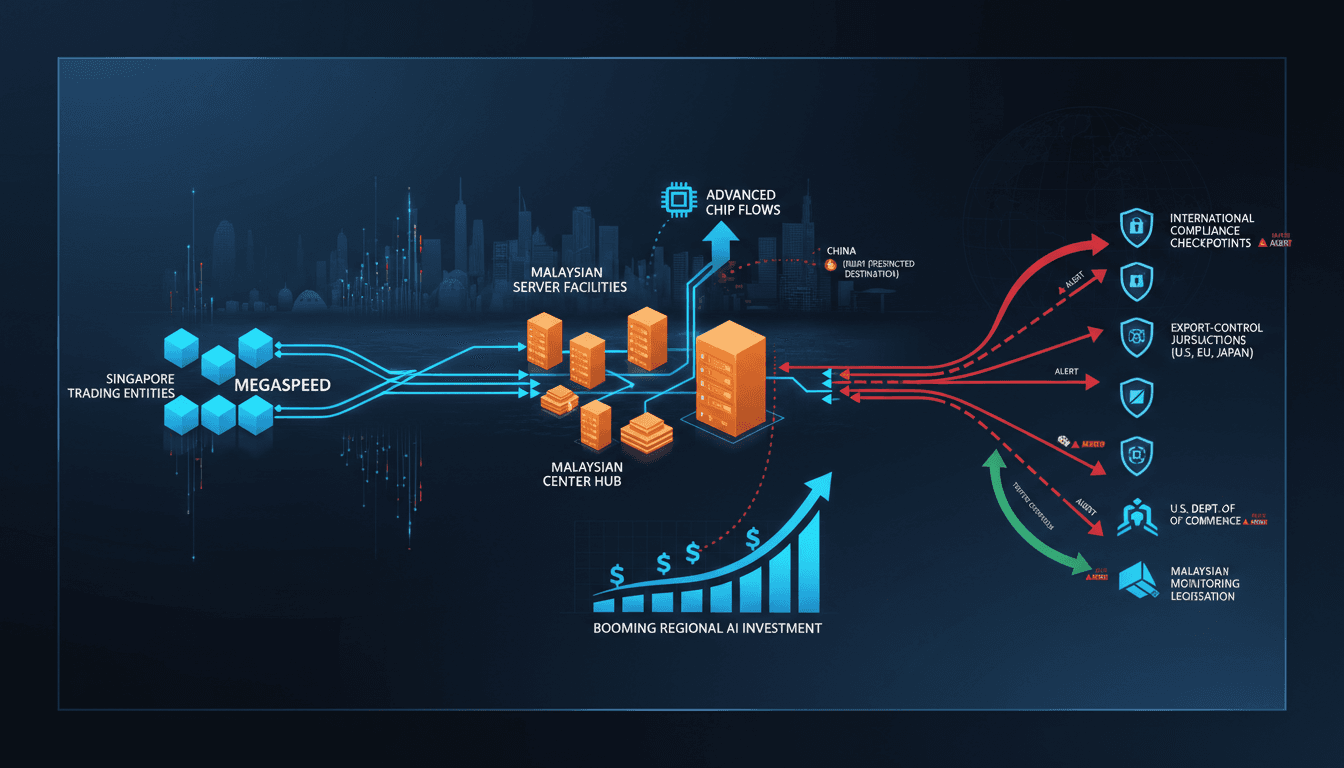
If your enterprise infrastructure roadmap leans on overseas compute clusters, tightening regional export controls will alter the latency, compliance audits, and legal exposure of where your workloads run.
Why it matters
The convergence of national security oversight and cross-border hardware distribution exposes the structural fragility of relying on third-party regional hubs to access restricted artificial intelligence technology.
What happened (in 30 seconds)
- Leadership shakeup: Former Nvidia CEO Jensen Huang resigned around November 13, 2026, following public reports detailing a relationship with Alice Huang, an executive at Singapore-based Megaspeed International Pte Ltd suspected by authorities of ties to Chinese intelligence.
- Export scrutiny expands: U.S. lawmakers and international regulators opened inquiries into whether Singapore-based Megaspeed and its related operations in Malaysia functioned as conduits to divert restricted advanced Nvidia AI hardware to China.
- Regulatory backlash: Malaysian officials announced consideration of new operational oversight laws for local facilities, while Singapore and Washington moved to close cross-border loopholes governing physical chip deliveries and remote compute access.
The context you actually need
- The regional infrastructure rush: Since 2021, Malaysia's trade ministry approved 385.7 billion ringgit ($94.67 billion) in data center-related investments, establishing the country as a primary regional destination for compute infrastructure alongside Singapore's traditional financial entrepôt.
- Export control baselines: Washington has incrementally barred direct shipments of cutting-edge graphics processing units (GPUs) to Chinese entities, establishing a perimeter that encouraged firms to locate capital-intensive clusters across Southeast Asia.
- The compute loophole: Beyond direct hardware transit, cross-border cloud architectures allow remote operators located in restricted jurisdictions to rent compute clusters hosted legally in neutral third-party hubs, evading physical trade interdictions.
What's really happening
The operational friction emerging in Southeast Asia is not merely the outcome of an isolated corporate leadership change. It reflects the closure of an intermediate operating zone that global technology firms and regional governments utilized to capture trade inflows without violating the letter of export controls.
Following the enforcement of advanced semiconductor trade restrictions, capital flowed directly toward jurisdictions adjacent to mainland supply routes. Between 2021 and late 2026, Malaysia captured 385.7 billion ringgit ($94.67 billion) in data center-related project approvals. Singapore provided the financing, legal structuring, and telecommunications interconnection required to host these facilities. This division of labor transformed the Singapore-Malaysia corridor into an advanced computational nexus.
The incentive structure was straightforward. Southeast Asian economies secured direct foreign capital, real estate buildouts, and digital infrastructure expansion. Technology vendors retained access to high-volume buyers operating out of neutral trade hubs. Intermediary enterprises, such as Megaspeed International Pte Ltd, built business models around purchasing compute capacity and server hardware legally in Singapore or Malaysia, then leasing computational time or moving components through regional distribution networks.
That equilibrium depended on political neutrality and technical deniability. The intelligence allegations surrounding Megaspeed and former Nvidia leadership dismantled that operational cover. When U.S. lawmakers from both parties framed the Singapore-Malaysia corridor as a potential transshipment conduit and a remote compute workaround, the regulatory risk profile permanently adjusted.
Industry executives describe this shift as a "post-DeepSeek" turning point. The mechanism of control is pivoting from tracking physical customs receipts to auditing network tenancy, equity ties, and remote software access. Because modern workloads do not require moving physical hardware across borders to extract value, authorities are shifting focus toward the ultimate beneficiaries renting server clusters.
For commercial operators, this translates directly into compliance overhead. Facilities running advanced Nvidia accelerators across Southeast Asia face mandatory audits on customer identities, stricter tracking on hardware serial numbers, and capital market volatility. Rather than relying on jurisdictional arbitrage to maintain market access, operators now navigate an environment where sovereign compliance frameworks are enforced directly down to individual server racks.
Who feels it first (and how)
- Enterprise infrastructure procurement leads: Face sudden audit requirements and know-your-customer (KYC) documentation demands when contracting high-density clusters across Southeast Asian colocation sites.
- Malaysian construction and data center operators: Experience permitting reviews and legislative delays as the government introduces formal statutory mechanisms to monitor physical capacity and tenant ownership.
- Cross-border cloud resellers: Must re-evaluate distribution models as chip manufacturers implement stringent serial tracking and end-user verification across third-party channel partners.
- Singaporean tech and trading intermediaries: Face heightened joint oversight from domestic and U.S. authorities over cross-border capital flows and hardware transshipment manifests.
What to watch next
- Malaysian statutory draft legislation: The regulatory framework under review by Malaysian authorities will define whether data center operators must actively report and restrict remote compute access by foreign users.
- U.S. Department of Commerce rules on cloud compute exports: Any statutory shift expanding export controls from physical hardware transfers to cloud-based software provisioning will directly alter international data center tenancy economics.
- Nvidia channel compliance protocols: Enhanced supply-chain telemetry or physical hardware validation systems deployed by the vendor will indicate how strictly component flows will be tracked in non-aligned jurisdictions.
Jensen Huang stepped down as Nvidia's chief executive; Malaysia has authorized 385.7 billion ringgit ($94.67 billion) in data center projects since 2021; U.S., Singaporean, and Malaysian authorities have placed Megaspeed and associated facilities under heightened review.
Southeast Asian data centers will experience extended procurement timelines, increased operational compliance costs, and potential equity restructuring to distance themselves from entities under trade scrutiny.
Whether upcoming statutory controls will retroactively penalize existing data center projects in Malaysia, or if restrictions will primarily cap future deliveries of high-performance accelerator chips.
Frequently Asked Questions
- Why it matters?
- The convergence of national security oversight and cross-border hardware distribution exposes the structural fragility of relying on third-party regional hubs to access restricted artificial intelligence technology.
- What happened (in 30 seconds)?
- Leadership shakeup: Former Nvidia CEO Jensen Huang resigned around November 13, 2026, following public reports detailing a relationship with Alice Huang, an executive at Singapore-based Megaspeed International Pte Ltd suspected by authorities of ties to Chinese intelligence. Export scrutiny expands: U.S. lawmakers and international regulators opened inquiries into whether Singapore-based Megaspeed and its related operations in Malaysia functioned as conduits to divert restricted advanced Nvidia
- What's really happening?
- The operational friction emerging in Southeast Asia is not merely the outcome of an isolated corporate leadership change. It reflects the closure of an intermediate operating zone that global technology firms and regional governments utilized to capture trade inflows without violating the letter of export controls. Following the enforcement of advanced semiconductor trade restrictions, capital flowed directly toward jurisdictions adjacent to mainland supply routes. Between 2021 and late 2026,
- Who feels it first (and how)?
- Enterprise infrastructure procurement leads: Face sudden audit requirements and know-your-customer (KYC) documentation demands when contracting high-density clusters across Southeast Asian colocation sites. Malaysian construction and data center operators: Experience permitting reviews and legislative delays as the government introduces formal statutory mechanisms to monitor physical capacity and tenant ownership. Cross-border cloud resellers: Must re-evaluate distribution models as chip manufac
- What to watch next?
- Malaysian statutory draft legislation: The regulatory framework under review by Malaysian authorities will define whether data center operators must actively report and restrict remote compute access by foreign users. U.S. Department of Commerce rules on cloud compute exports: Any statutory shift expanding export controls from physical hardware transfers to cloud-based software provisioning will directly alter international data center tenancy economics. Nvidia channel compliance protocols: Enha
Macro commentary, policy analysis, growth/inflation themes, and global outlooks.
"Contextual macro coverage that complements day-to-day market headlines."
— A47 Editor
Nvidia fallout throws spotlight on Southeast Asia’s AI boom
Nvidia's stock came under pressure after co-founder and CEO Jensen Huang resigned with immediate effect as CEO, president and board member, following an internal board-led investigation tied to reports of a personal relationship with an alleged Chine...
Curated tech headlines including AI stories.
"Influential aggregator surfacing the day’s top tech/AI links."
— A47 Editor
US officials say Trump is not expected to raise allegations of a Chinese intelligence operation involving Jensen Huang during his upcoming meeting with Xi (Dan Mangan/CNBC)
US officials have indicated that President Donald Trump is not expected to raise allegations of a Chinese intelligence operation involving Nvidia's former CEO Jensen Huang during his upcoming meeting with Chinese leader Xi Jinping, according to a CNB...
Insights and news on social issues, policy, and political movements across the United States.
"The Wall Street Journal is known for its deep political coverage, especially at the intersection of policy, regulation, and social dynamics."
— A47 Editor
More than almost any CEO, Jensen Huang helped shape President Trump’s AI strategy and was involved in chip deals and state visits all over the world
Nvidia CEO Jensen Huang, long a key figure in the Trump administration's AI and chip policy, is now at the center of an independent board investigation into his personal relationships, including reports of an intimate relationship with Chinese busine...
Market-moving headlines impacting equities, bonds, and related risk assets.
"Real-time catalysts and volatility drivers across indices and sectors."
— A47 Editor
Trump not expected to raise Alice Huang case with China’s Xi, US officials say
Officials say US President Donald Trump is not expected to raise the case of Chinese businesswoman Alice Huang, who is linked to a US investigation as a suspected spy, when he meets Chinese leader Xi Jinping. The base report, published by Investing.c...
Editor-curated FT homepage stories spanning markets, business, world, and opinion.
"The Financial Times is a globally respected business publication with a centrist/center-left tone and strong markets focus."
— A47 Editor
Trump will not raise Nvidia spy issue with Xi at summit, officials say
The Financial Times reports that US President Donald Trump will not raise the Nvidia spy issue with Chinese leader Xi Jinping at a trilateral meeting planned with Russia's Vladimir Putin next week, according to officials. The decision comes as the sc...
Market-moving headlines impacting equities, bonds, and related risk assets.
"Real-time catalysts and volatility drivers across indices and sectors."
— A47 Editor
What we know about Chinese businesswoman Alice Huang
Alice Huang, a Chinese businesswoman who rose from finance into the chip sector, is at the center of reports that U.S. intelligence assessed her as a Chinese asset after she was linked romantically to Nvidia CEO Jensen Huang, according to reporting f...