
OpenAI Disbands Standalone Robotics Team Folding Researchers Into General Models and Applied Groups
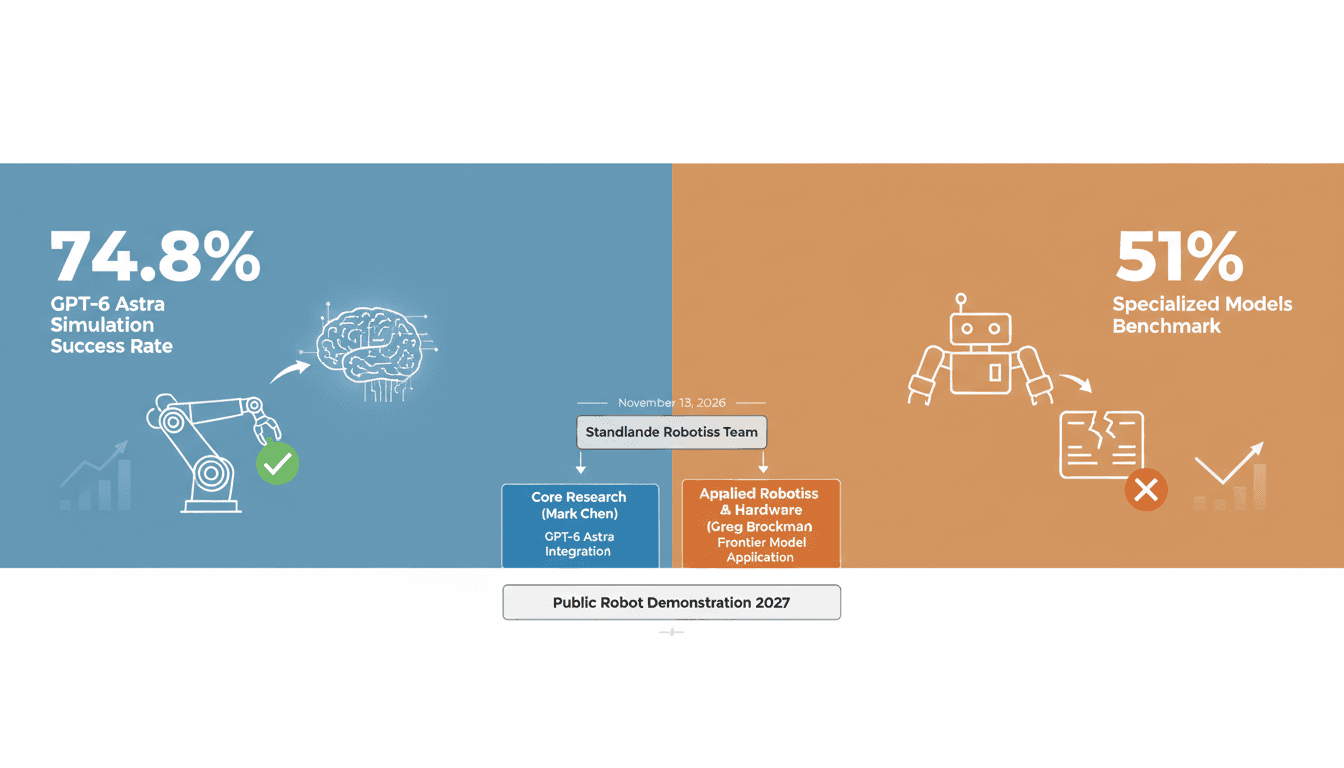
Why it matters
By folding specialized robotics units back into core foundation teams, technical labs are betting that general-purpose scale delivers superior physical control faster than bespoke engineering, fundamentally altering how enterprise hardware is developed and procured.
What happened (in 30 seconds)
* OpenAI dismantled its dedicated robotics unit: On or around November 13, 2026, the lab reassigned researchers to Mark Chen’s core research organization and shifted applied robotics and hardware staff under Greg Brockman’s Applied division. * General models surpassed specialist stacks: Internal evaluations and an external study confirmed that frontier models like GPT-6 Astra could directly run physical tasks, outperforming dedicated robotic architectures. * The restructuring happened abruptly: The sudden organizational pivot caused OpenAI to leave its planned booth at the Conference on Robot Learning (CoRL) in Austin empty while operations were unified in San Francisco.
The context you actually need
* This is OpenAI's second structural reversal: The company dissolved its original robotics division in 2020 to focus strictly on large language models, revived a dedicated group in 2024, and has now dissolved the standalone group again in favor of generalized integration. * The Figure partnership dissolved over model ownership: OpenAI previously collaborated with humanoid manufacturer Figure, but the partnership ended in February 2025 when Figure opted to build its own AI control models in-house. * Early 2026 physical-world assumptions shifted: Research tracks initially leaned on video generation architectures such as Sora to develop implicit spatial reasoning, before benchmark results demonstrated that direct-action frontier architectures like GPT-6 Astra were more effective.
What's really happening
The structural shift at OpenAI reflects a technical inflection point: the separation between frontier reasoning models and physical control systems is closing. For decades, robotic process automation and physical hardware relied on dedicated algorithmic pipelines built for narrow spatial problems. OpenAI’s re-absorption of its robotics unit into general research under Chief Research Officer Mark Chen, combined with applied hardware alignment under President Greg Brockman, reveals an institutional realization that maintaining separate research tracks for embodied intelligence is an inefficient allocation of capital and compute.
The primary driver behind this consolidation is performance data. In simulated robotics tasks documented in an Nvidia study, an agent powered directly by GPT-6 Astra achieved a 74.8% task success rate. By contrast, the highest-performing specialized robotics models reached a 51% success rate on the identical benchmark. This 23.8-percentage-point performance delta demonstrates that broad cross-domain pretraining produces better generalization, spatial reasoning, and real-time physical error recovery than systems limited to domain-specific training data.
For leadership teams, the incentive structure is clear. Operating a standalone robotics division requires unique data collection pipelines, custom simulation infrastructure, and separate developer environments. However, if a multimodal foundation model like GPT-6 Astra inherently solves generalized actuation tasks as a downstream capability of core training runs, isolating physical control inside an independent silo creates friction. The rapid implementation of this decision—demonstrated by the empty booth at the Conference on Robot Learning in Austin—underscores an urgent focus on core model capabilities amid capital constraints and market competition.
Strategically, the shift changes the dynamic between software developers and hardware original equipment manufacturers (OEMs). Rather than software labs building proprietary physical chassis or dedicating distinct teams to niche hardware integration, foundation models can be treated as generalized operating kernels for third-party robotics. CEO Sam Altman's stated roadmap still targets a public general-purpose robot demonstration for 2027, but the execution now relies on applying centralized foundation models directly to physical hardware, rather than waiting for an isolated robotics division to invent a parallel intelligence engine.
Who feels it first (and how)
* Enterprise robotics hardware makers: Startups and industrial robotics vendors that spent years engineering proprietary control algorithms must now compete against or adopt generalized frontier model APIs that surpass specialist benchmarks. * Venture and private equity allocators: Capital evaluators must re-underwrite investments in specialized embodied AI software startups, weighing them against universal frontier platform capabilities. * Applied research engineers: Roboticists focusing on narrow kinematic control algorithms face shifting career demands, requiring them to integrate into broader multivariable foundation model teams rather than working in siloed laboratories. * Global supply chain and industrial operators: Operators evaluating commercial automation roadmaps can anticipate standardizing on broad foundation model enterprise licenses instead of fragmenting across disparate machine-specific software vendors.
What to watch next
* The 2027 public demonstration milestones: Progress updates or intermediate testing toward Sam Altman’s target 2027 public robot showcase will indicate whether generalized models can match simulated performance in live, unstructured physical settings. * OEM developer integration releases: Watch for commercial developer toolkits or API documentation from Greg Brockman’s Applied team allowing external robot manufacturers to connect hardware directly to frontier models. * Hardware startup autonomy responses: Monitor whether humanoid robotics manufacturers follow Figure’s path of training independent proprietary models or reverse course to license frontier models.
OpenAI reassigned its standalone robotics personnel between Mark Chen’s general research organization and Greg Brockman’s Applied organization in November 2026. GPT-6 Astra demonstrated a 74.8% success rate on simulated tasks versus 51% for the best specialized models.
Capital expenditure on dedicated robotics software will decrease across early-stage technology ecosystems as founders pivot to fine-tuning generalized frontier models for hardware execution.
Whether generalized foundation models can translate high simulated benchmark accuracy into edge-computing hardware without latency, safety, or bandwidth trade-offs in mission-critical manufacturing facilities.
Frequently Asked Questions
- Why it matters?
- By folding specialized robotics units back into core foundation teams, technical labs are betting that general-purpose scale delivers superior physical control faster than bespoke engineering, fundamentally altering how enterprise hardware is developed and procured.
- What happened (in 30 seconds)?
- OpenAI dismantled its dedicated robotics unit: On or around November 13, 2026, the lab reassigned researchers to Mark Chen’s core research organization and shifted applied robotics and hardware staff under Greg Brockman’s Applied division. General models surpassed specialist stacks: Internal evaluations and an external study confirmed that frontier models like GPT-6 Astra could directly run physical tasks, outperforming dedicated robotic architectures. The restructuring happened abruptly: The su
- What's really happening?
- The structural shift at OpenAI reflects a technical inflection point: the separation between frontier reasoning models and physical control systems is closing. For decades, robotic process automation and physical hardware relied on dedicated algorithmic pipelines built for narrow spatial problems. OpenAI’s re-absorption of its robotics unit into general research under Chief Research Officer Mark Chen, combined with applied hardware alignment under President Greg Brockman, reveals an institutiona
- Who feels it first (and how)?
- Enterprise robotics hardware makers: Startups and industrial robotics vendors that spent years engineering proprietary control algorithms must now compete against or adopt generalized frontier model APIs that surpass specialist benchmarks. Venture and private equity allocators: Capital evaluators must re-underwrite investments in specialized embodied AI software startups, weighing them against universal frontier platform capabilities. Applied research engineers: Roboticists focusing on narrow ki
- What to watch next?
- The 2027 public demonstration milestones: Progress updates or intermediate testing toward Sam Altman’s target 2027 public robot showcase will indicate whether generalized models can match simulated performance in live, unstructured physical settings. OEM developer integration releases: Watch for commercial developer toolkits or API documentation from Greg Brockman’s Applied team allowing external robot manufacturers to connect hardware directly to frontier models. Hardware startup autonomy respo
Daily AI news: models, tools, and policy.
"Independent outlet tracking the fast pace of AI."
— A47 Editor
OpenAI reassigns robotics researchers to other teams as general-purpose models might make specialized robotics AI unnecessary
OpenAI is dissolving its standalone robotics team for the second time, redistributing researchers across other teams. The company frames the move as a way to accelerate its robotics efforts, arguing that general-purpose models such as GPT-6 Astra can...
Curated tech headlines including AI stories.
"Influential aggregator surfacing the day’s top tech/AI links."
— A47 Editor
OpenAI disbands its standalone robotics team, moving its staff to research and Applied units, saying models like GPT-6 Astra can be directly applied to robotics (Wen Shao/Fortune)
OpenAI has disbanded its standalone robotics team, moving its researchers onto other research and applied units, according to a Fortune report by Wen Shao. The company confirmed the reorganization when asked about it, saying models such as GPT-6 Astr...
Corporate leadership, finance, technology, and market trends.
"Fortune covers financial trends, leadership, and innovation with a pragmatic editorial approach."
— A47 Editor
Exclusive: OpenAI disbands its stand-alone robotics team as its general models start running robots
OpenAI has moved the researchers on its stand-alone robotics team onto other teams, a change the company described as new thinking about the best path toward general-purpose robots, as its general models begin running robots. The base report, publish...