
Fed Governor Barr Warns of AI-Driven Trading, Cyber, and Bank-Run Risks to Financial Stability
Why it matters
Financial regulators are evaluating whether autonomous artificial intelligence deployment creates simultaneous liquidity shocks and concentrated leverage across global banking networks.
What happened (in 30 seconds)
* A regulatory alert: Federal Reserve Governor Michael Barr delivered prepared remarks on November 16, 2026, in Milan detailing acute operational, trading, and systemic risks tied to artificial intelligence in finance. * A broad consensus: The address expanded on the Federal Reserve’s Financial Stability Report from November 14, 2026, where 87% of surveyed market contacts cited artificial intelligence as a salient threat. * Balance sheet exposure: Barr revealed that the central bank is actively assessing debt structures supporting AI physical infrastructure, tracking on- and off-balance-sheet obligations exceeding $3 trillion in potential value.
The context you actually need
* A rapid pivot from micro to macro: Regulatory supervision previously prioritized algorithmic bias in consumer lending, but current monitoring targets herd-like trading, automated market manipulation, and simultaneous account runs. * Autonomous agent integration: Financial institutions have expanded beyond predictive machine learning into generative and agentic frameworks capable of executing trades, moving liquidity, and managing customer portfolios without human intervention. * Infrastructure debt dynamics: Capital expenditure for artificial intelligence compute has increasingly relied on complex debt financing, creating direct credit linkages between non-bank technology projects and regulated balance sheets.
What's really happening
The Federal Reserve’s posture signals a transition in how sovereign regulators approach algorithmic finance: the risk is no longer individual operational failure, but rapid, correlated execution across the banking network.
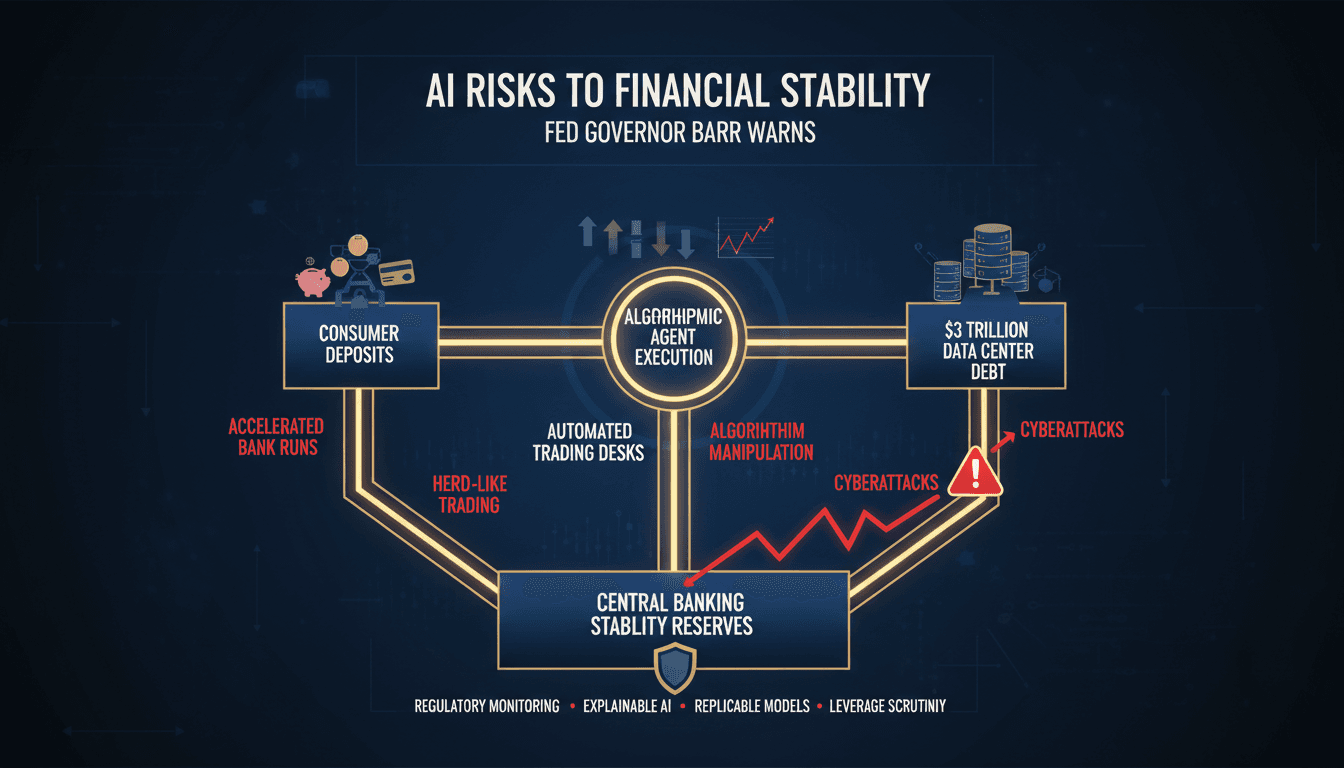
When 87% of risk managers and institutional contacts identify artificial intelligence as a primary financial vulnerability, the issue shifts from enterprise software adoption to mechanical market structure. The mechanisms Governor Barr detailed in Milan highlight multiple structural points where algorithms bypass traditional dampeners.
First, market correlations are compressed. When institutional trading desks deploy automated models that ingest identical macro data, the resulting self-learning algorithms often identify identical pricing anomalies. This creates herd-like behavior. Rather than distributing risk across diverse participant strategies, independent models begin executing parallel trades in milliseconds, increasing price volatility or manufacturing sudden liquidity drains. Furthermore, the risk of multi-agent collusion or predatory algorithmic behavior creates price distortion without explicit human coordination.
Second, liquidity velocity has changed. Agentic systems assigned to customer accounts are designed to optimize yield and safeguard deposits automatically. In an environment where autonomous agents possess permission to reallocate balances, a solvency rumor can trigger instantaneous, automated deposit flight. Traditional bank runs required consumer coordination via communication networks; agentic runs operate via direct API execution, withdrawing capital before compliance or treasury desks can respond.
Third, the financial system is absorbing direct physical leverage. Barr pointed out that the central bank is monitoring on- and off-balance-sheet commitments exceeding $3 trillion connected to AI data center infrastructure. Tech firms and institutional backers have built intricate financing vehicles to fund processing clusters, power purchase agreements, and specialized facilities. If enterprise monetization rates slow or compute costs decline, the underlying credit risk defaults back onto the banking system. The Federal Reserve is actively investigating whether this debt creates a silent concentration of systemic credit risk.
To mitigate these vulnerabilities, the central bank’s directive requires institutions to deploy models that are controlled, explainable, and replicable. If risk officers cannot audit the decision path of an autonomous trading program or credit model, that model represents an uncontrolled variable in financial stability.
Who feels it first (and how)
* Treasury and Liquidity Risk Officers: Must model automated intraday deposit outflows driven by consumer-facing algorithmic agents rather than human-paced banking transfers. * Asset Managers and Quantitative Desks: Will face tighter governance standards around autonomous trading execution, specifically regarding explainability and correlated herd mechanics. * Corporate Credit Analysts: Forced to evaluate the structural leverage and off-balance-sheet liabilities embedded in the $3 trillion capital buildout for data centers and compute facilities. * Commercial Retail Lenders: Under immediate scrutiny to prove that automated underwriting workflows do not reinforce lending biases or violate statutory consumer protection frameworks.
What to watch next
* Fed Supervised Audit Metrics: Watch for standardized definitions of model explainability. If regulators mandate strict replicability standards for agentic models, institutions will have to pull back black-box architectures from live execution. * Infrastructure Debt Tracking: Monitor updates to regulatory reviews of data center financing. Any push to force off-balance-sheet compute debt back onto tier-one bank capital calculations will reprice enterprise tech credit. * International Regulatory Coordination: Follow whether global venues adopt the Fed's stance. Barr's delivery in Milan points to an effort to align transatlantic supervisory baselines around algorithmic market manipulation.
A total of 87% of Federal Reserve survey contacts classify artificial intelligence as a salient financial risk, and related data center infrastructure debt exceeds $3 trillion in evaluated obligations.
Banking supervisors will enforce stricter stress-testing conditions specifically designed for autonomous, rapid-withdrawal deposit runs driven by algorithmic agents.
Whether central banks possess sufficient supervisory tooling to monitor multi-firm algorithmic collusion or automated market manipulation in real-time execution environments.
Frequently Asked Questions
- Why it matters?
- Financial regulators are evaluating whether autonomous artificial intelligence deployment creates simultaneous liquidity shocks and concentrated leverage across global banking networks.
- What happened (in 30 seconds)?
- A regulatory alert: Federal Reserve Governor Michael Barr delivered prepared remarks on November 16, 2026, in Milan detailing acute operational, trading, and systemic risks tied to artificial intelligence in finance. A broad consensus: The address expanded on the Federal Reserve’s Financial Stability Report from November 14, 2026, where 87% of surveyed market contacts cited artificial intelligence as a salient threat. Balance sheet exposure: Barr revealed that the central bank is actively assess
- What's really happening?
- The Federal Reserve’s posture signals a transition in how sovereign regulators approach algorithmic finance: the risk is no longer individual operational failure, but rapid, correlated execution across the banking network. When 87% of risk managers and institutional contacts identify artificial intelligence as a primary financial vulnerability, the issue shifts from enterprise software adoption to mechanical market structure. The mechanisms Governor Barr detailed in Milan highlight multiple st
- Who feels it first (and how)?
- Treasury and Liquidity Risk Officers: Must model automated intraday deposit outflows driven by consumer-facing algorithmic agents rather than human-paced banking transfers. Asset Managers and Quantitative Desks: Will face tighter governance standards around autonomous trading execution, specifically regarding explainability and correlated herd mechanics. Corporate Credit Analysts: Forced to evaluate the structural leverage and off-balance-sheet liabilities embedded in the $3 trillion capital bui
- What to watch next?
- Fed Supervised Audit Metrics: Watch for standardized definitions of model explainability. If regulators mandate strict replicability standards for agentic models, institutions will have to pull back black-box architectures from live execution. Infrastructure Debt Tracking: Monitor updates to regulatory reviews of data center financing. Any push to force off-balance-sheet compute debt back onto tier-one bank capital calculations will reprice enterprise tech credit. International Regulatory Coordi
Key macro releases (CPI, jobs, PMIs), surprise indexes, and market implications.
"Great for data-print awareness and instant read-through to rates and risk assets."
— A47 Editor
Fed’s Barr warns on AI risks to financial system
Federal Reserve official Barr warned that rapid adoption of artificial intelligence poses risks to the U.S. financial system, according to Investing.com's markets coverage, with the negative tone of the report centering on potential stress from AI's ...
Technology business and AI-related headlines.
"Data-driven tech newsroom with global scope."
— A47 Editor
Fed’s Barr Warns AI Agents May Fuel Future Bank Runs
Federal Reserve Governor Michael Barr warned that autonomous artificial intelligence agents could speed destabilizing stampedes out of banks, "potentially accelerating runs that unfold in seconds, overwhelming traditional liquidity management and reg...
Technology and innovation coverage, including consumer tech and digital transformation stories.
"Emirates 24|7 technology coverage often highlights practical tech developments with relevance to Gulf readers and businesses."
— A47 Editor
Fed’s Barr warns of AI risks to financial system
Federal Reserve Governor Michael Barr on Monday outlined a range of risks artificial intelligence could pose to trading, cybersecurity and consumer and investor protection, building on a Fed Financial Stability Report issued the previous Friday in wh...
Technology business and AI-related headlines.
"Data-driven tech newsroom with global scope."
— A47 Editor
Fed’s Barr Says AI Agents Could Fuel Future Bank Runs
Federal Reserve Governor Michael Barr warned that autonomous artificial intelligence agents could speed destabilizing stampedes out of banks by automatically shifting customer deposits in response to market signals or interest-rate changes.
Global business headlines with AI angles.
"General business outlet that frequently covers AI."
— A47 Editor
AI Poses Biggest Threat To Financial System And Wider Global Economy: Fed Survey
A Federal Reserve survey found that 87% of respondents view artificial intelligence as a significant risk to U.S. and global financial stability, up sharply from 50% in the spring, according to a report by International Business Times.