
Foreign Investors Return to Indian Equities With Record $8.5 Billion Monthly Inflow as Global AI Trade Unwinds
Why it matters
The unwinding of capital-intensive artificial intelligence trades has driven the largest single-month foreign institutional inflow into Indian equities in six years, demonstrating how structural shifts in tech expenditure ripple across emerging market capital balances.
What happened (in 30 seconds)
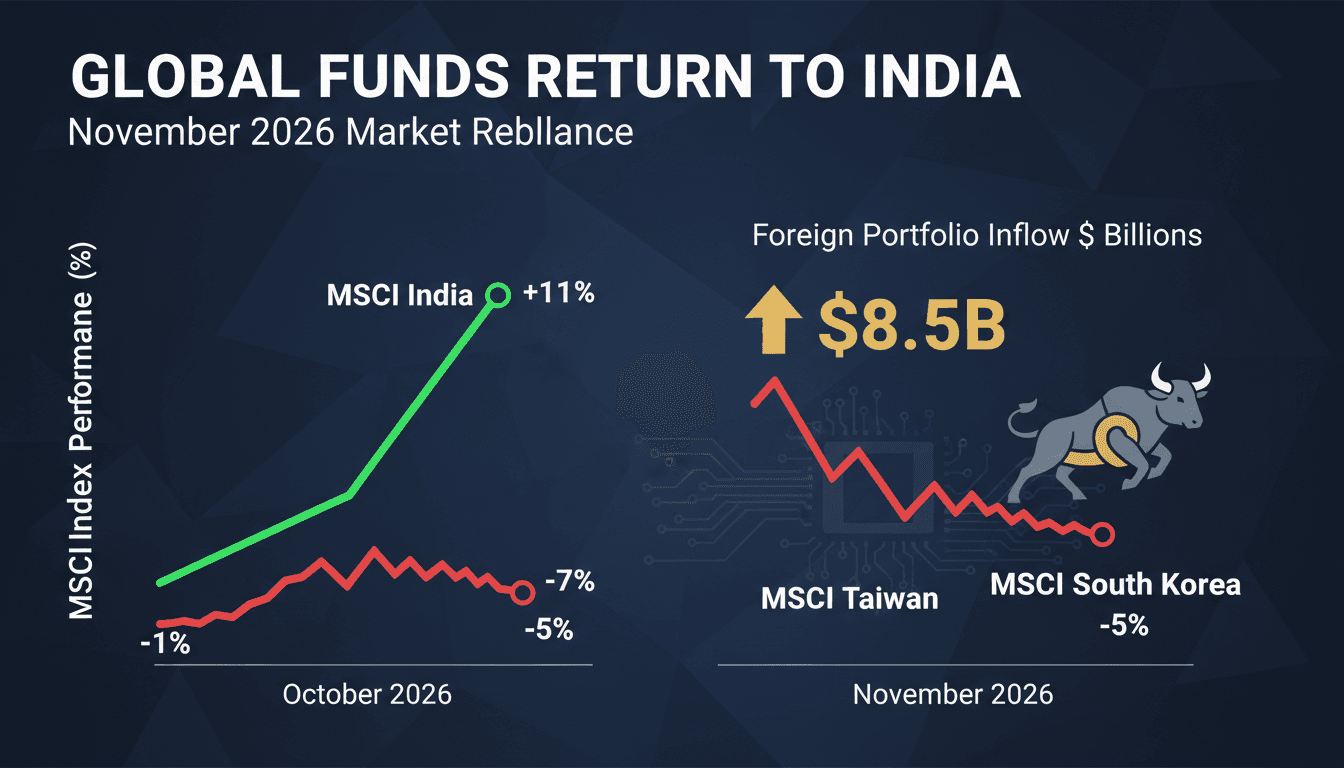
- Foreign capital returned: Foreign portfolio investors channeled roughly $8.5 billion into Indian equities across November 2026, marking the largest single-month net foreign inflow the market has recorded in six years.
- Indices staged a recovery: The MSCI India index rebounded 11% from its October low, adding more than $400 billion in market value and nearly wiping out year-to-date losses for the $5.4 trillion equity base.
- The AI trade rotated: Capital rotated rapidly away from tech-heavy benchmarks in the United States, South Korea, and Taiwan, driven by scrutiny of tech balance sheets and elevated capital expenditures.
The context you actually need
- A multi-year drought reversed: From 2025 through mid-2026, Indian equities faced sustained foreign outflows surpassing $50 billion over two years as global allocators prioritized direct AI beneficiaries in North America and East Asia.
- Benchmarks remain structurally underweight: Even with the November 2026 influx reducing year-to-date net outflows to approximately $22 billion, global institutional funds remain underweight India by an estimated $74 billion relative to baseline allocation indices.
- Macro conditions provided an entry point: Easing crude oil prices and accelerating domestic corporate earnings—projected by Bank of America to reach 18% growth—offered fundamental support as global tech valuations faced compression.
What's really happening
Global portfolio allocators are actively reassessing risk-adjusted returns after two years of intense concentration in the artificial intelligence value chain. The investment thesis that directed over $50 billion out of broader emerging markets and into semiconductor, hardware, and hyperscaler equities in the United States, Taiwan, and South Korea encountered resistance in late 2026. Institutional participants began questioning the trajectory of returns on invested capital relative to the high capital expenditures incurred by major technology balance sheets, introducing regulatory and execution concerns into crowded positions.
The mechanical response from asset allocators has been a disciplined rotation toward structural insulation. India’s equity composition offers a distinct profile: AI-exposed firms represent roughly 16% of the MSCI India index, compared to concentration levels between 70% and 80% found in benchmark peers across Taiwan and South Korea. As institutions moved to cut high-multiple hardware exposure, India served as a liquid alternative for regional reallocation.
This rotation accelerated rapidly. During the single week ending November 6, 2026, foreign institutional investors deployed $5.2 billion into Indian shares, building to a monthly total of approximately $8.5 billion. Major institutional brokerages, including Jefferies, CLSA, and Pictet Asset Management, upgraded their equity stances, reframing the market’s low tech exposure from a multi-year drag into a primary defensive asset.
The reallocation is reinforced by fundamental domestic metrics. For energy-importing economies like India, softening global crude prices lower input costs across manufacturing, transport, and consumer sectors. Corporate earnings expectations expanded in response, leading investment banks to project forward earnings growth of 18%. Combined with benchmark gauges such as the Nifty 50 rallying 10% to 12% off mid-October lows, the valuation discount created by cumulative 2026 outflows of $32 billion narrowed.
Because active global funds entered this rotation underweight India by an estimated $74 billion, closing that tracking error requires sustained capital flows. The initial $8.5 billion inflow does not represent an isolated momentum bet, but rather a structural rebalancing where managers exchange tech-concentration volatility for domestic-demand earnings growth.
Who feels it first (and how)
- Emerging market fund managers: Institutional allocators running regional mandates must decide whether to deploy dry powder to cover their $74 billion underweight position or risk relative benchmark underperformance as the MSCI India index advances.
- Hardware and semiconductor equities in East Asia: Technology firms in South Korea and Taiwan experience capital outflows and multiple compression as global capital diverts toward non-tech sectors.
- Domestic Indian corporate balance sheets: Consumer, industrial, and banking firms benefit from renewed equity liquidity, lower cost of equity capital, and an 11% recovery across broader benchmark valuations.
- Middle East cross-border asset allocators: Diversified regional funds and institutional offices in hubs like Dubai that run global emerging market mandates capture portfolio value through exposure to the rebounding $5.4 trillion Indian market.
What to watch next
- The $74 billion underweight gap: Watch weekly foreign institutional investor flow tallies; sustained net buying above $2 billion per week will confirm institutional managers are actively reducing their multi-year tracking errors.
- Corporate earnings prints: Track whether quarterly earnings match the 18% growth baseline projected by Bank of America, as premium valuations require corporate delivery to stay insulated from broader emerging-market headwinds.
- Big tech capital expenditure revisions: Monitor quarterly balance sheet disclosures from North American and East Asian tech giants; any further drop in projected return on invested capital will accelerate capital reallocation into domestic-consumption markets.
Foreign institutional investors added approximately $8.5 billion in net inflows to Indian equities in November 2026, lifting the market's total capitalization past $5.4 trillion as the MSCI India index gained 11%.
Global funds will continue incremental rotation into non-AI markets as long as capital expenditure doubts weigh on technology-heavy benchmarks in East Asia and the US.
Whether domestic earnings execution will expand fast enough to prevent valuation multiples from overheating before the structural $74 billion institutional underweight is closed.
Frequently Asked Questions
- Why it matters?
- The unwinding of capital-intensive artificial intelligence trades has driven the largest single-month foreign institutional inflow into Indian equities in six years, demonstrating how structural shifts in tech expenditure ripple across emerging market capital balances.
- What happened (in 30 seconds)?
- Foreign capital returned: Foreign portfolio investors channeled roughly $8.5 billion into Indian equities across November 2026, marking the largest single-month net foreign inflow the market has recorded in six years. Indices staged a recovery: The MSCI India index rebounded 11% from its October low, adding more than $400 billion in market value and nearly wiping out year-to-date losses for the $5.4 trillion equity base. The AI trade rotated: Capital rotated rapidly away from tech-heavy benchmar
- What's really happening?
- Global portfolio allocators are actively reassessing risk-adjusted returns after two years of intense concentration in the artificial intelligence value chain. The investment thesis that directed over $50 billion out of broader emerging markets and into semiconductor, hardware, and hyperscaler equities in the United States, Taiwan, and South Korea encountered resistance in late 2026. Institutional participants began questioning the trajectory of returns on invested capital relative to the high c
- Who feels it first (and how)?
- Emerging market fund managers: Institutional allocators running regional mandates must decide whether to deploy dry powder to cover their $74 billion underweight position or risk relative benchmark underperformance as the MSCI India index advances. Hardware and semiconductor equities in East Asia: Technology firms in South Korea and Taiwan experience capital outflows and multiple compression as global capital diverts toward non-tech sectors. Domestic Indian corporate balance sheets: Consumer, in
- What to watch next?
- The $74 billion underweight gap: Watch weekly foreign institutional investor flow tallies; sustained net buying above $2 billion per week will confirm institutional managers are actively reducing their multi-year tracking errors. Corporate earnings prints: Track whether quarterly earnings match the 18% growth baseline projected by Bank of America, as premium valuations require corporate delivery to stay insulated from broader emerging-market headwinds. Big tech capital expenditure revisions: Mon
Technology business and AI-related headlines.
"Data-driven tech newsroom with global scope."
— A47 Editor
Global Investors Return to Indian Stocks After AI Trade Woes
Foreign investors are returning to Indian stocks as oil prices fall, corporate earnings improve, and capital rotates out of crowded global AI trades, according to Bloomberg Technology. The shift follows a period of wobbling in the global AI trade tha...
Technology business news, market impacts, and innovation trends.
"Bloomberg is a premier financial and tech news provider, respected for its in-depth reporting and analytical rigor."
— A47 Editor
Global Investors Return to Indian Stocks After AI Trade Woes
Foreign investors are returning to Indian stocks as oil prices fall, corporate earnings improve, and capital rotates out of crowded global AI trades, according to Bloomberg Technology. The shift follows a period of wobbling in the global AI trade tha...
Global markets, investing, and macroeconomics from a premier financial newsroom.
"Bloomberg is respected for in-depth financial reporting and data-driven analysis."
— A47 Editor
Aerospace Stocks Shine as Anti-AI Flows Pour Into India
Aerospace stocks rose as a global aircraft shortage pushed more aerospace work toward India, according to a Bloomberg report that classified the development as positive for markets.
Technology business and AI-related headlines.
"Data-driven tech newsroom with global scope."
— A47 Editor
India Stock Market Rebounds as AI Trade Unwinds, Foreign Funds Return
Indian stocks suffered heavy losses in the first nine months of the year as the artificial intelligence trade drew in global investor capital, but the unwinding of that strategy has since turned India's equities into one of the world's strongest perf...
Technology business news, market impacts, and innovation trends.
"Bloomberg is a premier financial and tech news provider, respected for its in-depth reporting and analytical rigor."
— A47 Editor
India Stock Market Rebounds as AI Trade Unwinds, Foreign Funds Return
Indian stocks suffered heavy losses in the first nine months of the year as the artificial intelligence trade drew in global investor capital, but the unwinding of that strategy has since turned India's equities into one of the world's strongest perf...